
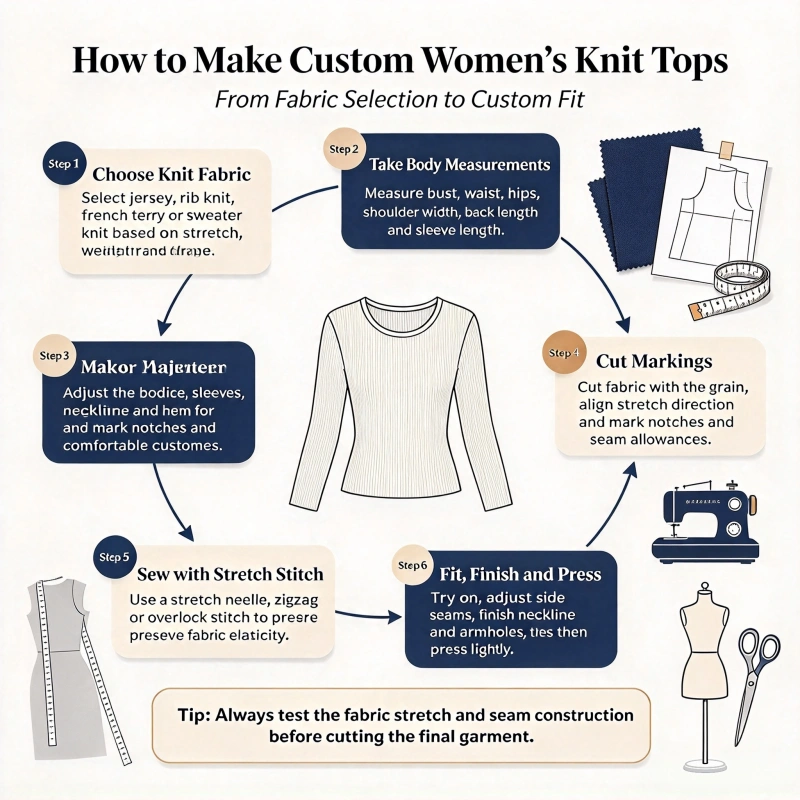
How to Make Custom Women’s Knit Tops: A Step-by-Step
If you are planning to launch a women’s knitwear collection, you may already have a design in mind. Perhaps you want a fitted ribbed top, a lightweight knitted polo, a cropped sweater, or a basic knit top with your own label. The next question is how to turn that idea into a product that a manufacturer can actually produce.
Making custom women’s knit tops involves more than choosing a fabric and sending a picture to a factory. You need to confirm the yarn, knit structure, measurements, colors, construction, branding, target cost and production requirements before moving into bulk manufacturing.
At Qingdao Chengyuan Garment Co., Ltd., we provide integrated garment development services covering design, pattern making, sample development and bulk production. Our monthly production capacity is approximately 80,000–120,000 finished garments, and we support both small trial orders and larger production programs.
In this guide, we explain the custom women’s knit top manufacturing process from a buyer’s perspective, including the decisions that affect product quality, cost and delivery.
1. Define Your Product and Target Market
Before contacting a manufacturer, decide exactly what kind of women’s knit top you want to develop.
Women’s knit tops cover a broad range of products, including:
- Basic crew-neck and V-neck knit tops
- Ribbed fitted tops
- Sleeveless knitted tops and tank tops
- Short-sleeve and long-sleeve knit tops
- Knitted polo shirts
- Cropped knit tops
- Lightweight layering tops
- Fashion knit tops with jacquard, open-knit or textured details
Your target customer determines many of the decisions that follow.
For example, a brand selling affordable everyday basics may prioritize easy-care yarns, repeatable colors and cost efficiency. A premium boutique label may focus more on yarn softness, refined stitch structures, finishing and distinctive details.
Before requesting a quotation, prepare these five basic details:
| Information | What to Decide |
|---|---|
| Product type | Tank top, ribbed top, polo, cropped top or another style |
| Target market | Everyday basics, premium fashion, resort wear or another segment |
| Order quantity | Estimated total units and quantity per color |
| Target price | Your intended factory cost per piece |
| Launch date | When the products must be ready for shipment or sale |
You do not need to have every technical detail finalized at this stage. However, a clear product direction helps the manufacturer recommend suitable materials and construction methods.
2. Prepare a Tech Pack or Reference Sample
A tech pack is one of the most useful documents in custom clothing production. It communicates your requirements in a format that the factory can follow.
A knit top tech pack should ideally include:
- Front and back technical drawings
- Yarn or material requirements
- Knit structure and stitch details
- Garment measurements and size chart
- Color references
- Neckline, sleeve and hem construction
- Labels, logos and trims
- Washing and care requirements
- Packaging instructions
- Target quantity and delivery schedule
If you do not have a complete tech pack, you can start with a sketch, photographs, a reference garment or a sample purchased from the market.
However, be specific about what you want to reproduce. For example, if you send a photograph of a ribbed knit top, explain whether you want to copy its silhouette, rib pattern, neckline, fabric thickness or all four.
A photograph shows the appearance, but it rarely communicates every production detail. Clear notes and measurements help reduce misunderstandings during sampling.
3. Select the Yarn and Knit Structure
This is one of the most important steps because yarn and knit structure influence the garment’s appearance, weight, stretch, drape, comfort and cost.
Choose the right yarn
Common options for women’s knit tops include:
| Yarn or Fiber Option | Typical Characteristics | Common Applications |
|---|---|---|
| Cotton | Breathable, familiar hand feel and suitable for many casual styles | Everyday tops and summer knitwear |
| Viscose | Smooth drape and a soft feel | Fashion tops and lightweight layering pieces |
| Polyester | Useful for durable, easy-care blends | Casual and commercial knitwear |
| Acrylic | Can provide a wool-like appearance at a different price point | Fashion knit tops and sweaters |
| Merino wool | Fine wool fiber with natural temperature-regulating properties | Premium seasonal knitwear |
| Blended yarns | Combine selected fiber characteristics | Products balancing cost, comfort and performance |
These are general characteristics, not guarantees. The final result depends on yarn quality, construction, finishing and the specific blend.
Choose the knit structure
Your manufacturer should also help determine the appropriate knit structure.
- Plain knit: A versatile option for simple, clean designs.
- Rib knit: Offers stretch and is often used for fitted silhouettes.
- Pointelle: Creates a delicate openwork appearance.
- Jacquard: Supports more complex patterns and color combinations.
- Textured knit: Adds surface interest without relying only on printed graphics.
Gauge matters, too. As an illustrative industry reference, knitwear may use approximately 3–5 gauge for chunkier structures, 7–9 gauge for some medium-weight structures, and 12–14 gauge for finer structures. These are not fixed rules for every knit top. The suitable gauge depends on the yarn, machine, design and desired fabric properties. Kiwi Giyim’s knitwear tech pack guide provides further technical background.
Practical tip: Do not select gauge independently of yarn and stitch structure. Ask the manufacturer to assess these elements together before approving the sample.
4. Confirm Measurements, Fit and Size Grading
A knit top can look attractive on a model but still perform poorly in retail if the fit is inconsistent.
For women’s knit tops, key measurements commonly include:
- Chest width
- Shoulder width
- Body length
- Sleeve length
- Armhole depth
- Neck opening
- Hem width
Start by choosing a base size, such as size S or M, and create a measurement chart for the full size range.
For example, if your planned collection covers XS–XXL, that means six size labels. Define the measurement increments between sizes based on your target customer’s proportions and the intended fit, rather than using arbitrary increases.
Also clarify whether measurements are taken with the garment lying flat, in a relaxed state, or under a specified amount of stretch.
This matters because knitted materials can change shape after washing, drying or steaming.
A fitted ribbed top, for instance, may require different stretch and recovery expectations from a loose, straight-cut knit top. Approving the size chart without checking the physical sample can lead to costly adjustments later.
5. Develop and Review the First Sample
Once the technical details are sufficiently clear, the manufacturer can develop a sample for evaluation.
The sample process commonly involves:
- Reviewing the design and technical requirements.
- Confirming yarn availability and construction feasibility.
- Developing the first sample.
- Measuring the garment and checking its appearance.
- Recording your comments and making necessary revisions.
- Producing a final sample for approval.
The first sample does not always need to be perfect. Its purpose is to reveal problems while changes are still manageable.
When reviewing your women’s knit top sample, check the following:
| Checkpoint | What to Look For |
|---|---|
| Fit | Does the top match your intended silhouette? |
| Hand feel | Is the material soft, firm, lightweight or structured as required? |
| Stitching | Are seams and joining areas neat and secure? |
| Neckline | Does it sit correctly without unwanted stretching or gaping? |
| Rib recovery | Does the ribbed area return appropriately after stretching? |
| Color | Does the sample match the approved color reference? |
| Measurements | Are the key points within your specified tolerances? |
| Finishing | Are there loose threads, holes, stains or visible defects? |
A useful rule is to record comments in a numbered list and attach photographs showing the exact problem areas.
Instead of writing, “The neckline looks wrong,” write something like, “Reduce the neckline opening by 1 cm on the approved base size and resubmit for review.” The exact adjustment will depend on your design, but specific instructions are much easier for a factory to implement.
6. Test Washing and Approve the Pre-Production Sample
This step is easy to overlook, especially when the first sample looks good straight out of the package.
Knitwear can change after washing or finishing. Depending on the fiber and construction, you may see shrinkage, stretching, twisting, pilling or changes in hand feel.
Before bulk production, agree on the care method and the relevant performance checks for your product.
For example, you can compare the garment’s measurements before and after a defined washing procedure. If the top is intended for machine washing, test it under conditions that reflect the intended care instructions.
There is no single shrinkage percentage that applies to every women’s knit top. The acceptable result should be agreed upon according to the fabric, garment design and buyer’s quality requirements.
Once the pre-production sample is approved, retain a physical reference sample and the corresponding measurement specifications. This gives both the buyer and manufacturer a clear standard for bulk production.
Do not approve a sample based only on appearance if fit, washing performance or fabric feel is important to your product.
7. Confirm Pricing, MOQ and Production Schedule
After the design and sample requirements become clear, request a detailed quotation.
The price of a custom women’s knit top depends on several factors:
- Yarn composition and yarn consumption
- Knit structure and construction complexity
- Garment weight and dimensions
- Number of colors and custom-dye requirements
- Labels, trims and decorative details
- Order quantity per style and color
- Testing, finishing and packaging requirements
For an accurate comparison, ask manufacturers to quote against the same specifications.
For example, don’t compare a basic cotton knit top and a fine-gauge merino top on unit price alone. Their material costs, production requirements and intended retail positioning may differ considerably.
Also confirm the minimum order quantity (MOQ) per style and color, sample charges, payment terms, production lead time, shipping terms, and any extra development costs.
There is no universal MOQ or production timeline for custom knit tops. These depend on the factory, yarn availability, construction and order details. Ask the manufacturer to confirm the terms for your specific project instead of relying on an industry-wide estimate.
At Qingdao Chengyuan Garment, As a professional manufacturer of women’s knit tops, we support small trial orders as well as larger B2B production programs. Confirm available quantity and schedule based on each order’s requirements.
8. Move Into Bulk Production and Quality Control
Begin bulk production only after the essential details are confirmed.
Before production, make sure the buyer and manufacturer have approved:
- Final sample and measurement chart
- Yarn composition and color standard
- Knit structure and construction
- Labels, logos and trims
- Washing and finishing requirements
- Size and color breakdown
- Packaging and carton specifications
- Delivery schedule and inspection requirements
Quality control should occur throughout production, not only at the end.
For women’s knit tops, important checks include yarn and color consistency, stitch quality, garment measurements, neckline and hem construction, loose threads, stains, holes and overall appearance.
A practical approach is to check an early production unit against the approved sample before the entire order proceeds too far. This helps identify problems while there is still time to correct them.
Before shipment, confirm the final inspection procedure and the quality acceptance criteria agreed upon in the purchase order.
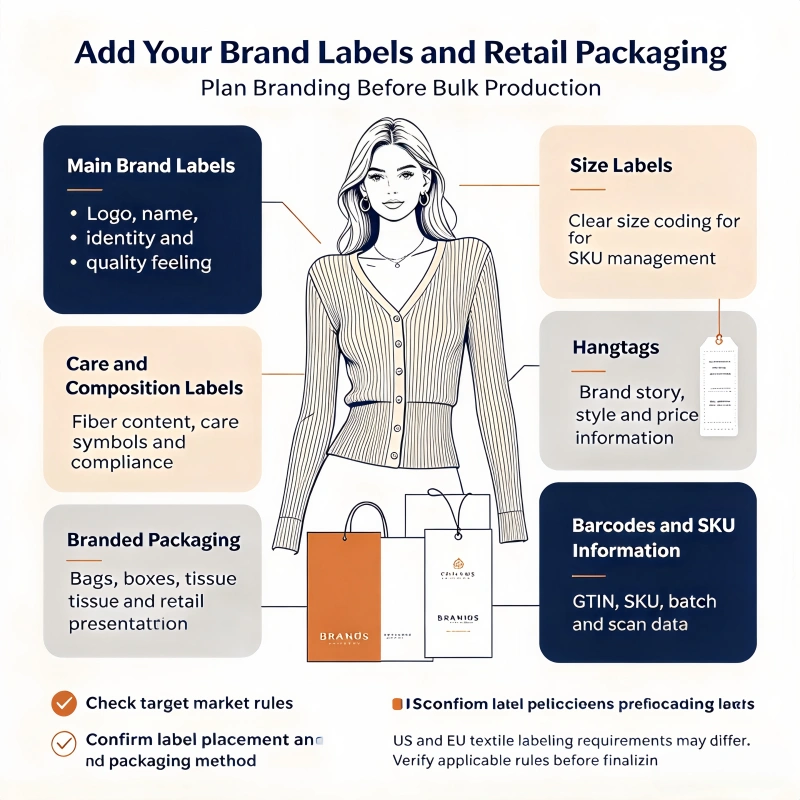
9. Add Your Brand Labels and Retail Packaging
For private-label buyers, plan branding before bulk production, not as an afterthought.
Depending on your requirements, customization may include:
- Main brand labels
- Size labels
- Care and composition labels
- Hangtags
- Branded packaging
- Barcodes and SKU information
Check that the fiber composition and care instructions are accurate and comply with the applicable labeling rules in your target market.
For example, US and EU textile labeling requirements differ in several respects. Buyers should confirm the rules that apply to their products and destination markets before finalizing labels.
Also review the label placement and packaging method on the approved sample. Small details can affect the finished product’s presentation and retail readiness.
10. How to Work With Qingdao Chengyuan Garment Co., Ltd.
At Qingdao Chengyuan Garment Co., Ltd., we provide garment development and manufacturing services for overseas B2B buyers.
Our process brings together design, pattern making, sample development and bulk production. We can work from technical packs, sketches or reference garments to develop women’s knit tops according to the buyer’s requirements.
Our monthly production capacity is approximately 80,000–120,000 finished garments across our production operations. This capacity supports a range of garment categories; actual availability for a specific knit top order depends on the product, quantity and production schedule.
For a more efficient quotation, buyers should prepare as much of the following information as possible:
- Product photographs, sketches or a reference sample
- Preferred yarn or material
- Target colors and size range
- Estimated quantity per style and color
- Branding and packaging requirements
- Target factory price
- Required delivery date and destination
If some technical details are still undecided, tell us what you already know and where you need recommendations. A clear discussion at the beginning can help identify practical options before sampling and bulk production.
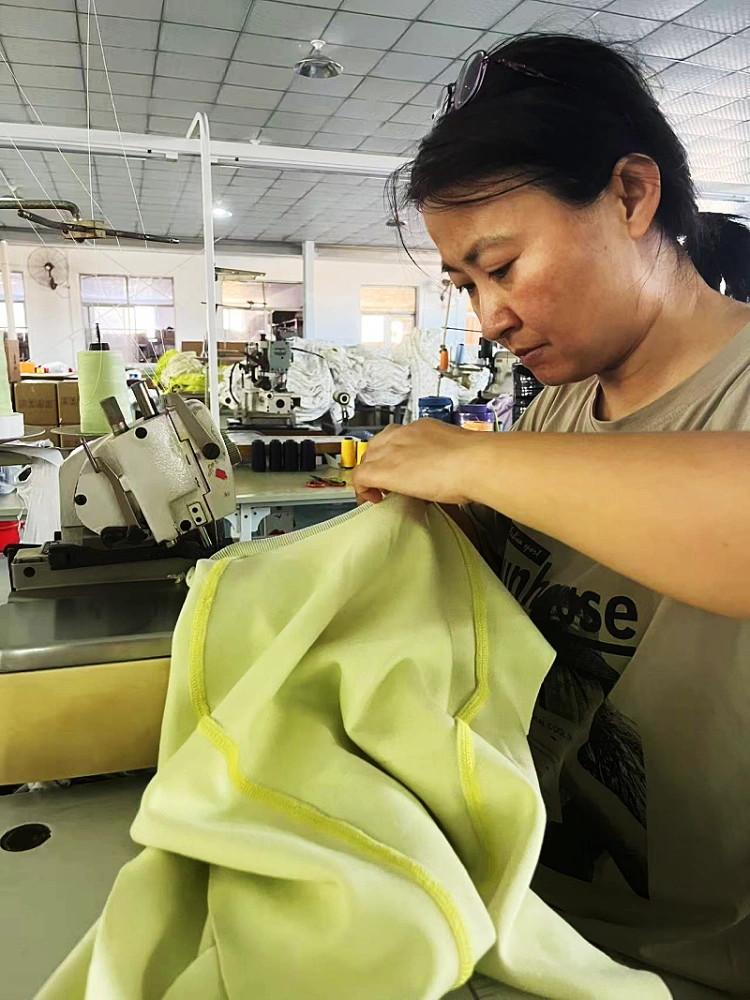
Chengyuan Garment factory from Qingdao China
Frequently Asked Questions
How long does it take to make custom women’s knit tops?
The timeline depends on yarn availability, design complexity, sample revisions, order quantity and production scheduling. Ask the manufacturer for separate estimates for sample development, sample approval, bulk production and shipping.
Can I make custom knit tops from a picture?
Yes, a photograph can be a useful starting point. However, you should provide measurements, material preferences, construction details and notes explaining which features must be reproduced. A reference sample or detailed tech pack usually gives the manufacturer more information.
What information should I send for a quotation?
At minimum, provide the product type, reference image, estimated quantity, target material, size range, branding requirements and expected delivery date. A complete tech pack will help the manufacturer prepare a more accurate quotation.
What is the difference between a knit top and a knitted sweater?
The terms can overlap. In general, knit tops often refer to lighter garments such as ribbed tops, knitted T-shirts and short-sleeve styles, while sweaters commonly refer to warmer or heavier knitwear. The precise product category depends on the garment’s construction and intended use.
Can I order a small quantity before placing a bulk order?
Many manufacturers can support trial orders, but MOQ varies by style, yarn, color and production method. Confirm the minimum quantity and whether a later bulk order can reuse the approved specifications.
How can I reduce quality problems in bulk production?
Provide clear specifications, approve the correct sample, define measurement tolerances, test washing performance where necessary, and agree on inspection criteria before production. Retaining an approved reference sample is particularly useful for repeat orders.
Final Thoughts
Making custom women’s knit tops is a step-by-step process, but the most important decisions happen before bulk production begins.
Define the product, prepare a clear tech pack, select the yarn and knit structure, confirm measurements, review samples, test washing performance, agree on pricing and MOQ, and establish quality standards before approving the order.
For buyers, the biggest lesson is simple: do not rush sample approval just to save a few days. A careful review of fit, material and finishing can prevent much more expensive problems during bulk manufacturing.
If you are planning a women’s knit top collection, Qingdao Chengyuan Garment can help you move from an initial concept or reference sample toward a finished garment, with production arrangements confirmed according to your specific requirements.

I am a supplier with 10 years of experience in the apparel industry. As a professional clothing manufacturer, we provide you with a one-stop solution.


Leave a Reply
Want to join the discussion?Feel free to contribute!