
How to Make Custom Women’s Knit Bottoms
Custom women’s knit bottoms let fashion brands, wholesalers, retailers, and private-label businesses develop products around their own designs, target customers, and price points. Popular options include knitted trousers, wide-leg pants, ribbed leggings, knit shorts, pencil skirts, maxi skirts, and matching knit sets.
However, producing custom knit bottoms involves more than choosing a color and sending a picture to a factory. Yarn composition, knitting structure, garment measurements, stretch recovery, waistband construction, and finishing all influence the final product.
As a garment manufacturer in Qingdao, China, we recommend that B2B buyers approach product development step by step. This guide explains how to turn an idea into a production-ready style, what information to prepare before requesting a quotation, and which quality checkpoints matter before placing a bulk order.
1. Understand What B2B Buyers Want from Custom Women’s Knit Bottoms
Before contacting a manufacturer, define the product category, target customer, and commercial purpose. These decisions determine the materials, construction, pricing strategy, and sampling requirements.
Different buyers may use the term “women’s knit bottoms” to describe very different products.
| Product type | Typical design features | Potential target market |
|---|---|---|
| Knitted wide-leg pants | Relaxed fit, straight or wide legs, soft drape | Fashion brands and lifestyle retailers |
| Ribbed knit leggings | Stretch fit, elastic waistband, close-fitting silhouette | Contemporary apparel and comfortwear brands |
| Knitted trousers | Structured waistband, tailored or straight-leg design | Premium fashion and office-casual retailers |
| Knit shorts | Pull-on waistband, short or mid-thigh length | Summer collections and loungewear brands |
| Knitted pencil skirts | Slim silhouette, ribbed or fine-gauge construction | Boutique and coordinated fashion collections |
| Knit maxi skirts | Long silhouette, elastic waist or fitted waistband | Seasonal fashion and resortwear brands |
| Matching knit sets | Coordinated tops and bottoms with matching yarn and color | Private-label brands and fashion retailers |
What information should buyers confirm first?
Before development begins, we suggest defining these five elements:
- Target market: Identify your intended customer, sales channel, and target retail price.
- Product category: Decide whether you need leggings, trousers, shorts, skirts, or matching sets.
- Fit direction: Specify slim, regular, relaxed, straight-leg, wide-leg, or oversized styling.
- Season and use: Clarify whether the product is designed for summer, winter, everyday wear, travel, or lounging.
- Order plan: Estimate the number of styles, sizes, colors, and pieces required for the first order.
For example, a brand developing a premium winter knit set may prioritize warmth, a soft hand feel, and a coordinated appearance. A retailer sourcing lightweight summer knit pants may emphasize breathability, drape, opacity, and easy-care performance.
Defining these requirements early helps the manufacturer recommend a practical construction instead of developing a sample based on assumptions.
2. Prepare a Tech Pack for Custom Women’s Knit Bottoms
A tech pack translates your design concept into specifications that a manufacturer can follow during sampling and bulk production. If you do not have a complete tech pack, you can start with a sketch, reference photographs, a physical garment, or a product description. Then confirm the missing technical details with your supplier.
A useful tech pack should include the following information.
| Technical detail | What to provide | Why it matters |
|---|---|---|
| Design | Front and back sketches, reference images, style number | Establishes the intended appearance |
| Material | Fiber composition, yarn type, fabric weight where applicable | Controls hand feel, drape, warmth, and cost |
| Knit structure | Rib, jersey, cable, jacquard, pointelle, or other structure | Determines surface texture and stretch behavior |
| Measurements | Waist, hip, rise, inseam, outseam, thigh, leg opening, skirt length | Controls fit and sizing |
| Construction | Waistband, pockets, cuffs, slits, seams, closures | Defines functional and visual details |
| Color | Pantone reference or approved physical swatch | Reduces color-matching uncertainty |
| Branding | Main label, care label, logo, hangtag | Supports private-label presentation |
| Packaging | Folding method, polybag, size sticker, carton requirements | Aligns production with your sales channel |
For knit bottoms, a general clothing specification is not always enough. The manufacturer also needs to understand the yarn, knitting structure, gauge where applicable, and finishing method. These factors can change the garment’s dimensions and appearance. See this knitwear tech-pack guide for further technical background.
Our practical recommendation: If you are developing a product from a reference garment, send clear photographs and a measurement sheet together. Highlight the features you want to retain and the features you want to change. This makes the first development round more focused.
3. Choose the Right Yarn and Knitting Structure
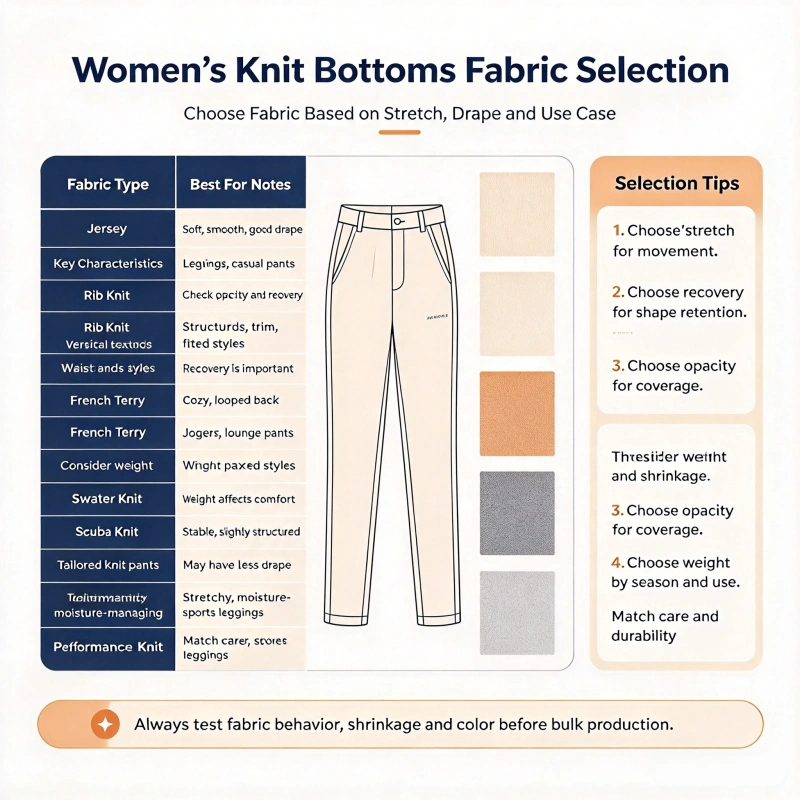
Material selection is one of the most important decisions in manufacturing custom knit bottoms. Two products with similar designs can perform differently because of their fiber composition, yarn construction, knitting structure, and finishing.
Common yarn options
| Yarn or fiber option | Main characteristics | Suitable applications |
|---|---|---|
| Cotton | Soft hand feel and familiar everyday comfort | Casual pants, shorts, skirts, loungewear |
| Viscose or rayon | Smooth touch and fluid drape | Wide-leg pants, lightweight skirts |
| Polyester | Useful for durability and color consistency, depending on construction | Fashion bottoms and selected performance-oriented styles |
| Acrylic | Can provide a wool-like appearance at a different price point | Fashion knit pants and seasonal collections |
| Wool or merino wool | Warmth and a natural fiber feel | Cold-weather trousers, skirts, and premium knitwear |
| Blended yarns | Can balance selected properties of different fibers | Versatile commercial collections |
These are general material characteristics, not guarantees for every yarn. Fiber quality, yarn count, blending ratio, stitch structure, and finishing all affect the final result.
For instance, a viscose-rich yarn may create the drape desired for wide-leg trousers, but the manufacturer still needs to evaluate the finished garment’s dimensional stability. A cotton blend may suit casual knit pants, but the exact construction must provide the required stretch and recovery.
Select a knit structure that matches the design
The main structures used in knitwear include:
- Rib knit: Often selected for fitted silhouettes, textured panels, waistbands, and cuffs.
- Jersey knit: Suitable for many lightweight, smooth-surface designs, depending on the yarn and construction.
- Cable knit: Creates a raised, decorative appearance for more textured seasonal products.
- Jacquard knit: Allows patterns and multiple colors to be incorporated into the knitted structure.
- Pointelle knit: Creates decorative openwork that works well for lightweight fashion styles.
- Waffle or textured knit: Adds surface dimension and a more structured visual effect.
The best option depends on the product’s intended fit, opacity, stretch, weight, and price positioning.
What do buyers need to know about knitting gauge?
For machine-made knitwear, gauge is a technical parameter that affects stitch density and the fabric’s appearance. Some flat-bed knitwear programs use gauges such as 3GG–5GG for chunkier constructions, 7GG–9GG for many medium-weight designs, and 12GG–14GG for finer constructions. These are indicative examples, not universal rules; the right gauge depends on the machine, yarn, structure, and product specification.
Don’t treat gauge as a substitute for fabric weight or fiber composition. Two products made at the same gauge may have different weights, drape, and stretch characteristics.
For more technical context, review this overview of knitwear manufacturing.
4. Decide How the Knit Bottoms Will Be Constructed
Not every knitted garment is made in the same way. The appropriate production method depends on the design, material, machine capabilities, and required finish.
Option A: Fully fashioned knit construction
In fully fashioned knitwear, garment panels or shaped sections are knitted to the required form and then joined. This approach suits structured fashion knitwear and selected knitted trousers or skirts.
Potential advantages include shaped knitted components and reduced reliance on cutting the garment from a large piece of knitted fabric. However, you must evaluate machine programming, yarn choice, panel shaping, and linking requirements for each style.
Option B: Cut-and-sew knitted fabric
In this method, the clothing manufacturer first produces knitted fabric, then cuts it to pattern and sews it into the finished garment. It may suit certain leggings, knit shorts, casual trousers, and other knitted styles.
The manufacturer needs to evaluate fabric relaxation, stretch direction, pattern layout, seam construction, and cutting stability. If the material stretches or relaxes significantly, cutting before the fabric has been properly prepared may lead to inconsistent garment dimensions.
Neither method is automatically better for every design. Buyers should ask the manufacturer to recommend the construction that best fits their product requirements and target price.
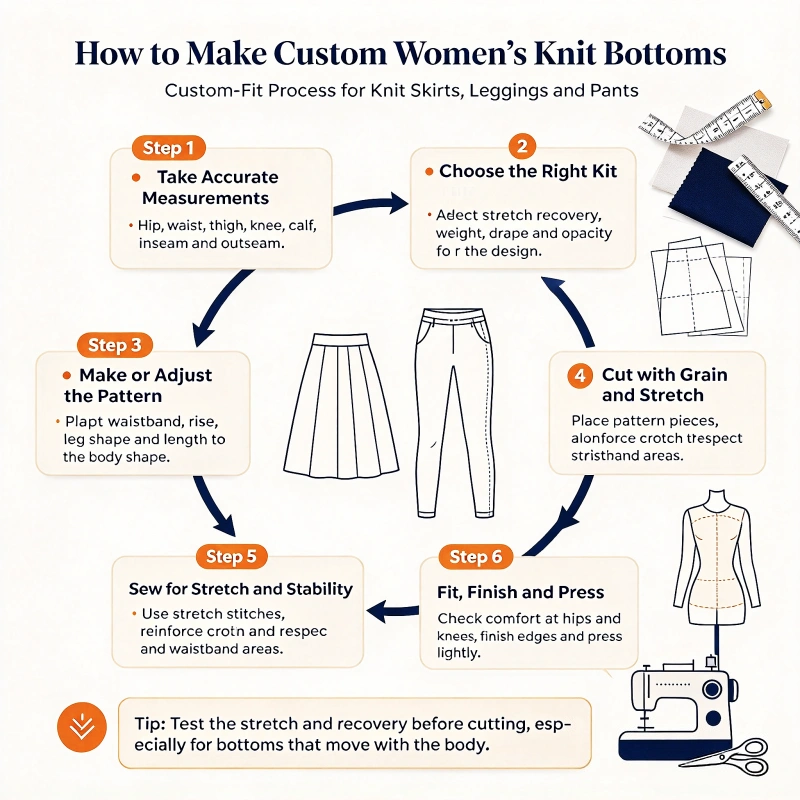
5. Develop the Pattern and Confirm Measurements
Fit is a major factor in whether custom women’s knit bottoms meet a brand’s expectations. A pair of trousers may look correct in a sketch but fit poorly if the rise, hip ease, leg shape, or waistband is not developed correctly.
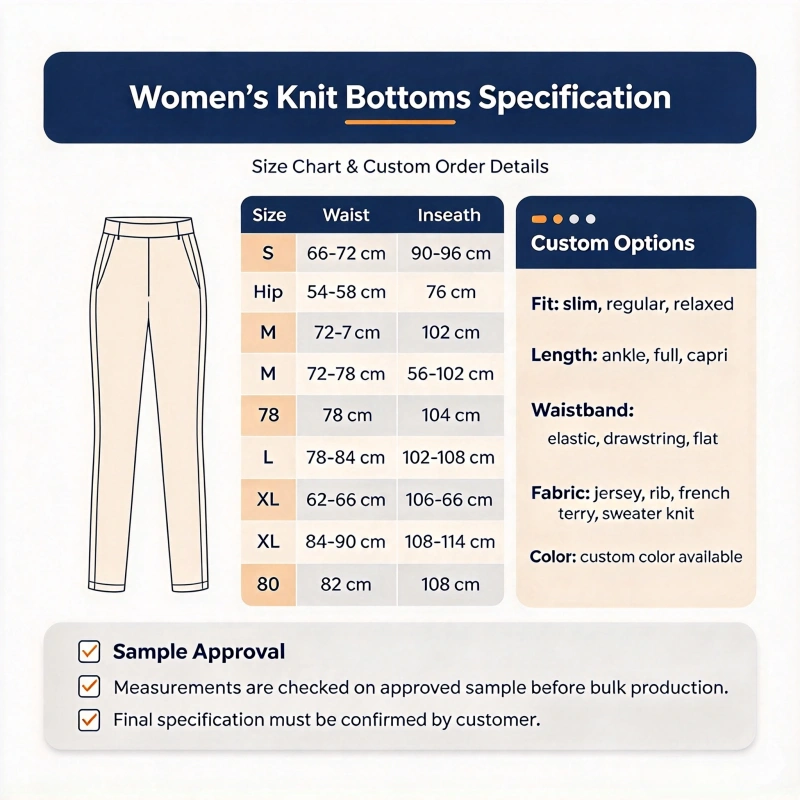
Start by identifying the base size, then prepare a graded size chart for the complete size range.
For example, a brand offering XS, S, M, L, XL, and XXL needs specifications for 6 sizes. Set grading increments based on intended fit, customer measurements, and product category, not a single increment for all measurements.
Key measurement points
| Measurement | What it controls |
|---|---|
| Waist circumference | Waist fit and comfort |
| Hip circumference | Room through the seat and hips |
| Front rise | Front waist-to-crotch proportion |
| Back rise | Rear coverage and seat comfort |
| Thigh circumference | Upper-leg ease |
| Inseam | Inside-leg length |
| Outseam | Overall trouser length |
| Leg opening | Straight, tapered, or wide-leg silhouette |
| Skirt length | Overall skirt proportion |
| Waistband height | Appearance and support at the waist |
For a fitted product, such as ribbed leggings, stretch and recovery are particularly important. For wide-leg knit pants, drape and the balance between hip ease and leg width may have a greater influence on the final silhouette.
How should buyers evaluate the fit sample?
While reviewing a sample, verify additional criteria beyond whether the garment is wearable. Compare the actual measurements against the specification and examine how the product behaves when standing, sitting, walking, and bending.
Pay particular attention to:
- Whether the waistband rolls, twists, or slips.
- Whether the fabric becomes excessively transparent when stretched.
- Whether the rise provides sufficient coverage and comfort.
- Whether the legs hang evenly and maintain the intended silhouette.
- Whether the garment length remains suitable after washing.
- Whether the fabric returns to its intended shape after stretching.
Experience-based advice: For stretch knit bottoms, evaluate the waistband and hip area together. A waistband that appears correct when measured flat may still feel uncomfortable or move out of position when the wearer sits or walks.
6. Make Samples Before Confirming Bulk Production
Sampling gives both the buyer and manufacturer an opportunity to identify technical issues before committing to a production order.
For a new custom knit bottoms project, we recommend the following development sequence.
Step 1: Review the design brief. Confirm the target product, size range, yarn direction, knit structure, colors, and construction details.
Step 2: Confirm materials and swatches. Review yarn samples or knitted swatches to assess color, texture, thickness, and hand feel.
Step 3: Develop the first garment sample. Produce a physical sample using the proposed construction and measurements.
Step 4: Review the fit. Check waist, hip, rise, length, leg shape, and other product-specific measurements.
Step 5: Revise and approve. Clearly record changes and confirm the final sample and specifications before bulk production.
A simple design may require fewer revisions than a style involving complex jacquard patterns, unusual shaping, or coordinated knit structures. No single sampling schedule applies to every project, so buyers should confirm the development timeline with the factory.
During sample review, use a written comment sheet rather than relying only on verbal feedback. For example, record the exact measurement that needs to change, the required new value, and whether the change applies to one size or the complete size range.
This creates a clear record for the next sample and reduces the risk of repeating the same correction.
7. Calculate the Cost of Custom Women’s Knit Bottoms
The cost of custom knit bottoms depends on more than the garment’s finished weight. Material selection, knitting method, design complexity, order quantity, finishing, branding, and packaging all influence the quotation.
A manufacturer typically needs enough technical information to assess the project before providing a meaningful unit price.
Cost factors affect the quotation. Yarn composition drives material costs. Different fibers, yarn qualities, and blends vary in cost. Knit structure influences programming or production work. Complex textures or patterns may require extra steps. Construction method matters: fully fashioned and cut-and-sew styles need different production resources. Garment dimensions require more material or machine time. Design details add operations, such as pockets, waistbands, and trims. Order quantity changes how setup and development costs are allocated across sizes. Color options affect yarn sourcing, dyeing, and planning. Branding and packaging add costs like labels, hangtags, folding, and retail packaging.
There is no reliable universal price for custom women’s knit bottoms without knowing the specifications. Buyers should not expect a basic knit short and a complex jacquard wide-leg trouser to have the same unit cost.
How can B2B buyers control costs?
- Standardize materials where possible. Using the same approved yarn across coordinated styles may simplify sourcing.
- Limit unnecessary design variations. Multiple structures, trims, or color combinations can add complexity.
- Confirm the size range early. Size distribution affects production planning and material estimates.
- Ask for quantity-based quotations. Compare the unit cost at your realistic order quantities rather than relying on one volume.
- Clarify what the price includes. Confirm sampling charges, labels, packaging, inspection, shipping terms, and any other applicable costs.
When comparing suppliers, make sure the quotations describe the same product. A lower price is not necessarily a better deal if the yarn, measurements, finishing, or packaging specifications differ.
8. Confirm MOQ, Lead Time, and Production Capacity
Before placing a purchase order, confirm the manufacturer’s minimum order quantity (MOQ), sampling schedule, bulk production lead time, and capacity for repeat orders.
These details vary by supplier and project. Fully fashioned knitwear, complex patterns, custom yarn colors, and multiple size or color combinations can require different planning from simpler knitted garments.
As a buyer, ask the factory to clarify:
- Is the MOQ calculated per style, per color, or per order?
- Can multiple sizes be included within one colorway?
- Are custom yarn colors subject to a separate minimum?
- How long will sample development take?
- When does the bulk production lead time begin?
- Can the manufacturer support repeat orders using the approved specifications?
At Qingdao Chengyuan Garment Co., Ltd., we provide integrated garment services covering design, pattern making, sampling, and bulk production. We maintain a monthly capacity of 80,000–120,000 finished garments across our operations. We support small trial orders and larger B2B production programs, with project requirements reviewed before confirming feasibility.
This capacity figure refers to our overall garment operations, not a guaranteed monthly output for women’s knit bottoms alone. Actual production availability depends on the style, construction, order quantity, and production schedule.
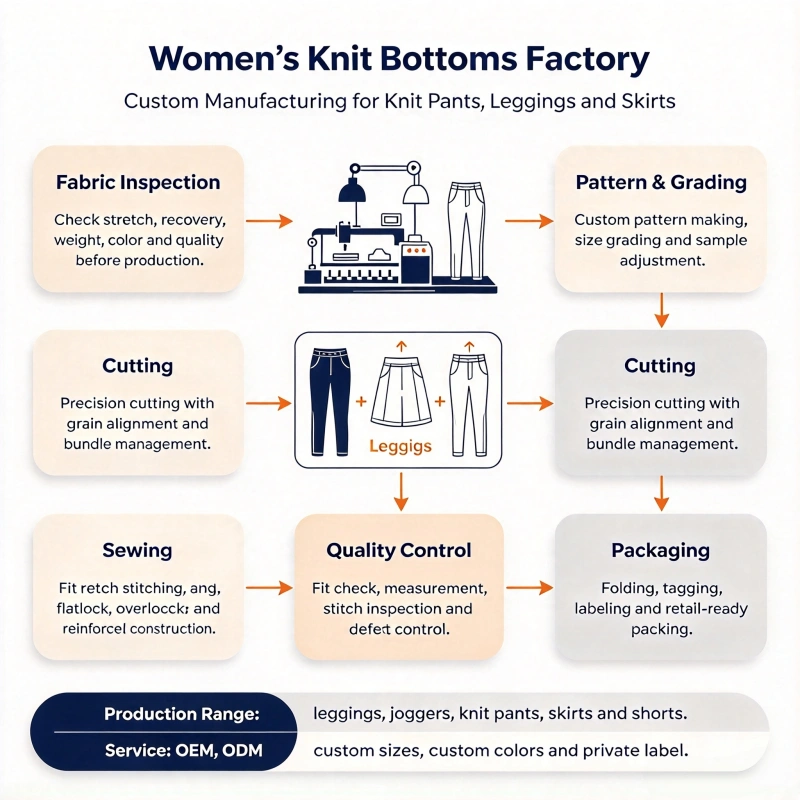
9. Establish Quality Control Standards Before Bulk Production
Start quality control before bulk manufacturing, not only when the finished garments are packed.
For knit bottoms, the most useful approach is to agree on measurable acceptance criteria with the manufacturer before production starts.
Recommended quality checkpoints
Incoming materials
- Confirm the agreed fiber composition and yarn or fabric specification.
- Check color consistency against the approved reference.
- Evaluate visible material defects.
- Test dimensional stability where relevant to the material and product.
During production
- Check knitting or fabric defects.
- Inspect seams, linking, waistband attachment, and other construction details.
- Compare garment measurements with the approved specification.
- Monitor color consistency and the knit structure’s appearance.
After finishing
- Measure garments using the agreed measurement method.
- Check appearance after any required washing or finishing.
- Inspect the waistband, hems, seams, pockets, and decorative details.
- Confirm labels, size identification, folding, and packaging.
Test shrinkage and shape retention
Knitwear can change dimensions after washing, drying, steaming, or other finishing processes. The extent of change depends on fiber composition, yarn, construction, and care conditions.
Before bulk production, agree on the applicable care method and dimensional stability requirements. Test a representative sample using the intended care process, then compare the measurements before and after treatment.
For example, if a pair of knit trousers is approved at a specified inseam length, the buyer and factory should establish the acceptable measurement range after the agreed finishing process. Do not assume that all knit fabrics will behave the same way.
Use a documented inspection standard
For bulk orders, establish acceptable measurement tolerances, defect classifications, and final inspection requirements in writing. Some buyers use an AQL-based sampling plan, but the inspection level and acceptance criteria should be agreed upon for the specific product and order.
A written standard makes it easier for the buyer, factory, and third-party inspector to evaluate the same batch consistently.
10. Customize Branding and Packaging for Your Market
For private-label buyers, confirm branding details before bulk production. These elements affect the garment’s presentation and may require additional materials or production steps.
Common options include:
- Woven brand labels.
- Printed care and composition labels.
- Hangtags with product information.
- Branded size labels or size stickers.
- Individual polybags or other agreed packaging.
- Custom folding and carton marking.
For coordinated knit sets, confirm whether the top and bottom should use matching yarn, color, branding, and packaging. If both pieces are sold together, their color and texture consistency can influence how the complete set is perceived.
Buyers should also ensure that fiber-content labels, care instructions, country-of-origin information, and other required labeling comply with the rules applicable to their destination market. The exact requirements depend on where the products will be sold.
11. Common Mistakes to Avoid When Sourcing Custom Knit Bottoms
Even a clear design concept can run into production problems if you leave key decisions open.
Mistake 1: Sending only a reference image.
A picture communicates appearance, but it may not specify yarn, measurements, construction, or finishing. Provide a tech pack or work with the manufacturer to document these details before sampling.
Mistake 2: Choosing yarn based only on price.
A low-cost yarn may not provide the required drape, softness, stretch recovery, or appearance. Compare material options against the intended product performance.
Mistake 3: Approving the sample without checking measurements.
A sample may look attractive but still fail to meet the brand’s fit requirements. Record measurements and review the garment on an appropriate fit model or through a documented fitting process.
Mistake 4: Ignoring post-wash performance.
The product should be evaluated under its intended care conditions. Otherwise, shrinkage or shape changes may become visible only after customers begin using the garment.
Mistake 5: Changing specifications after bulk production starts.
Changes to yarn, color, dimensions, or construction can affect cost and delivery schedules. Approve the key specifications before authorizing production.
Mistake 6: Comparing quotations without comparing specifications.
Confirm that suppliers are quoting the same composition, construction, measurements, quantity, labels, and packaging. This provides a more meaningful basis for comparison.
12. How to Start a Custom Women’s Knit Bottoms Project with Our Factory
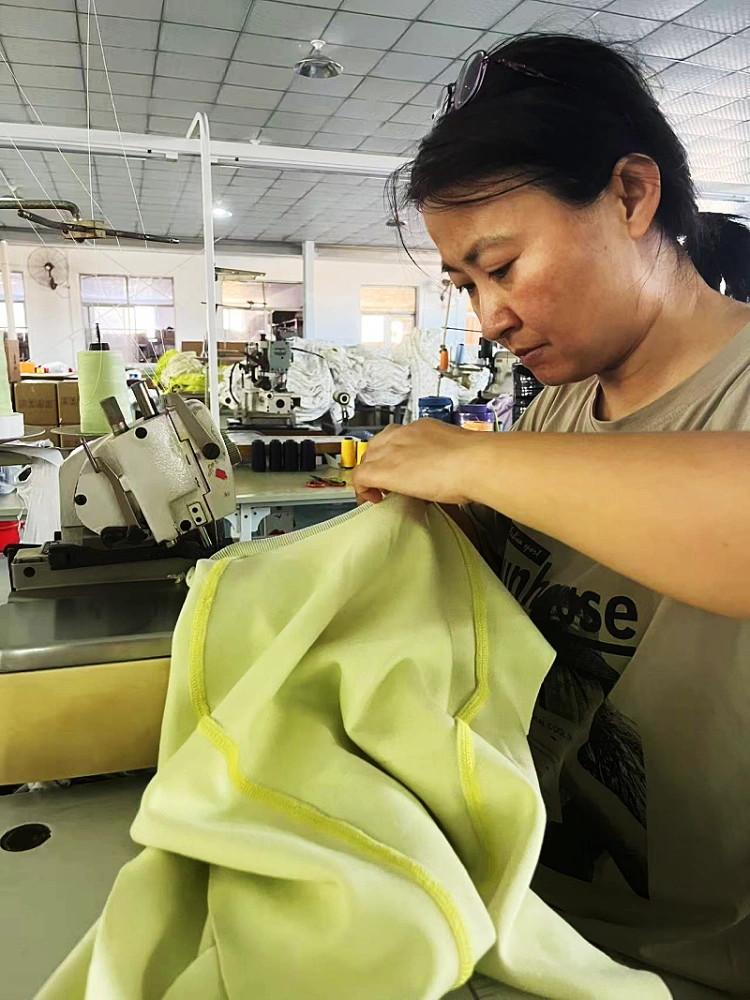
At Qingdao Chengyuan Garment Co., Ltd., we work with B2B customers developing apparel collections for wholesale, retail, and private-label markets. Our integrated services cover design, pattern making, sample development, and bulk garment production.
To help us evaluate a custom women’s knit bottoms project, buyers can prepare the following information:
- Product type: knitted trousers, leggings, shorts, skirts, or matching sets.
- Reference images, sketches, a tech pack, or an existing sample.
- Target yarn or material composition, if already decided.
- Required colors and size range.
- Estimated quantity by style and color.
- Branding, labeling, and packaging requirements.
- Target delivery date and destination market.
If you have not finalized the material or construction, you can still start with a reference design and your target retail positioning. We can review the requirements and identify which details need confirmation before sampling and quotation.
The goal is to establish a clear production specification, approve a sample that meets your expectations, and use that approved standard to guide bulk manufacturing.
Frequently Asked Questions
1. What types of custom women’s knit bottoms can a garment manufacturer develop?
Depending on the manufacturer’s equipment and production capabilities, options may include knitted trousers, wide-leg pants, ribbed leggings, shorts, pencil skirts, maxi skirts, and coordinated knit sets. Confirm the construction and material requirements for your specific design before starting development.
2. Can I develop custom knit bottoms from a picture instead of a tech pack?
Yes. You can use a reference picture to start the discussion. However, the manufacturer will still need to confirm measurements, yarn, knit structure, construction, color, and finishing details before producing a reliable sample.
3. What information is needed for a quotation?
The most useful information includes product type, reference design, material requirements, measurements, size range, colors, order quantity, branding, and packaging. The more details you provide, the easier it is for the manufacturer to evaluate the project accurately.
4. What is the MOQ for custom women’s knit bottoms?
MOQ varies by manufacturer, construction method, yarn availability, color requirements, and order complexity. Ask whether the minimum applies per style, colorway, or total order, and confirm the minimum before approving development.
5. How long does it take to make custom knit bottoms?
The timeline depends on material availability, design complexity, sample revisions, order quantity, and production scheduling. Request separate estimates for sampling and bulk production, and clarify when the bulk lead time officially starts.
6. How can I reduce the risk of inconsistent sizing?
Provide a complete measurement chart, define tolerances, approve the fit sample, and confirm how garments will be measured after finishing. For a multi-size collection, request a graded size specification rather than relying on one sample size alone.
7. Can I customize the waistband, pockets, and leg shape?
These details can often be customized, subject to the selected construction and factory capabilities. Confirm the waistband height and finish, pocket dimensions and position, rise, leg opening, and overall silhouette during product development.
8. Can the factory produce matching knit tops and bottoms?
Coordinated sets may be developed when the manufacturer can support both products. Confirm the yarn, color reference, knit structure, and finishing requirements for each piece so the finished set has a consistent appearance.
9. How should I check the quality before shipment?
Agree on the approved sample, measurement tolerances, material requirements, appearance criteria, defect classifications, and inspection method before bulk production. Depending on the order, inspection can include measurements, construction, color, finishing, labeling, and packaging.
10. What is the best way to start working with a Chinese garment manufacturer?
Prepare a clear product brief, send reference materials, explain your target market and order plan, and ask the manufacturer to confirm feasibility before sampling. Review the sample carefully and document every approved specification before authorizing bulk production.
Conclusion
Making custom women’s knit bottoms is a coordinated process involving product planning, yarn and structure selection, pattern development, sampling, cost evaluation, bulk production, and quality inspection.
For B2B buyers, the most effective starting point is a clear product brief and a realistic understanding of the intended fit, material, and target price. Confirming these details before sampling helps manufacturers provide more useful recommendations and reduces avoidable changes later in the production process.
If you are planning a new women’s knit bottoms collection, prepare your design references, size range, target quantity, and customization requirements before requesting a quotation. A well-defined specification is the foundation for consistent quality and a more predictable manufacturing process.

I am a supplier with 10 years of experience in the apparel industry. As a professional clothing manufacturer, we provide you with a one-stop solution.