
Free Dog Sweater Knitting Pattern Straight Needles
You probably want something more practical than a complicated knitting project: a free pattern that works with ordinary straight needles, uses basic stitches, and can be adjusted to your dog’s actual measurements.
The good news is that several free patterns are designed specifically for flat knitting on straight needles. Some cover small, medium, and large dogs, while others suit tiny breeds or specific chest measurements.
This guide explains how to choose a pattern, measure your dog, calculate gauge, select yarn and needles, and avoid the most common fitting mistakes.
Free Dog Sweater Knitting Pattern Straight Needles: What Are You Looking For?
The search phrase “free dog sweater knitting pattern straight needles” combines several specific intentions:
| Search intent | What the knitter wants |
|---|---|
| Free pattern | No paid pattern required |
| Dog sweater | A wearable garment rather than a blanket or coat |
| Straight needles | No circular or double-pointed needles |
| Easy | Suitable for beginners or advanced beginners |
| Adjustable | Able to fit different dog sizes |
| Practical | Warm, comfortable, and easy to put on |
| Printable instructions | Easy to follow while knitting |
This matters because not every “free dog sweater pattern” meets the same requirements.
For example, some patterns are worked in the round, while others are knitted flat and seamed. If you specifically own a pair of traditional straight knitting needles, a worked-flat pattern is usually the simplest choice.
One current free pattern, for example, is knitted flat in one piece on straight needles and provides small, medium, and large measurements.
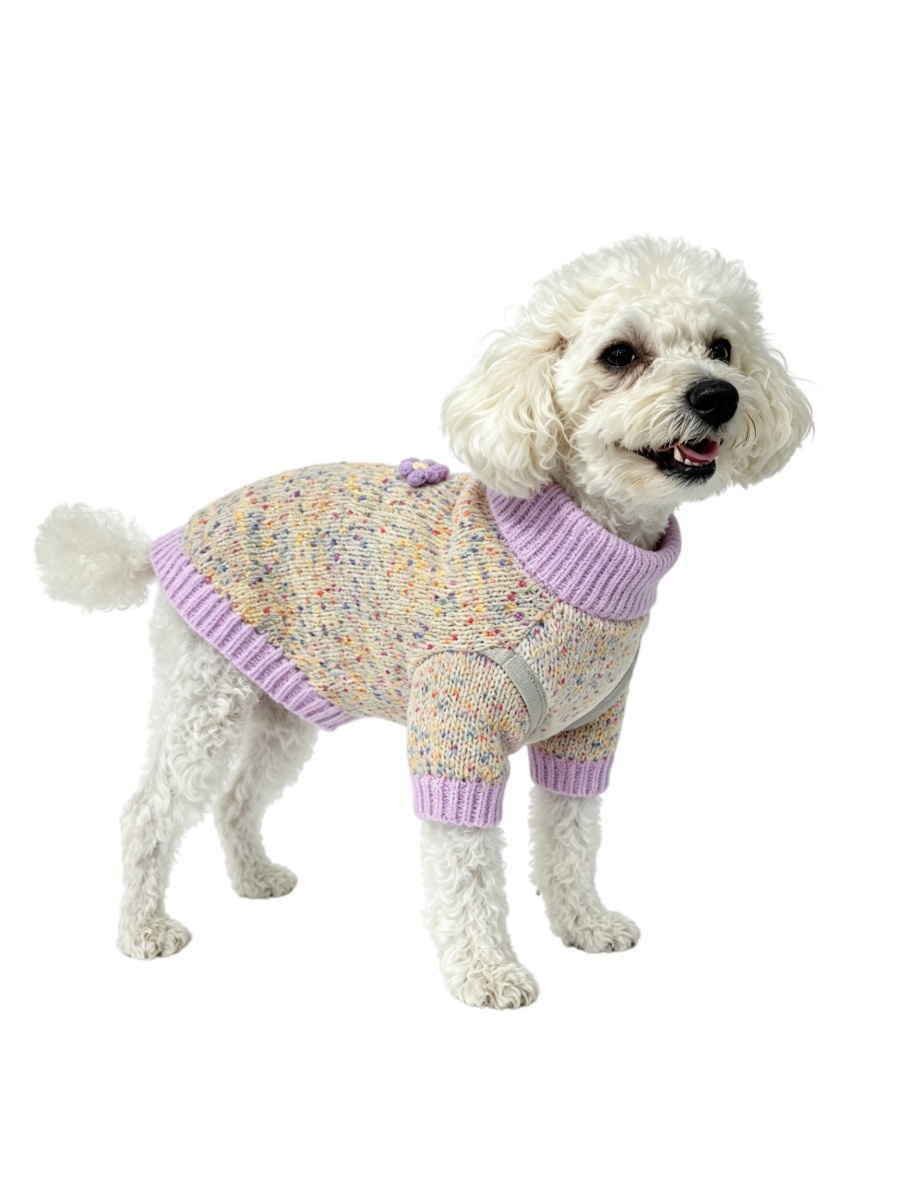
Keep your little fur baby warm and stylish through cold days with this adorable winter dog sweater, perfectly tailored for small‑size pups including Teddy, Schnauzer, Bichon Frise and other small breeds.
Crafted from premium soft knit material, this dog sweater is skin‑friendly, lightweight and breathable. It offers great warmth without causing overheating or discomfort for your furry friend. No scratchy seams, gentle against sensitive dog skin for all‑day wear.
Featuring charming classic multicolor speckled yarn mixed with delicate 3D raised flower decorations, this outfit brings dreamy princess‑vibe aesthetics. Your girl dog will look sweet and eye‑catching whether for daily walks, home lounging, holiday gatherings, or photo shoots.
The thoughtful ruffled mock neck fits snugly around the neck without tight rubbing or choking. Exquisite ruffled flutter cap sleeves add lovely feminine, ladylike flair. The stretchy knit hem allows easy on‑and‑off, and maintains a comfy fit while your dog runs, plays, or curls up for naps.
A must‑have cute wardrobe addition to keep your small dog cozy and fashionable all winter long.
Best Free Dog Sweater Pattern Using Straight Needles
A particularly useful approach is a one-piece or two-piece flat-knit sweater.
A current free straight-needle pattern uses:
- 4 mm / US 6 needles
- DK or light-worsted yarn
- Approximately 19 stitches × 30 rows = 4 × 4 inches
- Small, medium, and large sizes
- 1×1 ribbing
- Knit and purl stitches
- Basic increases and decreases
The published finished-width ranges are approximately:
| Size | Body width | Length excluding collar |
|---|---|---|
| Small | 14–18 in | 14 in |
| Medium | 20–24 in | 17 in |
| Large | 26–30 in | 20 in |
These measurements show why you should choose dog sweaters by body measurements rather than breed name alone.
Another free straight-needle design uses chunky yarn and comes in small, medium, and large sizes. Its published chest circumferences are approximately 14–16 in, 20–24 in, and 30–32 in.
So, yes—there is no universal “small dog size.” A Chihuahua and a stocky French Bulldog can both be called small dogs, but their sweater dimensions can be dramatically different.
How to Measure Your Dog Before Knitting
This is probably the most important step.
Don’t choose a pattern simply because your dog weighs 10 lb, 20 lb, or 30 lb. Weight is a useful reference, but chest and back measurements determine whether the sweater actually fits.
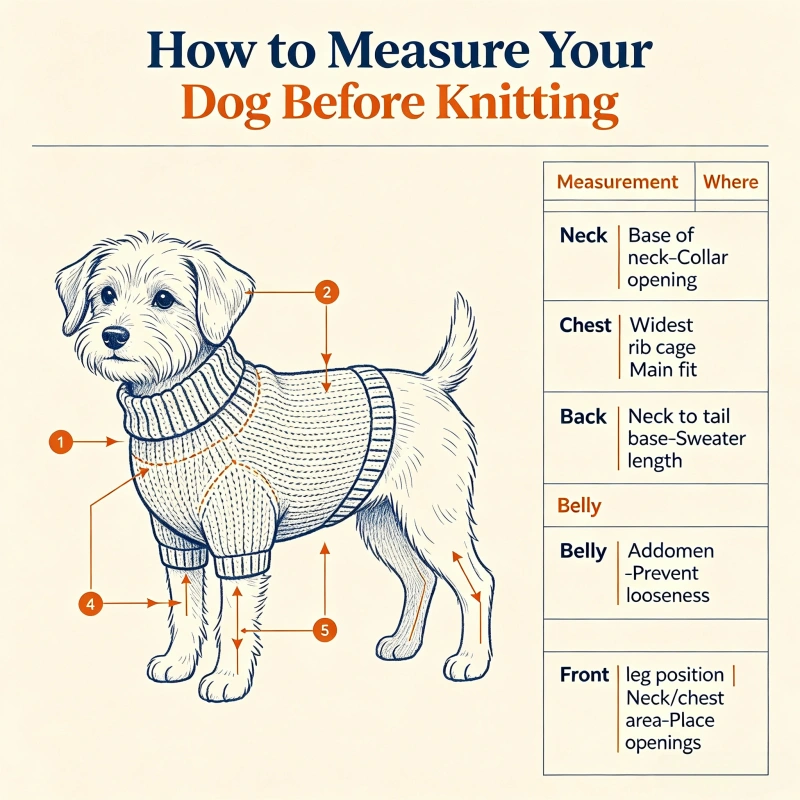
Measure these three areas:
1. Neck circumference
Place a soft measuring tape around the base of the neck.
Leave enough room to comfortably insert approximately two fingers between the tape and your dog’s neck.
2. Chest circumference
Measure around the deepest part of the rib cage, immediately behind the front legs.
This is usually the most important measurement for sweater fit.
3. Back length
Measure from the base of the neck to the base of the tail.
For most sweaters, you don’t need to cover the entire tail area.
Simple measurement chart
| Measurement | Where to measure | Why it matters |
|---|---|---|
| Neck | Around base of neck | Collar opening |
| Chest | Around widest rib cage | Main sweater circumference |
| Back | Neck to tail base | Sweater length |
| Belly | Around abdomen | Prevents excessive looseness |
| Front-leg position | From neck/chest area | Helps position openings |
A good rule is to measure your actual dog before casting on, even when the pattern provides S/M/L instructions.
What Size Dog Sweater Should You Knit?
Here’s a practical starting point:
| Dog category | Approx. chest circumference | Typical approach |
|---|---|---|
| Toy / XS | 10–14 in | Shorter body, narrow neck |
| Small | 14–20 in | Standard small pattern |
| Medium | 20–26 in | Increase body width |
| Large | 26–32 in | Larger stitch count |
| Extra large | 32+ in | Usually requires customization |
These are starting ranges, not universal sizes.
For comparison, one free Premier Yarns dog sweater lists finished lengths of 10, 13 and 16 inches and corresponding chest circumferences of approximately 18–20, 21–25 and 26–30 inches for its three sizes. It uses US 9 / 5.5 mm straight needles.
This illustrates an important point: two “medium” dog sweaters can have completely different dimensions.
Dog Sweater Knitting Gauge: Why It Matters
Gauge is one of the easiest things for beginners to ignore—and one of the fastest ways to end up with a sweater that doesn’t fit.
Suppose your pattern specifies:
19 stitches = 4 inches
but your knitting produces:
23 stitches = 4 inches
Your stitches are smaller.
That means the finished sweater will be narrower than the pattern measurements suggest.
Example
Imagine a section requires approximately 76 stitches.
At 19 stitches per 4 inches:
76 ÷ 19 × 4 = 16 inches
But at 23 stitches per 4 inches:
76 ÷ 23 × 4 ≈ 13.2 inches
That’s almost 3 inches narrower.
On a human sweater, that’s annoying.
On a dog sweater, it can mean your dog can’t get its chest through the opening.
Therefore, knit a gauge swatch before starting the actual sweater. A current straight-needle pattern uses 19 stitches and 30 rows per 4 inches, demonstrating how precise gauge can be for a fitted pet garment.
How Many Straight Needles Do You Need?
For a basic dog sweater, you generally need:
- 1 pair of straight knitting needles
- Yarn
- Tape measure
- Scissors
- Yarn/darning needle
- Stitch holder or spare needle
The needle size depends on the yarn and pattern.
Common combinations
| Yarn | Typical needle range | Best use |
|---|---|---|
| DK / Light worsted | 3.75–4.5 mm | Lightweight sweater |
| Worsted | 4.5–5.5 mm | Everyday dog sweater |
| Bulky | 6–8 mm | Thick winter sweater |
| Super bulky | 8–12 mm | Very warm, quick projects |
Don’t automatically choose a larger needle because you want a softer sweater. Gauge should come first.

What Yarn Is Best for a Knitted Dog Sweater?
For most dogs, the best yarn is:
- Soft
- Washable
- Comfortable against the coat and skin
- Not excessively heavy
- Reasonably durable
Wool
Warm and naturally insulating, but some dogs may find certain wool yarns itchy.
Acrylic
A practical choice for washable dog sweaters. It is also widely available in many colors.
Wool-acrylic blends
Often a good compromise between warmth, softness, durability and ease of care.
For example, one free dog sweater pattern uses a 49% wool/51% acrylic bulky yarn and recommends about 100 g for small, 150 g for medium, and 170 g for large.
Another free pattern for a 4.6-lb Maltese uses worsted-weight yarn and about 210 yards.
So yarn consumption can vary considerably depending on the dog’s size, pattern, stitch density and yarn weight.
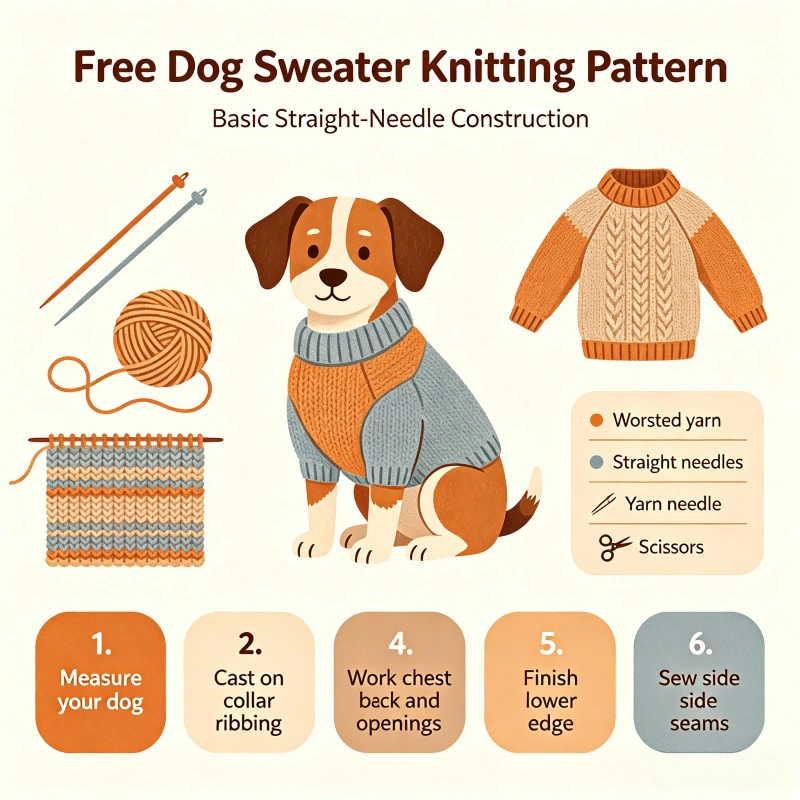
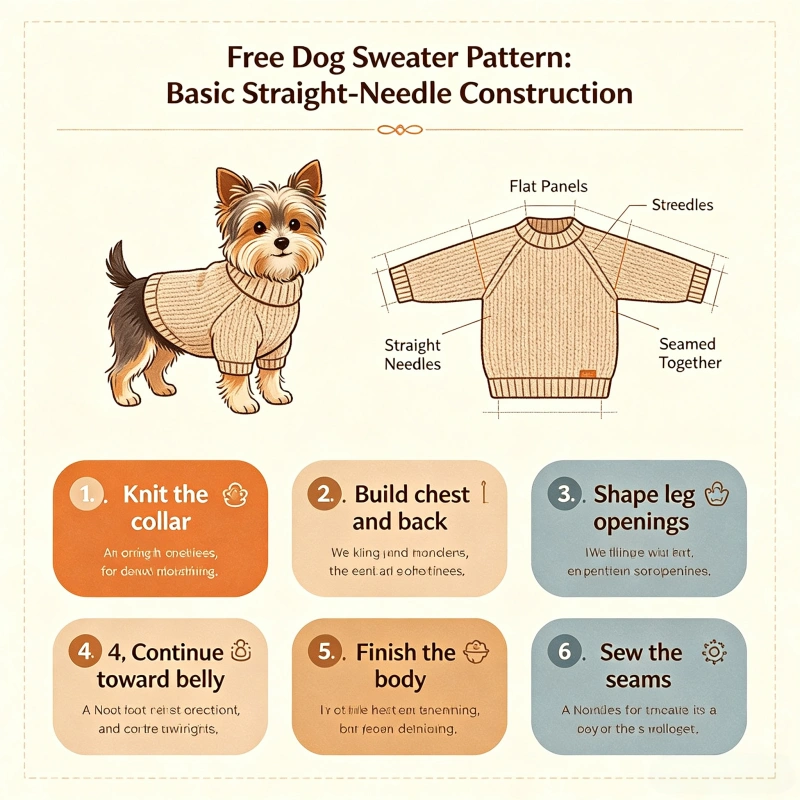
Free Dog Sweater Pattern: Basic Straight-Needle Construction
If you’re creating your own simple pattern rather than following a published design, a flat construction can be surprisingly straightforward.
A typical design looks like this:
Step 1: Knit the collar
Start with ribbing such as:
K1, P1
or:
K2, P2
Ribbing gives the neck opening some elasticity.
Step 2: Build the chest and back
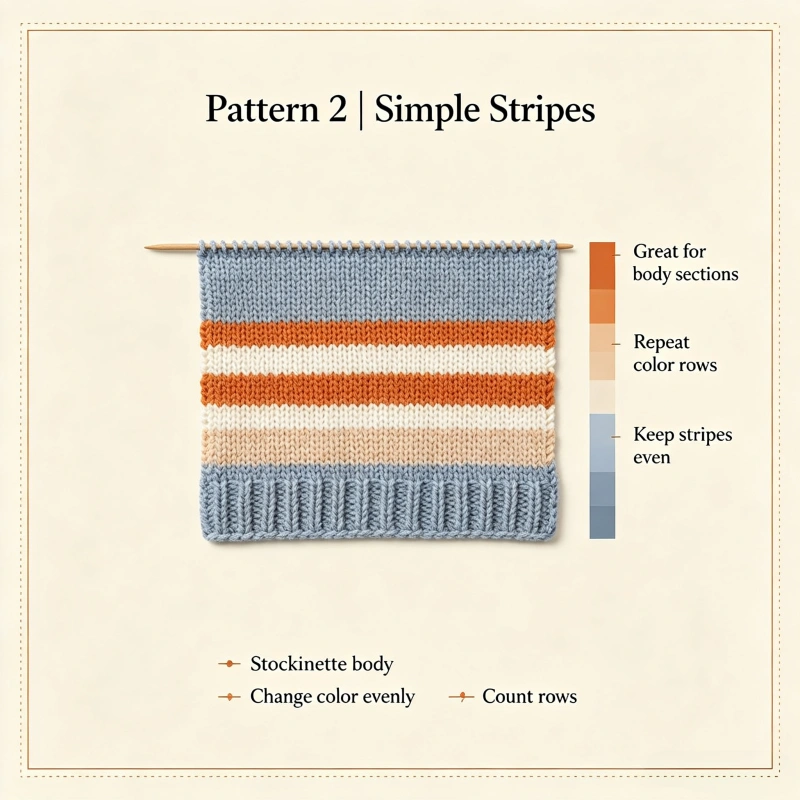
Continue in stockinette, garter stitch or another simple stitch pattern.
You can increase gradually around the chest.
Step 3: Shape the leg openings
Leave or decrease sections where the front legs need room.
This is one of the most important areas to customize.
Step 4: Continue toward the belly
The belly section generally doesn’t need to be as long as the back.
This is especially important for male dogs because excessive coverage underneath can create hygiene problems.
Step 5: Finish the body
Use ribbing around the lower edge if you want the sweater to sit more securely.
Step 6: Sew the seams
If the sweater is made from separate panels, use a yarn needle and mattress stitch or another suitable seam.
Flat construction is one of the biggest advantages of using straight needles: you can knit recognizable rectangular sections without managing circular needles or multiple needles.
Straight Needles vs Circular Needles for Dog Sweaters
Which is better?
It depends on the knitter.
| Feature | Straight needles | Circular needles |
|---|---|---|
| Beginner friendly | ⭐⭐⭐⭐⭐ | ⭐⭐⭐ |
| Flat knitting | Excellent | Excellent |
| Knitting in the round | No | Yes |
| Small dog sweaters | Very practical | Also practical |
| Seaming required | Often | Not always |
| Traditional knitting feel | Excellent | Moderate |
| Learning curve | Lower | Slightly higher |
If your search specifically includes “straight needles,” there’s no reason to switch to circular needles simply because many modern patterns use them.
Several free dog sweater designs are specifically constructed flat with straight needles.
A Simple Dog Sweater Calculation Example
Let’s say you measure a dog’s chest at:
20 inches
Your gauge is:
19 stitches / 4 inches
The approximate number of stitches needed for 20 inches is:
20 ÷ 4 × 19 = 95 stitches
However, you shouldn’t automatically cast on exactly 95 stitches.
You also need to consider:
- Ribbing
- Ease
- Stitch pattern
- Seam allowance
- Stretch
- Leg openings
- Neck shaping
For example, if you want approximately 2 inches of wearing ease, your target circumference becomes:
20 + 2 = 22 inches
At 19 stitches per 4 inches:
22 ÷ 4 × 19 ≈ 105 stitches
This is why gauge + measurement + ease is much more reliable than simply following an S/M/L label.

Case Study: Making a Sweater for a 12-Pound Small Dog
Consider a hypothetical 12-lb mixed-breed dog with:
- Neck: 11 in
- Chest: 17 in
- Back: 13 in
A pattern labeled “Small” may or may not fit.
Suppose the pattern’s small size is designed for a chest around 14–18 inches.
That looks promising.
But back length also matters.
If the pattern has a 16-inch back and the dog needs only 13 inches, the sweater may extend too far toward the tail.
Better solution
Keep the original width but reduce the body length by approximately 3 inches.
This is much easier than resizing the entire sweater.
Lesson: For dog sweaters, length is often easier to customize than circumference.

Case Study: Why a Large-Breed Dog May Need a Custom Pattern
Imagine a Labrador-sized dog with a chest circumference around 30 inches.
One published straight-needle pattern offers a large size around 26–30 inches, which may be suitable.
But another pattern may define “large” differently.
For example, a separate free pattern gives a large chest circumference of approximately 30–32 inches.
Therefore, the word “large” isn’t a measurement.
The measurement is.
That distinction matters when searching Google for free dog knitting patterns.
7 Common Mistakes When Knitting a Dog Sweater
1. Choosing the size by dog breed
Breed is only a rough reference.
Two dogs of the same breed can have different chest sizes.
Solution: Measure the dog.
2. Skipping the gauge swatch
This can change the final sweater dimensions substantially.
Solution: Always test your stitch gauge.
3. Making the belly too long
A long belly section can interfere with bathroom breaks.
Solution: Keep the underside shorter when appropriate.
4. Making the neck too tight
A beautiful sweater is useless if your dog hates putting it on.
Solution: Use ribbing or a slightly larger neck opening.
5. Making the armholes too small
The sweater should not restrict the dog’s front-leg movement.
Solution: Check the leg opening against your dog’s actual chest and leg position.
6. Using scratchy yarn
Some dogs tolerate wool well; others don’t.
Solution: Choose soft yarn and observe your dog’s reaction.
7. Ignoring the harness
If your dog wears a harness, check whether the sweater will be worn underneath or over it.
Some patterns specifically allow room for a harness, which can be an important practical consideration.
Can Beginners Knit a Dog Sweater With Straight Needles?
Yes.
If you’re comfortable with:
- Casting on
- Knit stitch
- Purl stitch
- Increasing
- Decreasing
- Casting off
- Basic seaming
you can tackle many dog sweater patterns.
One free straight-needle pattern classifies itself as advanced beginner and requires basic techniques including casting on, casting off, knitting, purling and slipping stitches.
For a first project, look for:
flat-knit + worsted/DK yarn + simple shaping + minimal color changes.
Avoid an elaborate cable pattern that looks like it requires a PhD in sheep mathematics.
Frequently Asked Questions
Can I knit a dog sweater with only straight needles?
Yes. Many dog sweater patterns are specifically designed to be worked flat on straight needles. You may need to sew the finished sections together afterward.
What is the easiest dog sweater pattern for beginners?
Look for a pattern using basic knit and purl stitches, simple ribbing and straightforward increases/decreases. A flat-knit pattern is generally easier for someone who is already comfortable with traditional straight needles.
What size needles are best for a dog sweater?
There isn’t one universal size. DK yarn commonly works around 3.75–4.5 mm, worsted around 4.5–5.5 mm, and bulky yarn around 6–8 mm. Always prioritize the gauge the pattern specifies.
How much yarn do I need for a dog sweater?
It depends on the dog’s size and yarn weight. One bulky-yarn pattern estimates approximately 100 g for small, 150 g for medium and 170 g for large dogs.
Can I modify a free dog sweater pattern?
Yes, provided the pattern’s copyright terms allow modifications for personal use. Common modifications include changing body length, chest width, collar depth and leg-opening placement.
How do I make a dog sweater smaller?
The easiest approach is usually to adjust stitch counts while maintaining the original gauge. For major changes, calculate the required circumference from your dog’s measurements rather than simply removing random rows.
Can I use circular needles as straight needles?
Yes. You can use circular needles to knit flat, but if you want to use traditional straight needles, choose a pattern designed for flat knitting.
Should a dog sweater be tight?
No. It should be snug but not restrictive. Your dog should be able to walk, sit, lie down, and move its front legs normally.
How do I know if the sweater fits?
Check the neck, chest, leg openings, and back length. The sweater should stay in position without squeezing the chest or restricting movement.
What is the best stitch for a beginner dog sweater?
Stockinette, garter stitch, and simple ribbing are excellent starting points. Ribbing is particularly useful around the neck and lower edge because it provides stretch.
Final Checklist Before You Cast On
Before starting your free dog sweater knitting pattern with straight needles, check these numbers:
- Neck circumference
- Chest circumference
- Back length
- Desired sweater ease
- Gauge
- Yarn weight
- Needle size
- Front-leg opening position
- Belly length
- Harness compatibility
The biggest takeaway is simple:
Don’t knit to the label. Knit to the measurement.
A pattern may say “small,” “medium,” or “large,” but your dog’s chest circumference, back length and body shape are what determine whether the finished sweater actually works.
For beginners, a flat-knit pattern on straight needles using DK or worsted yarn is one of the most approachable ways to make a customized dog sweater. And once you have one successful sweater, adjusting the next one becomes much easier because you already have your dog’s measurements and your actual gauge.
Contact us; as a professional clothing manufacturer, we provide one-stop solutions.

I am a supplier with 10 years of experience in the apparel industry. As a professional clothing manufacturer, we provide you with a one-stop solution.