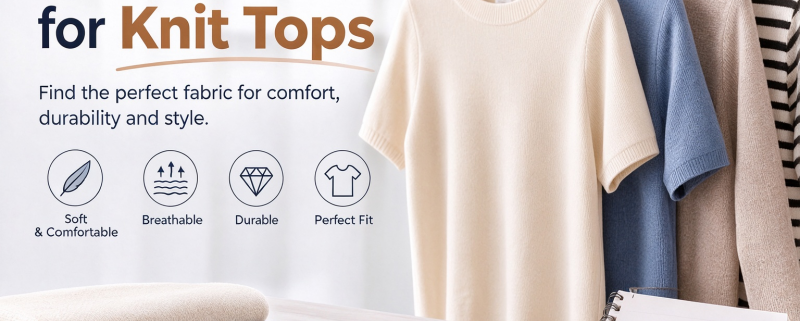
How to Choose the Best Fabric for Knit Tops: A Complete Guide for Clothing Brands
Choosing the best fabric for knit tops is one of the most important decisions when developing a clothing collection. The right fabric determines how a garment feels against the skin, how it fits the body, how well it holds its shape, and how it performs after repeated washing. It also influences production costs, product positioning, and customer satisfaction.
For fashion brands, wholesalers, and private-label businesses, fabric selection involves more than choosing between cotton, polyester, or viscose. You also need to consider knit construction, fabric weight (GSM), stretch and recovery, drape, breathability, durability, and the requirements of your target market.
A lightweight cotton jersey may work perfectly for a summer knit T-shirt, while a fitted ribbed top may require a fabric with better elasticity and recovery. Similarly, a premium-looking oversized knit top needs enough structure to maintain its silhouette without feeling unnecessarily heavy.
So, what is the best fabric for knit tops?
The answer depends on the garment design, intended use, target customer, season, and retail price point. This guide explains how to compare different knit fabrics and make informed material decisions before moving into sampling and bulk production.
1. Understand the Difference Between Fiber Composition and Knit Fabric Construction
Before comparing individual materials, it is important to understand two basic concepts: fiber composition and fabric construction.
They are closely related, but they describe different aspects of a textile.
Fiber composition identifies the materials used to make the yarn, such as cotton, polyester, modal, viscose, or elastane.
Knit construction describes how the yarn is formed into fabric. Common structures include single jersey, rib knit, interlock, and French terry.
For example, cotton can be made into jersey, rib, or interlock fabric. Each construction creates a different appearance, stretch characteristic, thickness, and wearing experience, even when the fiber composition is similar.
This distinction matters when communicating with a clothing manufacturer. Simply requesting 100% cotton fabric does not provide enough information to develop a consistent knit top.
A more complete material specification should include:
- Fiber composition
- Knit construction
- Fabric weight (GSM)
- Fabric width
- Stretch and recovery requirements
- Surface texture and hand feel
- Color and finishing requirements
Understanding these details makes it easier to compare material options and avoid misunderstandings during product development.
2. Compare the Most Popular Fabrics for Knit Tops
Different fibers offer different advantages. The best option depends on what you want the finished garment to achieve.
2.1 Cotton Knit Fabric: Natural Comfort and Everyday Versatility
Cotton is one of the most widely used materials for everyday knit tops because of its soft hand feel, moisture absorption, and versatility.
Cotton knit fabrics are suitable for casual T-shirts, sleeveless tops, polo tops, and relaxed everyday styles.
Main advantages:
- Soft and comfortable against the skin
- Good moisture absorption
- Suitable for everyday wear
- Available in different weights and knit structures
- Works well with many printing and embroidery applications
Potential limitations:
- Can shrink if fabric preparation and garment care are not properly controlled
- May wrinkle more easily than some synthetic blends
- Stretch recovery depends on the knit structure and fiber blend
- Lightweight versions may lack opacity, particularly in light colors
For brands developing casual or summer collections, cotton jersey is often a practical starting point.
Combed cotton is another option for products requiring a smoother yarn surface and a more refined hand feel.
For example, Chengyuan has developed an openwork women’s polo knit top using 100% combed cotton at 220 GSM. The material provides a substantial feel while the openwork construction creates a breathable, textured appearance.
See our custom women’s knit top manufacturing capabilities for more product development options.
2.2 Modal Knit Fabric: Smoothness and Fluid Drape
Modal is a regenerated cellulosic fiber commonly used in soft knit garments.
It is valued for its smooth surface, soft touch, and fluid drape. Compared with a more structured cotton fabric, modal-based knits can create a softer silhouette that follows the body’s movement.
Main advantages:
- Smooth and soft hand feel
- Fluid drape
- Comfortable for garments worn close to the skin
- Suitable for lightweight tops and loungewear
- Can be blended with cotton or elastane
Potential limitations:
- Performance depends on the exact yarn and fabric construction
- Some lightweight modal fabrics may require additional care to maintain their shape
- Pilling and dimensional stability should be evaluated on the actual fabric
- Pricing may vary depending on fiber quality and blend composition
Modal blends are worth considering for premium casualwear, fitted tops, and soft loungewear collections.
When selecting modal, evaluate the finished fabric rather than relying only on the fiber name. A well-developed blend should balance softness, drape, recovery, and durability.
2.3 Viscose Knit Fabric: Soft Drape and an Elegant Appearance
Viscose is another regenerated cellulosic fiber frequently used in fashion knitwear.
It is particularly useful when a design requires a soft, flowing appearance rather than a stiff or structured silhouette.
Main advantages:
- Smooth and soft surface
- Attractive drape
- Comfortable wearing experience
- Suitable for lightweight fashion tops
- Can create an elegant, fluid silhouette
Potential limitations:
- Some constructions can become weaker when wet
- Shrinkage and dimensional stability need attention
- May require more careful washing and drying
- Lightweight versions can be prone to stretching or distortion if poorly constructed
Viscose is often a good option for women’s fashion knit tops, draped silhouettes, and seasonal collections.
For fitted designs, viscose-elastane blends may provide a better balance between softness and stretch. However, the actual recovery performance should always be checked through sampling.
2.4 Polyester Knit Fabric: Durability and Design Flexibility
Polyester is a versatile synthetic fiber used in many types of apparel.
It can be developed into lightweight jersey, textured knits, performance fabrics, and blended materials.
Main advantages:
- Generally good dimensional stability
- Quick drying compared with conventional cotton fabrics
- Good color retention when properly dyed and finished
- Suitable for various printing applications
- Available in a wide range of textures and weights
Potential limitations:
- Moisture absorption is generally lower than cotton
- Some constructions may feel less breathable
- Pilling performance varies according to yarn and fabric quality
- Surface appearance and hand feel depend heavily on finishing
Polyester can be suitable for fashion tops, active-inspired garments, and products requiring easy-care characteristics.
For more comfortable everyday garments, polyester is often blended with cotton, viscose, or other fibers to balance different performance requirements.
2.5 Cotton-Elastane and Other Stretch Blends: Better Fit and Recovery
When a knit top needs to fit closely to the body, elasticity becomes especially important.
Cotton-elastane and viscose-elastane blends are common choices for fitted tops, ribbed garments, and body-hugging silhouettes.
Main advantages:
- Improved stretch
- Better fit around the body
- Greater freedom of movement
- Useful for fitted necklines, sleeves, and body sections
Potential limitations:
- Recovery depends on elastane content, yarn quality, and fabric construction
- Excessive stretching may cause permanent deformation
- Heat and care conditions can affect elastane performance
- Fabric costs and production requirements may increase
Do not assume that a higher elastane percentage automatically produces better quality.
The important question is whether the fabric stretches comfortably and returns close to its original dimensions after the force is removed.

Fiber Material Comparison
3. Choose the Right Knit Structure for Your Garment Design
Fiber composition is only part of the decision. Knit construction also determines how a garment looks and performs.
The following structures are commonly used in knit top development.
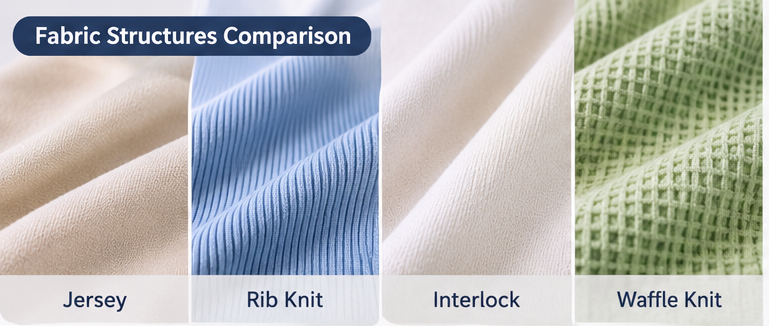
Single Jersey
Single jersey has a relatively smooth face and a different appearance on the reverse side.
It is widely used for T-shirts, lightweight tops, casual garments, and layering pieces.
Best suited for:
- Basic knit T-shirts
- Short-sleeve tops
- Lightweight long-sleeve tops
- Relaxed and oversized styles
Its advantages include versatility, comfortable stretch, and a relatively lightweight construction.
However, single jersey can curl at cut edges and may develop twisting or distortion if knitting, finishing, or garment construction is not properly controlled.
Rib Knit
Rib knit is characterized by alternating raised and recessed vertical columns.
Common constructions include 1×1 rib and 2×2 rib.
The structure provides greater widthwise elasticity, making it useful for close-fitting garments.
Best suited for:
- Fitted sleeveless tops
- Body-hugging knit tops
- Cropped tops
- Neckbands and cuffs
- Stretch-focused fashion styles
Rib knit can create an attractive body-contouring silhouette. However, buyers should evaluate both stretch and recovery rather than selecting a material simply because it feels elastic.
Interlock Knit
Interlock is a double-knit construction with a smoother appearance on both sides.
Compared with many single jersey fabrics, it generally offers a more substantial feel and greater dimensional stability.
Best suited for:
- Premium casual tops
- Structured T-shirts
- Children’s knit garments
- Soft coordinated sets
- Tops requiring a smoother two-sided appearance
Interlock can be a practical choice when the design requires a balance between softness and structure.
Its actual thickness and drape will depend on the yarn, gauge, composition, and finished weight.
French Terry
French terry features a relatively smooth face and looped yarns on the reverse side.
It is generally heavier than lightweight jersey and provides a comfortable, casual appearance.
Best suited for:
- Sweatshirt-style tops
- Casual long-sleeve garments
- Loungewear
- Transitional-season clothing
French terry is particularly useful when a brand wants a relaxed garment with more body than a standard T-shirt.
Waffle Knit and Textured Knits
Waffle knit features a raised, grid-like surface that creates visual depth and texture.
It can be used for casual tops, thermal-inspired garments, and loungewear.
Textured knit structures can help a basic silhouette look more distinctive without relying entirely on printing or decorative accessories.
When choosing waffle or other textured fabrics, check the thickness, surface stability, snagging resistance, and finished garment appearance.
Fabric Structures Comparison
4. Understand GSM: How Fabric Weight Affects Knit Tops
GSM stands for grams per square meter. It measures the weight of a fabric over a standardized area.
For apparel buyers, GSM is an important reference when comparing materials, estimating fabric consumption, and developing a target hand feel.
However, higher GSM does not automatically mean better fabric quality.
A lightweight fabric can be premium if it has suitable yarn quality, construction, finishing, and performance. Likewise, a heavy fabric can still have poor recovery, excessive pilling, or an uncomfortable hand feel.
The following table provides illustrative starting ranges for common knit top applications.
| Fabric application | Indicative GSM range | Typical use |
|---|---|---|
| Lightweight jersey | 120–150 GSM | Summer tops and layering |
| Everyday jersey | 150–190 GSM | Casual T-shirts and basic tops |
| Medium-weight interlock | 180–260 GSM | Premium tops and structured styles |
| Rib knit | 180–280 GSM | Fitted tops and body-hugging designs |
| Textured waffle knit | 200–300 GSM | Casual and seasonal tops |
| French terry | 220–320 GSM | Sweatshirt-style tops and loungewear |
These are general development references, not universal quality standards. Actual ranges vary with fiber composition, gauge, construction, finishing, and market expectations.
How to Select GSM for Different Knit Top Styles
For lightweight summer tops:
Consider lightweight jersey or fine-gauge knits that provide airflow and comfortable drape. Pay particular attention to opacity, especially when developing white, cream, or pastel colors.
For fitted knit tops:
Focus on stretch, recovery, and fabric thickness. Rib structures and suitable elastane blends can help achieve a closer fit.
For oversized knit tops:
A medium-weight fabric may provide enough body to maintain the intended silhouette. However, the fabric should not be so heavy that it loses the relaxed movement of the design.
For premium casual tops:
Interlock and selected medium-weight jersey fabrics can offer a more substantial appearance and smoother surface.
The best way to confirm GSM is to evaluate a physical fabric swatch and then check the finished garment through sampling.
5. Evaluate Five Important Fabric Performance Factors Before Ordering
Two fabrics with identical fiber compositions and GSM can behave very differently after being made into garments.
For this reason, professional fabric selection should consider actual performance rather than specifications alone.
5.1 Stretch and Recovery
Stretch describes how far the fabric can extend when force is applied.
Recovery describes how well it returns toward its original dimensions after the force is removed.
Both properties are important for fitted knit tops.
A fabric with good stretch but poor recovery may gradually lose its shape around the neckline, bust, sleeves, or waist.
Before approving a fabric, check:
- Widthwise stretch
- Lengthwise stretch
- Recovery after repeated stretching
- Neckline stability
- Shape retention after washing
For a practical preliminary check, mark a measured section of fabric, stretch it comfortably, record the extended length, and then observe how closely it returns to its original measurement.
For commercial production, use an agreed test method and acceptance criteria.

Knit fabric stretch and recovery testing
5.2 Breathability and Moisture Management
Breathability influences how comfortable a garment feels during daily wear.
Cotton and many cellulosic fibers absorb moisture, while polyester can offer faster drying depending on its yarn and fabric construction.
However, fiber composition alone does not determine the entire wearing experience.
Fabric density, thickness, finishing, and garment design also influence airflow and moisture behavior.
For summer knit tops, consider lightweight structures and avoid unnecessary fabric density.
For active-inspired styles, evaluate moisture management on the actual finished fabric rather than assuming all polyester knits have the same performance.
5.3 Drape and Hand Feel
Drape describes how fabric falls and moves when worn.
Hand feel describes the sensation of touching the fabric.
These qualities are particularly important for fashion-oriented knit tops.
For example:
- Cotton jersey often creates a casual, everyday appearance.
- Modal jersey can provide a softer, more fluid drape.
- Rib knit creates a closer-fitting silhouette.
- Interlock can offer a smoother and more substantial appearance.
- Textured waffle fabric creates additional visual depth.
When comparing fabric samples, evaluate them both flat and on a body or dress form.
A fabric that feels attractive as a small swatch may behave differently when used across the full garment.
5.4 Shrinkage and Dimensional Stability
Shrinkage can change the finished garment’s body length, chest width, sleeve length, and overall fit.
This is especially important when producing multiple sizes and colors.
Before bulk production, evaluate:
- Lengthwise shrinkage
- Widthwise shrinkage
- Fabric spirality or skewing
- Seam appearance after washing
- Garment measurements after laundering
The acceptance limits should be agreed according to the garment type, buyer requirements, and relevant testing method.
Fabric relaxation, appropriate finishing, and controlled production conditions can help reduce dimensional variation.
5.5 Pilling and Surface Durability
Pilling occurs when loose fibers form small balls on the fabric surface through friction.
It can affect the perceived quality of a knit top, particularly in areas that experience repeated rubbing.
Pilling resistance depends on several factors, including:
- Fiber length and quality
- Yarn structure
- Fabric construction
- Surface finishing
- Blended fiber composition
If your brand targets a premium retail market, consider specifying an appropriate pilling test requirement before approving the material.
6. Match Fabric to the Intended Knit Top Style
One of the most effective ways to choose fabric is to start with the garment design rather than selecting a fiber first.
The following comparison provides a practical starting point for product development.
| Knit top style | Fabric options to consider | Main selection priority |
|---|---|---|
| Basic knit T-shirt | Cotton jersey, cotton-polyester jersey | Comfort, opacity, durability |
| Fitted ribbed top | Cotton-elastane rib, viscose-elastane rib | Stretch and recovery |
| Sleeveless knit top | Jersey, rib, interlock | Comfort and neckline stability |
| Oversized knit top | Medium-weight jersey, interlock | Drape and silhouette |
| Premium casual top | Interlock, combed cotton jersey | Smoothness and structure |
| Summer fashion top | Lightweight cotton, viscose blends, pointelle knits | Breathability and appearance |
| Loungewear top | Modal blends, cotton jersey, soft interlock | Softness and comfort |
| Textured fashion top | Waffle, rib, pointelle, jacquard knits | Texture and dimensional stability |
The table is a starting point rather than a fixed rule. The final choice should be confirmed against the specific pattern, target fit, color, and intended wearing conditions.
For example, a fitted ribbed top and an oversized cotton T-shirt may both be classified as knit tops, but they require different material performance.
Brands developing a complete collection should also consider coordinating fabric choices across related styles.
You can explore our women’s knit T-shirt manufacturing and men’s knit T-shirt manufacturing pages for examples of different product development requirements.
7. Consider Fabric Cost and Your Target Retail Market
Fabric selection also affects the commercial performance of a clothing collection.
The lowest fabric price does not necessarily create the lowest overall product cost.
A material that requires additional finishing, creates higher cutting waste, or produces inconsistent results may increase the final manufacturing cost.
When comparing fabric quotations, consider:
Fiber composition: Different fibers and blends have different raw material costs and supply conditions.
Fabric weight: Higher GSM generally requires more material weight per garment, although consumption also depends on fabric width, pattern layout, and garment dimensions.
Fabric construction: Different knitting structures may require different production processes and finishing treatments.
Dyeing and finishing: Custom colors, special surface treatments, and additional finishing can influence cost and lead time.
Order quantity: Fabric availability and minimum order requirements may affect the feasibility of smaller production runs.
Quality requirements: Additional testing, tighter dimensional tolerances, and more demanding performance specifications may influence the total development cost.
For new fashion brands, it is often sensible to develop a commercially balanced fabric specification rather than choosing the most expensive material immediately.
A practical approach is to compare two or three suitable fabric options based on hand feel, performance, appearance, and estimated garment cost before approving the final material.
8. How to Avoid Fabric Problems Between Sampling and Bulk Production
One of the most important stages in knit top manufacturing is maintaining consistency between the approved sample and the final bulk order.
A sample may look and feel correct, but bulk production can produce unexpected differences if fabric specifications are not clearly documented.
Common problems include:
- Changes in fabric weight
- Differences in hand feel
- Color variation between dye lots
- Unexpected shrinkage
- Inconsistent stretch and recovery
- Pilling or surface defects
- Different fabric widths affecting garment consumption
To reduce these risks, establish a clear fabric approval process.
Step 1: Confirm the material specification.
Record the agreed fiber composition, construction, GSM, color, and other relevant characteristics.
Step 2: Evaluate physical swatches.
Compare the appearance, hand feel, thickness, stretch, and recovery of available fabric options.
Step 3: Develop a garment sample.
Evaluate the actual fabric in the intended design, because the final garment may behave differently from a flat swatch.
Step 4: Conduct fit and performance checks.
Review garment measurements, silhouette, neckline, sleeve shape, shrinkage, and surface appearance.
Step 5: Approve the reference sample.
Keep the approved fabric and finished garment as references for bulk production.
Step 6: Inspect bulk materials and finished garments.
Check incoming fabric against the approved specifications and conduct production inspections to identify deviations.
This process is particularly important for brands planning repeat orders or launching multiple colors within one collection.
9. What Information Should You Send to a Knit Top Manufacturer?
You do not necessarily need a complete professional tech pack before discussing fabric development with a garment manufacturer.
However, providing clear information helps the factory recommend more suitable materials and prepare a more accurate quotation.
Here is a practical checklist for apparel buyers.
Basic product information
- Product type: T-shirt, fitted top, sleeveless top, polo top, or other style
- Target customer: Women, men, or children
- Intended season: Spring, summer, autumn, or winter
- Target market and retail positioning
- Estimated order quantity
Fabric requirements
- Preferred fiber composition
- Knit structure
- Target GSM or weight range
- Desired softness and hand feel
- Stretch and recovery requirements
- Preferred color
- Special finishing or surface texture
Garment requirements
- Reference design or technical drawing
- Fit and silhouette
- Size range and measurement chart
- Neckline and sleeve details
- Printing or embroidery requirements
- Logo and private-label details
If you are still developing your design, reference photos, sample garments, or simple measurement notes can also be useful starting points.
Working with an experienced OEM and ODM clothing manufacturer can help simplify communication between material selection, pattern development, sampling, and bulk production.
10. How Chengyuan Garment Supports Custom Knit Top Fabric Development
Choosing the right fabric is only the beginning of successful knit top development. The material must also work with the garment pattern, fit requirements, construction details, production process, and target retail market.
Qingdao Chengyuan Garment Co., Ltd is an integrated clothing manufacturer based in Qingdao, China, providing OEM and ODM manufacturing solutions for fashion brands, wholesalers, retailers, and private-label businesses.
We support customers throughout the product development process, from initial design communication and material selection to sample development, revisions, bulk production, quality inspection, and packaging.
Flexible Fabric and Product Customization
We support customization of fabric composition, fabric weight, color, fit, patterns, trims, printing, embroidery, logos, labels, and packaging.
Material recommendations can be discussed according to your product design, target market, required hand feel, and budget.
In-House Design Team and Independent Sample Room
Our design team and sample room support the development process from initial ideas to physical samples.
You can provide a complete tech pack, sketch, reference photo, existing sample garment, or simple measurement notes.
We can assist with pattern making, sampling, fit adjustments, and revisions before bulk production.
Flexible MOQ for Startups and Established Brands
We support both small trial orders and larger bulk production programs.
This gives startup brands, boutique labels, and established fashion companies greater flexibility when testing new knit top designs and expanding successful collections.
Stable Production Capacity
With standardized workshops, dedicated production lines, and advanced cutting, sewing, pressing, and printing equipment, our monthly production capacity reaches approximately 80,000–120,000 pieces.
We can support different order volumes and ongoing repeat production requirements.
Quality Control from Sampling to Bulk Production
We establish material, accessory, workmanship, and measurement requirements during the sampling stage.
Bulk production follows the approved sample and confirmed specifications, with quality checks throughout the manufacturing process.
Whether you are developing basic cotton knit T-shirts, fitted ribbed tops, lightweight fashion styles, or coordinated collections, our team can help turn your product requirements into finished garments.
Explore our women’s knit top collection and men’s knit top collection to learn more about our manufacturing capabilities.
You can also view our women’s sweater manufacturing solutions for additional knitwear development options.
11. Frequently Asked Questions About Choosing Fabric for Knit Tops
What is the best fabric for knit tops?
There is no single best fabric for every knit top. Cotton jersey is a versatile option for everyday tops, modal and viscose blends offer soft drape, polyester provides design flexibility and easy-care characteristics, while rib fabrics with suitable elastane content can work well for fitted styles. The best choice depends on the garment design, season, target customer, and performance requirements.
Is cotton or polyester better for knit tops?
Cotton is often preferred for its natural hand feel and moisture absorption. Polyester is valued for its quick-drying characteristics, color performance, and versatility. Cotton-polyester blends can provide a balance of different properties. The right option depends on the intended use and target price point.
What GSM is best for knit tops?
The suitable GSM depends on the fabric construction and garment style. Lightweight jersey may work for summer tops, while medium-weight jersey or interlock may be more suitable for structured everyday styles. Rib and textured knits can require different weight ranges. GSM should always be evaluated together with opacity, drape, stretch, and hand feel.
Is rib knit suitable for fitted tops?
Yes. Rib knit is widely used for fitted tops because its structure provides good widthwise stretch. However, stretch alone is not enough. Recovery, fabric stability, and the garment’s pattern must also be considered to maintain a comfortable and consistent fit.
What is the difference between jersey and interlock?
Single jersey is generally lighter and has a different appearance on its face and reverse side. Interlock is a double-knit construction with a smoother appearance on both sides and generally greater dimensional stability. Jersey is commonly used for casual T-shirts, while interlock can be useful for more substantial and structured tops.
How can I prevent knit tops from shrinking?
Shrinkage can be managed through suitable fabric preparation, finishing, material selection, and garment testing. Before bulk production, evaluate the fabric and finished garment after washing. Agree on acceptable dimensional changes and follow the appropriate care instructions.
Can I customize the fabric for private-label knit tops?
Yes. Custom knit top development can include fiber composition, knit construction, GSM, color, texture, stretch, and other fabric requirements. Buyers can provide a tech pack, reference sample, or design concept to begin the development process.
Can I order knit top samples before bulk production?
Yes. Sampling is recommended before mass production. It allows you to evaluate fabric hand feel, garment fit, measurements, color, workmanship, and other specifications. Revisions can be discussed before approving the final production sample.
12. Start Developing Your Custom Knit Top Collection
The best fabric for knit tops is not necessarily the most expensive or the softest material. It is the fabric that matches your garment design, target customer, performance requirements, and commercial positioning.
By considering fiber composition, knit construction, GSM, stretch and recovery, breathability, durability, and production consistency, you can make better sourcing decisions and reduce development risks.
If you are planning a new knit top collection, Qingdao Chengyuan Garment Co., Ltd can support your project from material discussions and sample development to customized OEM/ODM manufacturing.
You can send us your design sketches, reference photos, tech packs, or initial product ideas. Our team will help you evaluate suitable development options based on your requirements.
Ready to develop your custom knit tops?
Contact Chengyuan Garment to discuss your fabric requirements, request a sample, or get a customized manufacturing quotation.
Let’s turn your knit top ideas into production-ready garments.


Leave a Reply
Want to join the discussion?Feel free to contribute!