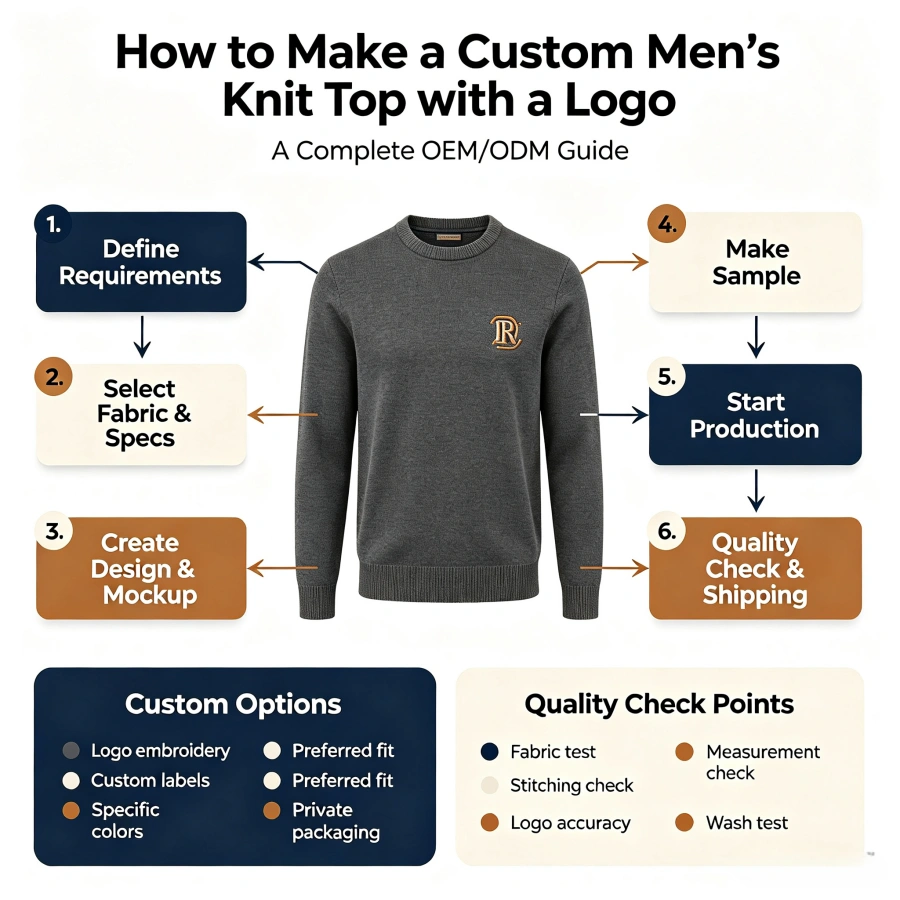
How to Make a Custom Men’s Knit Top with a Logo: A Complete OEM/ODM Guide
A custom men’s knit top with a logo is more than a basic garment with a brand name added to the chest. For clothing brands, retailers, wholesalers, and private-label businesses, successful customization requires the right combination of fabric, knit structure, garment fit, logo application, and production quality.
A logo that looks attractive on a design mockup may not work well on a real knitted garment. Heavy embroidery can make lightweight fabric stiff. Heat transfers may lose adhesion when applied to an unsuitable surface. An incorrectly positioned logo can distort when the garment stretches or changes shape after washing.
So, how do you make a custom men’s knit top with a logo that looks professional, feels comfortable, and can be reproduced consistently in bulk?
This guide explains the complete OEM/ODM development process, including product selection, fabric and knit construction, logo application methods, artwork preparation, placement, sampling, quality control, costs, and supplier selection.
Whether you are developing branded knit T-shirts, knitted polo shirts, casual tops, or fine-gauge knitwear, these practical steps will help you turn an initial design into a production-ready product.
1. Define the Type of Men’s Knit Top You Want to Customize
Before selecting a logo method or contacting a manufacturer, decide what kind of knit top you want to produce.
The term “men’s knit top” covers several garment categories. Each has different fabric characteristics, construction requirements, and branding considerations.
Men’s Knit T-Shirts
Men’s knit T-shirts are usually made from knitted jersey fabrics. They are suitable for casualwear, promotional apparel, lifestyle brands, and everyday fashion collections.
Common fabric options include cotton jersey, cotton-polyester blends, polyester jersey, and other knitted fabrics.
For logo customization, common choices include:
- Small chest embroidery
- Screen-printed graphics
- Heat-transfer logos
- Woven labels near the hem
- Printed or transferred neck branding
A knit T-shirt is often a practical starting point for brands developing their first custom men’s apparel collection.
Explore Chengyuan’s custom men’s knit T-shirt collection for a product-specific reference.
Men’s Knit Polo Shirts
Knit polo shirts are commonly associated with smart-casual clothing, corporate apparel, sports-inspired fashion, and lifestyle collections.
Their design details may include:
- Knitted or fabric polo collars
- Button or zip plackets
- Ribbed cuffs
- Contrast collar and sleeve details
- Chest embroidery or woven patches
A small embroidered chest logo is a familiar branding direction for polo shirts. However, the fabric construction and stretch should be evaluated before choosing embroidery density and backing.
For additional product inspiration, see Chengyuan’s custom men’s knit polo collection.
Men’s Fine-Gauge Knit Tops
Fine-gauge knit tops can offer a more refined appearance than ordinary jersey T-shirts. They are suitable for smart-casual collections, premium basics, and seasonal knitwear.
Depending on the structure, a logo can be added through embroidery, a small woven label, a printed detail, or an integrated knitted design.
For lightweight or delicate knit constructions, logo weight and needle penetration should be considered carefully.
Men’s Casual and Seasonal Knitwear
Some brands use the term knit top for a wider range of products, including long-sleeve tops, lightweight sweaters, and casual knitted pullovers.
For these products, the logo can become part of the knit design itself, rather than simply being added to the surface.
You can also review Chengyuan’s men’s sweater collection and men’s pullover sweater range for additional development directions.
2. Choose the Right Fabric and Knit Structure
Fabric selection is one of the most important decisions in custom men’s knit top manufacturing.
The same logo can look very different on a smooth cotton jersey, a textured pique fabric, or a lightweight fine-gauge knitted garment.
The fabric affects logo visibility, embroidery stability, print adhesion, stretch, garment weight, comfort, and durability.
Common Fabric Options for Custom Men’s Knit Tops
| Fabric Type | General Characteristics | Suitable Applications | Branding Considerations |
|---|---|---|---|
| Cotton Jersey | Soft, breathable, and versatile | Basic knit T-shirts | Suitable for several print and embroidery options depending on weight and stability |
| Cotton-Polyester Jersey | Combines cotton-like comfort with polyester properties | Everyday branded tops | Test print appearance and color behavior |
| Polyester Knit | Lightweight and available in different performance constructions | Sports-inspired and promotional tops | Confirm compatibility with transfer and printing processes |
| Cotton Pique | Textured surface with a recognizable polo appearance | Men’s knit polo shirts | Suitable for carefully controlled embroidery or other compatible branding |
| Interlock Knit | Smooth, stable double-knit structure | Premium basic tops | Can provide a more even surface for selected logo methods |
| Rib Knit | Elastic structure with visible ribs | Neckbands, cuffs, fitted tops | Logo application needs to account for stretch and recovery |
| Fine-Gauge Knit | Lightweight and refined appearance | Smart-casual knit tops | Avoid unnecessary logo weight and excessive embroidery density |
| Textured Knit | Decorative surface and varied stitch appearance | Fashion knitwear | Logo position should be selected to avoid interfering with the texture |
These are general material characteristics. Actual performance depends on fiber composition, fabric weight, knitting construction, finishing, and the specific branding process.
Why Fabric Weight Matters
Fabric weight affects both garment quality and branding performance.
A very lightweight knit may be comfortable for warm-weather use, but a dense embroidered logo can create unwanted stiffness or puckering.
A heavier or more stable fabric may support a larger embroidered design, but that does not mean embroidery is automatically the best solution for every product.
When discussing fabric with a manufacturer, confirm:
- Fiber composition
- Fabric weight in GSM
- Knit construction
- Stretch and recovery
- Surface texture
- Intended washing method
- Whether the selected fabric is compatible with the proposed logo technique
Do not choose fabric and logo method independently. They should be developed together.

3. Choose the Best Logo Application Method
One of the most important questions in custom branded knitwear is how to apply the logo.
There is no single best method for every men’s knit top. The right choice depends on the logo artwork, fabric structure, garment weight, order quantity, target retail positioning, and expected washing performance.
1. Embroidery
Embroidery uses thread to stitch a logo directly onto the garment.
It creates a raised, textured appearance and is commonly used for brand symbols, initials, small text, and chest logos.
Advantages:
- Creates a recognizable premium appearance.
- Suitable for simple logos and solid-color artwork.
- Offers durable branding when correctly applied.
- Works well with many stable polo and knit fabrics.
Potential limitations:
- Dense stitching can make lightweight fabric stiff.
- Excessive thread tension may cause puckering.
- Very small text and intricate gradients may not reproduce clearly.
- Large embroidery can add unnecessary weight.
For lightweight knit tops, ask the manufacturer to evaluate embroidery density, backing, stitch direction, and thread tension.
2. Screen Printing
Screen printing applies ink to the garment through a prepared screen.
It is commonly used for larger graphics, bold logos, lettering, and designs with a limited number of colors.
Advantages:
- Suitable for larger graphic designs.
- Can provide a relatively flat surface.
- Can be economical for suitable higher-volume orders.
- Supports a wide range of ink and color options.
Potential limitations:
- Screen preparation and setup may increase costs for complex artwork.
- Large printed areas can influence garment hand feel.
- Poorly matched ink or application conditions may affect stretch and washing performance.
Screen printing is often worth considering for basic jersey knit T-shirts with larger brand graphics.
3. Heat Transfer Printing
Heat transfer applies a prepared logo to the garment using heat and pressure.
Depending on the transfer technology, it can reproduce detailed graphics, multiple colors, and smaller designs without requiring conventional screen setup for each color.
Advantages:
- Useful for detailed or multi-color artwork.
- Suitable for certain smaller production runs.
- Can support intricate logo shapes and fine graphic details.
- Provides flexibility for different branding layouts.
Potential limitations:
- Adhesion depends on the fabric and transfer material.
- Excessive heat may damage sensitive fabrics.
- Some transfers can crack, lift, or lose appearance if not correctly applied.
- Stretch compatibility must be checked before approval.
For stretch knit fabrics, the transfer should be tested under the intended washing and wearing conditions.
Screenshot
4. Woven Labels and Sewn Patches
A woven logo label or patch is manufactured separately and then sewn onto the garment.
This method is particularly useful when the brand wants a clean identity without applying a large logo directly to the knit surface.
Common placements include:
- Lower side seam
- Bottom hem
- Back neck
- Sleeve
- Chest pocket area
Advantages:
- Suitable for many different garment constructions.
- Can provide detailed woven branding.
- Avoids some of the direct surface limitations of printing.
- Can become a recognizable brand signature.
Potential limitations:
- Poor placement can irritate the skin.
- A thick patch may feel uncomfortable on lightweight clothing.
- Edges and stitching must be finished properly.
5. Jacquard or Intarsia Logo Knitting
For certain fully fashioned or knitwear products, a logo can be integrated into the knitted structure.
Jacquard and intarsia are two possible approaches, depending on the artwork, knitting equipment, and construction.
Advantages:
- The logo becomes part of the knitted design.
- Can create a distinctive premium appearance.
- May be suitable for coordinated knitwear collections.
- Avoids treating the logo as a separate printed decoration.
Potential limitations:
- Not suitable for every logo design.
- Detailed artwork may need to be simplified.
- Multiple yarn colors can increase development complexity.
- The design must be evaluated together with gauge and stitch structure.
This method is worth discussing when developing branded sweaters, knitted polos, or fashion-focused men’s knit tops.
Logo Method Comparison
| Logo Method | Best Suited For | Main Advantage | Important Risk to Check |
|---|---|---|---|
| Embroidery | Small logos, crests, simple symbols | Raised and premium appearance | Puckering, stiffness, and excessive density |
| Screen Printing | Larger graphics and simple color artwork | Flat design and bulk suitability | Stretch, cracking, and print hand feel |
| Heat Transfer | Detailed and multi-color graphics | Artwork flexibility | Adhesion and wash durability |
| Woven Label | Brand names and small identity details | Clean and consistent branding | Comfort and label edge finishing |
| Sewn Patch | Badges and distinctive brand marks | Separate design element | Patch weight and stitching quality |
| Jacquard/Intarsia | Selected knitwear designs | Integrated knitted logo | Pattern complexity and production capability |
A good manufacturer should explain not only which methods are available, but also which method is suitable for your exact fabric and design.
4. How to Design a Logo for a Men’s Knit Top
Before production, prepare a logo that can be accurately reproduced.
A logo designed for a website or business card may not work well as embroidery or knitted artwork. Fine details, narrow lines, small text, and complicated gradients can be difficult to reproduce on a garment.
Prepare the Correct Artwork File
For a custom clothing project, provide the clearest artwork file available.
Preferred formats include:
- AI
- EPS
- SVG
- Editable PDF
- High-resolution PNG for reference when vector artwork is unavailable
Vector artwork is particularly helpful because it can be resized without losing sharpness.
If your logo uses specific brand colors, provide Pantone references or other agreed color standards where applicable. For embroidery, also confirm the thread colors, because thread appearance can differ from colors displayed on a monitor.
Simplify Artwork When Necessary
A small chest logo may require a different artwork version from a large back graphic.
For example, a brand symbol with several tiny letters may need to be simplified when converted into embroidery. Fine lines can become too close together, and very small text may lose readability.
Ask for a production-ready version of the logo rather than assuming the original graphic can be reproduced at every size.
Confirm Logo Dimensions
Specify the actual finished logo dimensions.
Do not rely only on instructions such as “small logo” or “medium logo.”
Your artwork specification should include:
- Finished width and height
- Logo proportion
- Color references
- Background or transparent areas
- Minimum text size where applicable
- Required spacing around the design
A physical logo sample or strike-off is useful for evaluating the actual appearance before approving bulk production.
5. Select the Right Logo Position
Logo placement influences both visual balance and brand recognition.
The best position depends on the garment style, logo dimensions, design direction, and intended customer.
Common Logo Placement Options
| Placement | Typical Application | Design Consideration |
|---|---|---|
| Left Chest | Knit polos and casual tops | Traditional and recognizable brand placement |
| Center Chest | Knit T-shirts and fashion tops | Works for larger logo designs |
| Right Chest | Minimalist or coordinated branding | Useful for selected asymmetric layouts |
| Sleeve | Small symbols, text, or badges | Needs to avoid uncomfortable sleeve seams |
| Back Neck | Small brand marks | Suitable for subtle branding |
| Lower Hem | Woven labels or small logos | Creates understated brand identification |
| Back Panel | Larger brand graphics | Consider graphic scale and garment movement |
How to Specify Logo Placement Correctly
A complete logo placement instruction should include more than a photograph.
Use a technical drawing showing the placement relative to specific garment reference points.
For example, a left-chest logo specification could identify:
- Horizontal distance from the center front
- Vertical distance from a defined shoulder or neckline reference point
- Finished logo width and height
- Orientation
- Color and application method
The exact dimensions should be agreed for each product and size range.
This matters because the same distance from the neckline may look different on a small size and a much larger size.
For bulk production, confirm whether the logo position follows a fixed measurement or is adjusted proportionally across sizes.
6. Prepare a Complete Tech Pack for Your Custom Men’s Knit Top
A tech pack translates your design into production instructions.
Without a clear technical package, a manufacturer may misunderstand your fabric, logo dimensions, placement, measurements, or finishing requirements.
A men’s knit top tech pack with a logo should include:
| Tech Pack Section | Required Information |
|---|---|
| Product Overview | Style name, style number, season, and target customer |
| Technical Drawings | Front, back, side, and detail views |
| Fabric Specification | Fiber composition, GSM, knit structure, and color |
| Fit and Measurements | Chest, shoulder, body length, sleeve length, and other POMs |
| Construction | Neckline, cuffs, hem, seams, placket, and other details |
| Logo Artwork | Original logo file and production-ready version |
| Logo Application | Embroidery, printing, transfer, patch, or knitted logo |
| Logo Placement | Position, width, height, orientation, and reference points |
| Branding Colors | Pantone references or approved thread colors |
| Labels | Main label, care label, size label, and other branding |
| Trims | Buttons, zippers, patches, and accessories |
| Finishing | Washing, steaming, pressing, and care requirements |
| Packaging | Folding, hangtags, polybags, barcodes, and carton requirements |
| Quality Requirements | Measurement tolerances, appearance standards, and testing criteria |
What If You Do Not Have a Complete Tech Pack?
You can start a project with a sketch, reference photograph, existing garment, logo file, or a basic description of your product concept.
For example, you could provide:
- A photograph of a men’s knit polo
- Your company logo in vector format
- A preferred fabric composition
- A size chart
- A reference showing the logo location
The manufacturer can then help clarify the missing technical details before sampling.
However, all important specifications should be documented before bulk production.
7. Develop and Test a Logo Sample Before Bulk Production
One of the most common mistakes in branded clothing development is approving a logo based only on a digital design or an image of an existing garment.
A digital mockup cannot show how the logo will interact with the actual knit fabric.
For better results, develop and review the logo on the intended material.
Step 1: Test the Logo on the Actual Fabric
Request a logo sample or strike-off using the same fabric or a representative production material.
This is especially important for:
- Lightweight jersey
- Stretch knit fabrics
- Fine-gauge knitwear
- Textured fabrics
- Ribbed constructions
An embroidery sample on heavy cotton fabric does not necessarily predict its performance on a lightweight stretch knit.
Step 2: Evaluate Appearance and Hand Feel
Review the logo from different distances and angles.
Check whether the logo is clear, centered, correctly sized, and visually balanced.
Also feel the area from both sides of the garment. A logo should not create an uncomfortable hard or bulky patch on a lightweight top.
Step 3: Check Stretch and Recovery
For stretch knit products, gently stretch the logo area according to the intended wearing conditions.
Check whether the surrounding fabric distorts, the logo cracks, the transfer edges lift, or embroidery causes excessive puckering.
Step 4: Conduct Washing Tests
Follow the agreed care instructions and evaluate the garment after washing.
Check for:
- Logo peeling or lifting
- Thread loosening
- Print cracking
- Color fading or transfer
- Fabric distortion around the logo
- Changes in logo dimensions
- Shrinkage or twisting of the garment
The test method should match the intended product use and care label instructions.
Step 5: Approve the Final Reference
Once the buyer approves the sample, retain a clear production reference.
The approved sample should include the correct fabric, logo artwork, dimensions, placement, construction, and finishing.
Document and confirm any changes after approval before bulk production.
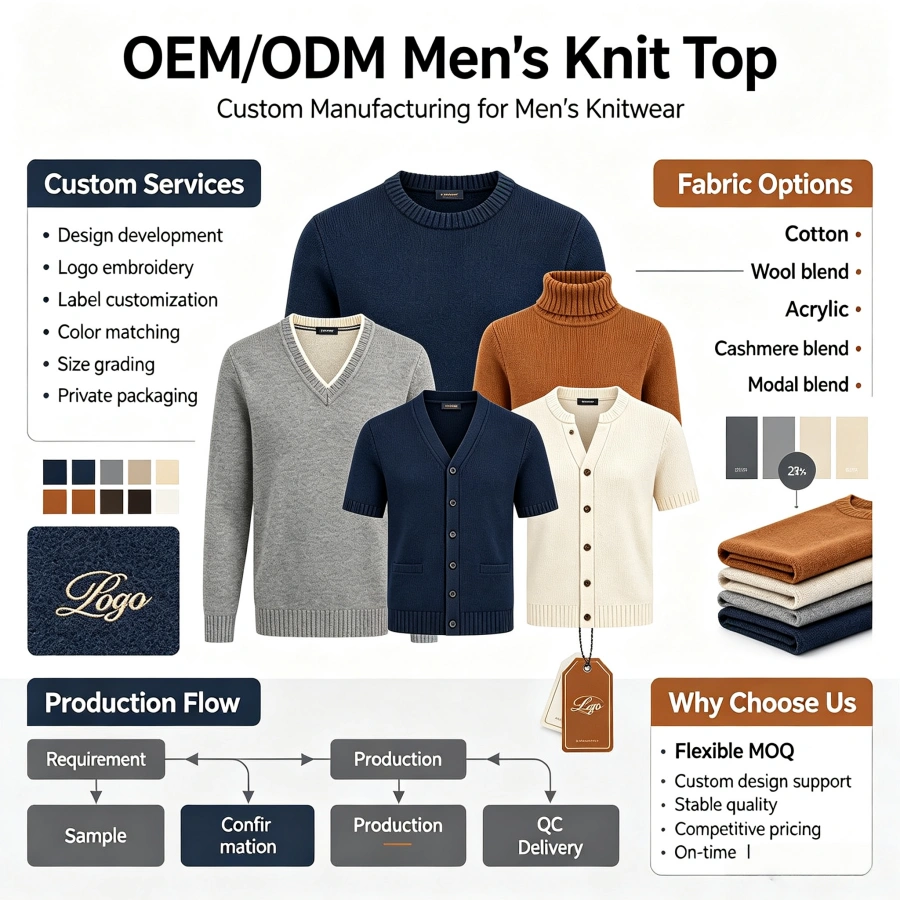
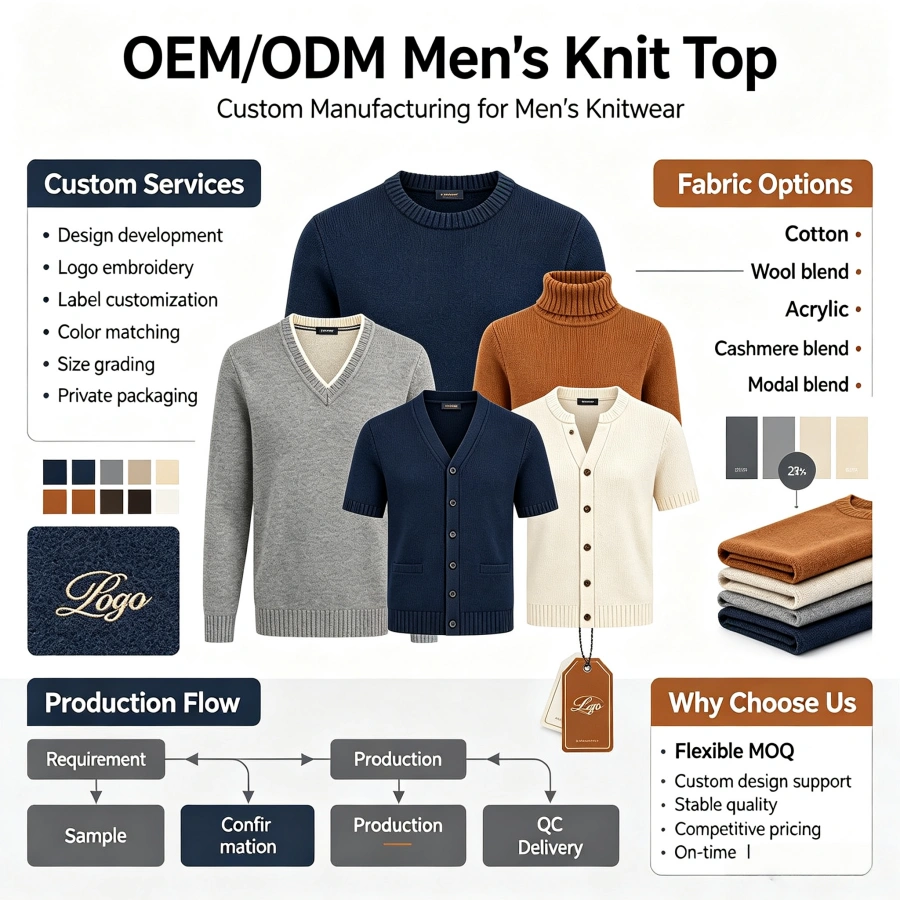
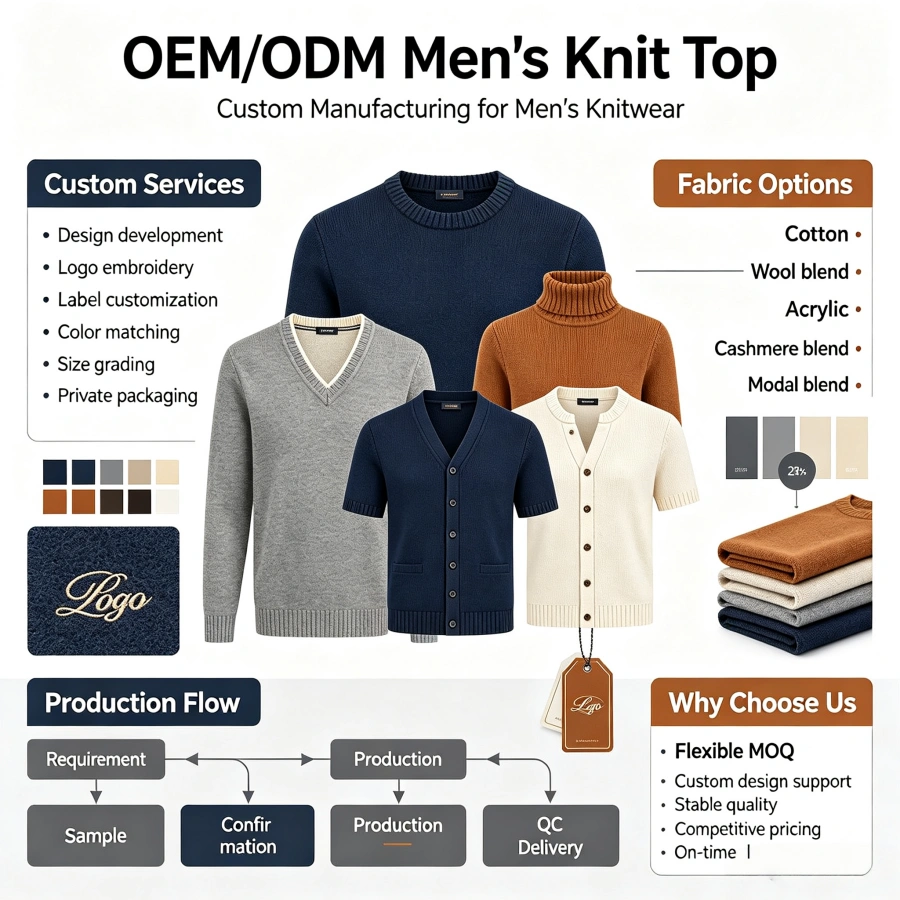
8. The OEM/ODM Manufacturing Process for Custom Men’s Knit Tops with Logos
A structured production process helps reduce communication errors and improves consistency between the approved sample and the finished order.
The exact manufacturing route depends on whether the product uses knitted fabric that is cut and sewn or knitted panels that are joined through linking or other assembly methods.
Step 1: Design and Requirement Review
The buyer provides the design, logo, size range, fabric preferences, estimated order quantity, and target market.
The manufacturer reviews the product and identifies important technical decisions.
These may include fabric sourcing, knit construction, logo method, branding position, trims, and packaging.
Step 2: Fabric and Color Confirmation
The required fabric and colors are selected or developed.
Confirm fiber composition, fabric weight, surface appearance, stretch, and color references.
If the garment uses a custom color, approve the relevant material or color sample before bulk sourcing.
Step 3: Logo Artwork and Application Development
Review the logo for size, detail, color, and application method.
For embroidery, the artwork may require digitizing. For printing or transfer, confirm the compatible process and color requirements.
For integrated knitted logos, confirm whether the pattern and construction can be produced with the selected knitting method.
Step 4: Pattern Making and Sample Production
The manufacturer develops the garment pattern and produces a sample.
The sample should include the selected fabric, correct fit, logo method, branding position, and relevant trims.
Step 5: Sample Review and Revision
Review the garment’s fit, dimensions, color, construction, and logo appearance.
Provide measurable comments instead of general instructions.
For example, rather than saying “move the logo slightly higher,” provide the required revised distance from the specified reference point.
Step 6: Pre-Production Approval
Before bulk manufacturing, confirm:
- Approved garment sample
- Fabric composition and color
- Size chart and grading
- Logo artwork and application method
- Logo dimensions and placement
- Labels and trims
- Finishing and washing requirements
- Packaging specifications
- Final quality requirements
The approved reference should be accessible to the production and inspection teams.
Step 7: Bulk Production and In-Process Quality Checks
Production proceeds according to the confirmed construction route.
Depending on the product, operations may include fabric preparation, cutting, knitting, sewing or linking, logo application, finishing, measurement checking, and packaging.
Quality checks should be carried out at appropriate stages rather than waiting until the entire order is finished.
Step 8: Final Inspection and Shipment Preparation
The finished garments are checked against the approved sample and specifications.
Confirm garment dimensions, logo appearance, workmanship, colors, labels, packaging, and the agreed acceptance criteria before shipment.
9. Quality Control Checklist for Custom Men’s Knit Tops with Logos
A branded knit top has two connected quality requirements: the garment itself and the branding applied to it.
A product may have good fabric and clean sewing but still fail commercially if the logo is crooked, damaged, poorly positioned, or uncomfortable.
Use the following checklist when evaluating samples and bulk orders.
| Quality Item | What to Inspect | Common Problems |
|---|---|---|
| Fabric | Composition, weight, texture, and color | Incorrect fabric or shade variation |
| Garment Measurements | Chest, shoulder, sleeve, and body length | Inconsistent sizing |
| Knit Structure | Surface and stitch consistency | Holes, uneven stitches, or visible defects |
| Neckline | Shape, elasticity, and finishing | Distortion or loose construction |
| Seams | Stitching and seam appearance | Skipped stitches or uneven seams |
| Logo Position | Distance from defined reference points | Crooked or inconsistent placement |
| Logo Size | Width, height, and proportion | Incorrect scaling |
| Embroidery | Thread tension, density, and backing | Puckering or loose threads |
| Printing | Color, edges, adhesion, and hand feel | Cracking or uneven coverage |
| Heat Transfer | Edge adhesion and flexibility | Peeling or lifting |
| Woven Label | Attachment and comfort | Loose edges or irritating placement |
| Washing Performance | Appearance after agreed care process | Shrinkage, fading, or logo damage |
| Packaging | Folding, labels, and size sorting | Wrong labels or packing errors |
Pay Special Attention to Logo Puckering
Puckering is one of the most important issues to check when embroidering knitted garments.
It can occur when the fabric moves during stitching, the embroidery tension is unsuitable, or the design density is too high for the material.
Possible preventive measures include:
- Selecting a more suitable embroidery design
- Adjusting stitch density and direction
- Using appropriate stabilizing materials
- Testing on the actual garment fabric
- Reviewing the result after finishing
The correct solution depends on the garment construction and embroidery process.
Check Color Consistency Between Fabric and Logo
A logo may use a brand color that is difficult to reproduce exactly with embroidery thread, printing ink, or transfer materials.
Confirm the acceptable color reference with the manufacturer before production.
For multi-color branding, approve a physical sample rather than relying only on a screen image.
Keep the Bulk Order Consistent with the Approved Sample
Use the approved sample as a reference for both garment construction and branding.
When bulk production starts, confirm that the actual fabric, logo dimensions, placement, and application process match the approved version.
This is particularly important for repeat orders, where seemingly small material or process changes can create a visibly different product.
10. What Affects the Cost of Custom Men’s Knit Tops with Logos?
The unit price depends on the complete product specification, not just the logo.
Two garments with the same logo can have very different costs because of their fabric, construction, size, quantity, and finishing requirements.
Main Cost Factors
1. Fabric and Material
Fiber composition, fabric weight, fabric quality, and special finishes can all influence the garment cost.
2. Garment Construction
A basic jersey knit T-shirt generally has different production requirements from a textured knit polo or a fully fashioned knit top.
3. Logo Application Method
Embroidery costs may depend on design dimensions, stitch count, and thread colors.
Screen printing may involve setup costs related to the artwork and number of colors.
Heat transfer costs depend on the transfer process, artwork, size, and quantity.
Woven labels and sewn patches have their own development and attachment costs.
4. Logo Size and Position
A small left-chest logo may require less material and application time than a large front or back design.
Multiple logo positions can also increase production complexity.
5. Order Quantity and Color Breakdown
Total quantity, number of styles, colors, and sizes can affect material sourcing, production planning, and setup costs.
A small order with several special colors may require a different cost structure from a larger order using one standard fabric color.
6. Labels and Packaging
Custom neck labels, care labels, hangtags, woven patches, polybags, and retail packaging should be included in the quotation requirements.
7. Quality Requirements and Testing
Additional inspections, logo wash tests, special measurements, or third-party checks may influence the overall project cost.
How to Request an Accurate Quotation
Send the manufacturer the following information:
- Product reference images or technical drawings
- Fabric composition or target material
- Fabric weight or preferred hand feel
- Garment size range
- Logo artwork file
- Logo application method, if already selected
- Logo size and placement
- Number of colors
- Quantity per color and size
- Labels and packaging requirements
- Target delivery date
If you have not decided on the logo method, provide the artwork and fabric reference first. The manufacturer can then help evaluate suitable application options.
11. Common Mistakes When Customizing Men’s Knit Tops with Logos
Mistake 1: Choosing Embroidery for Every Fabric
Embroidery is popular, but it is not automatically the right choice for lightweight or highly elastic knit fabrics.
A dense logo can make the garment stiff or create puckering.
Better approach: Test the embroidery on the actual fabric and consider printing, transfers, or woven labels where appropriate.
Mistake 2: Sending Only a Low-Resolution Logo Image
A small screenshot may not provide enough information for accurate production.
Better approach: Supply vector artwork where possible and confirm the finished dimensions and color references.
Mistake 3: Giving Vague Logo Placement Instructions
Instructions such as “put the logo on the chest” leave too much room for interpretation.
Better approach: Use front and back technical drawings with defined measurement reference points.
Mistake 4: Ignoring Fabric Stretch
Knit fabrics can stretch during wear and return toward their original shape afterward.
A logo that looks correct when the garment is laid flat may behave differently when worn.
Better approach: Evaluate the logo area under appropriate stretch and recovery conditions.
Mistake 5: Approving the Logo Without Washing Tests
The logo may look good on a new sample but perform poorly after washing.
Better approach: Test the finished garment according to the intended care instructions and review both the logo and surrounding fabric.
Mistake 6: Changing Materials After Sample Approval
Changing the fabric, fabric weight, or knit construction can affect logo appearance and garment dimensions.
Better approach: Confirm the production material and logo process before approving the pre-production sample.
Mistake 7: Comparing Supplier Prices Without Comparing Specifications
A lower quotation may exclude custom labels, a particular logo method, additional testing, or certain packaging requirements.
Better approach: Ask suppliers to quote against the same product specification and branding requirements.
12. How to Choose a Reliable Custom Men’s Knit Top Manufacturer
A suitable manufacturer should understand both garment development and branding requirements.
When evaluating suppliers, consider the following points.
Product Development Capabilities
Can the manufacturer work from sketches, tech packs, photographs, or reference samples?
Can the team help review fabric options, garment construction, measurements, and logo placement?
Logo Customization Options
Ask whether the supplier can coordinate the logo method, artwork, dimensions, placement, labels, and packaging.
For a new design, confirm that the logo can be tested on the intended material before bulk production.
Sampling and Approval Process
A reliable development process should allow you to review the garment and branding before placing a bulk production order.
Confirm how sample comments are recorded and how revisions are approved.
Production and Quality Management
Ask how the supplier controls material consistency, garment dimensions, workmanship, and logo quality during bulk production.
You should also clarify whether any special production operations are handled in-house or by approved external partners.
Communication and Technical Documentation
A manufacturer should be able to explain technical requirements clearly and provide written confirmation of important specifications.
This helps reduce the risk of misunderstandings between the buyer, product development team, and production staff.
13. Why Work with Chengyuan Garment for Custom Men’s Knit Tops?
Qingdao Chengyuan Garment Co., Ltd. is an integrated garment manufacturer based in Qingdao, Shandong, China.
We provide OEM and ODM garment development and production services for overseas clothing brands, retailers, wholesalers, importers, and private-label businesses.
Our production operation combines design, pattern making, sampling, and bulk garment production.
Custom Men’s Knit Top Development
We support men’s knit top projects based on buyer-provided sketches, technical packages, reference samples, or original concepts.
Depending on the product requirements, customization can include:
- Fabric composition and weight
- Knit structure and texture
- Garment colors and patterns
- Neckline and sleeve designs
- Fit and size specifications
- Embroidery and printing
- Woven labels and care labels
- Hangtags and packaging
You can explore our men’s knit top manufacturing service to learn more about the available product direction and customization options.
Private-Label Branding
For brands developing their own collections, branding details are part of the product specification rather than an afterthought.
We support private-label customization according to the project requirements, including logo details, garment labels, care labels, hangtags, and packaging.
The logo application method should be confirmed according to the garment fabric, design, and intended use.
Integrated Sampling and Production
Our in-house design team and dedicated sample room support product development from the initial concept through sample revisions.
This helps buyers evaluate fabric, fit, measurements, logo appearance, and workmanship before bulk production.
Production Capacity for Different B2B Requirements
Chengyuan has an overall monthly production capacity of approximately 80,000–120,000 finished garments across its operations.
We support both smaller trial orders and larger bulk programs. Actual order quantities, sampling arrangements, and production schedules depend on the selected product, fabric, construction, logo customization, and current production plan.
A Manufacturer for Different Apparel Collections
In addition to men’s knit tops, Chengyuan develops other apparel categories for buyers planning coordinated collections.
You can explore our complete garment product range or learn more about Chengyuan Garment.
14. What Should You Send When Requesting a Custom Men’s Knit Top Quote?
To make the quotation process more efficient, prepare a short product brief.
To make the quotation process more efficient, prepare a short product brief.
| Information | Example |
|---|---|
| Product Type | Men’s knit T-shirt, polo, or fine-gauge knit top |
| Reference | Design sketch, photograph, or existing sample |
| Fabric | Cotton jersey, pique, polyester knit, or other material |
| Fabric Weight | Target GSM or preferred hand feel |
| Fit | Regular, slim, relaxed, or oversized |
| Size Range | S–XXL or custom measurements |
| Color | Pantone reference or physical color sample |
| Logo Artwork | AI, EPS, SVG, editable PDF, or high-resolution reference |
| Logo Method | Embroidery, screen print, heat transfer, woven label, or recommendation needed |
| Logo Position | Left chest, center chest, sleeve, back neck, or hem |
| Logo Dimensions | Confirmed width and height |
| Quantity | Total pieces and quantity per color and size |
| Branding | Main label, care label, hangtag, and other details |
| Packaging | Individual polybag, branded packaging, and carton requirements |
| Target Delivery | Expected production and shipment date |
You do not need to have every technical detail finalized before making an initial inquiry.
Send your design reference and logo first. The manufacturer can then help identify which fabric, branding, and construction details need to be confirmed before sampling.
Frequently Asked Questions About Custom Men’s Knit Tops with Logos
1. Can I add my own logo to a custom men’s knit top?
Yes. Depending on the fabric and design, logo customization may include embroidery, screen printing, heat transfer, woven labels, sewn patches, or knitted-in designs.
The best method depends on the logo artwork, garment construction, target appearance, and required durability.
2. What is the best logo method for men’s knit T-shirts?
Screen printing and heat transfer are commonly considered for suitable jersey knit T-shirts, while embroidery can work well for selected small logos on stable fabrics.
The fabric’s weight, stretch, and surface should be tested before choosing the final method.
3. Is embroidery suitable for lightweight knitted fabric?
It can be, but the embroidery design and process must be carefully controlled.
Heavy or dense stitching may cause puckering, stiffness, or distortion. A fabric-specific test is recommended before bulk production.
4. Can I customize the size and position of my logo?
Yes. The logo’s width, height, colors, orientation, and placement can be defined in the technical package.
Provide a technical drawing with clear reference points to reduce placement errors.
5. Can I use the same logo on knit T-shirts and knit polo shirts?
Yes, but the application method may need to change.
A logo that works well on smooth jersey fabric may need different backing, stitching, or application conditions on a textured pique fabric.
6. Can I develop custom men’s knit tops from a photograph?
Yes. A product photograph, sketch, or reference sample can be used as the starting point for product development.
For more accurate results, provide additional information about the fabric, measurements, construction, logo artwork, and intended fit.
7. Can I order different colors and sizes in one bulk order?
This can be discussed according to the product and manufacturing plan.
Provide the planned quantity per color and size so the supplier can evaluate material requirements, production arrangements, and pricing.
8. How can I make sure the logo does not peel or fade after washing?
Use a branding method compatible with the garment material and test the finished product according to the intended care instructions.
For embroidery, inspect thread condition and stitching. For printing and transfers, evaluate adhesion, cracking, and color performance.
9. Should I approve a logo sample before bulk production?
Yes. A physical sample or strike-off helps you evaluate the logo’s real appearance, texture, dimensions, and position.
For new fabric and logo combinations, this step can prevent costly corrections after bulk production starts.
10. What information is needed for an accurate quotation?
Provide the garment design, fabric requirements, size range, logo artwork, application method, logo position, order quantity, branding details, and packaging requirements.
The more complete the specifications, the more accurately the supplier can evaluate the project.
Conclusion: Create a Custom Men’s Knit Top That Represents Your Brand
Making a custom men’s knit top with a logo involves more than adding branding to an existing garment. The fabric, knit structure, logo method, artwork, placement, fit, and quality requirements must work together.
For a successful result, start by selecting the right garment type and fabric. Then choose a logo application method that suits the knit construction, prepare accurate artwork and placement specifications, and approve a physical sample before bulk manufacturing.
Most importantly, evaluate the logo and garment as one complete product. A well-designed brand mark should look professional without compromising the fabric’s comfort, flexibility, or appearance.
Qingdao Chengyuan Garment Co., Ltd. supports OEM and ODM garment development for international B2B buyers. Whether you are creating branded knit T-shirts, custom polo shirts, or a coordinated men’s knitwear collection, our team can discuss product development and manufacturing requirements based on your design.
Ready to develop your own men’s knit tops with a custom logo? Contact Chengyuan Garment with your design, logo artwork, and estimated order quantity to start your project.

I am a supplier with 10 years of experience in the apparel industry. As a professional clothing manufacturer, we provide you with a one-stop solution.


Leave a Reply
Want to join the discussion?Feel free to contribute!