

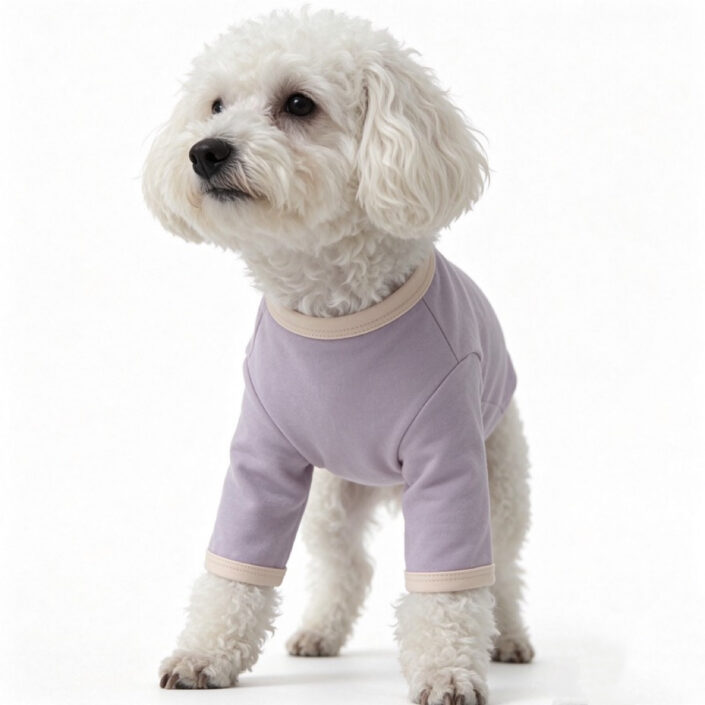
dog jumpsuit with feet
A cotton-spandex four-leg dog base layer should offer softness, stretch, and light warmth without restricting movement. A 95% cotton / 5% spandex knit with a brushed fleece-like inner face can feel comfortable next to the coat while supporting the shoulders, chest, belly, and legs. The four-leg pattern must preserve natural walking and bathroom access, while the fabric must recover after stretching and washing without becoming loose or twisted. This garment can work alone indoors, for travel, sleeping, or mild dry weather, and it can also function as a midlayer beneath a sweater, vest, or weather shell when temperatures fall. Successful layering requires enough room, compatible necklines, and smooth seams that do not create pressure. For pet brands, quality depends on testing stretch recovery, shrinkage, cuff stability, seam extension, and fit across every size. This versatile base layer is cozy, practical, and easier to build into a coherent seasonal collection.
Cotton-Spandex Four-Leg Dog Base Layer: Stretch, Warmth, and Layering Guide
A four-leg dog garment is easy to describe and surprisingly difficult to make well. Full leg coverage can keep a dog warmer and cleaner, but a fitted garment also has more chances to restrict the shoulder, twist at the belly, or slide down the legs. That is why fabric and pattern must be developed together. A soft 95% cotton / 5% spandex blend may feel comfortable in the hand, yet the garment will only work if the stretch recovers, the seams move with the dog, and the four leg openings follow the body instead of fighting it.
This guide examines a cotton-spandex four-leg dog base layer with a brushed fleece-like inner face. It can be worn alone on cool days or used under another layer when temperatures fall, making it more versatile than a single-purpose costume or traditional pajama. The article explains the fabric choices, fit requirements, layering logic, and production checks behind a strong product. Pet brands sourcing through a custom pet clothing manufacturer can use it to build a repeatable base-layer program with clear sizing and believable performance claims.
Quick answer: what makes a four-leg dog base layer useful?
A good dog base layer should do more than look cozy. It should:
- feel smooth against the dog’s coat and skin;
- stretch with the shoulders, chest, and legs;
- recover after movement and washing rather than becoming loose;
- cover the body without compressing the chest or belly;
- leave a clear bathroom opening;
- add a light layer of warmth without turning every walk into a heat trap;
- work underneath another garment without excessive bulk or friction.
A base layer is not automatically a winter coat. It creates a comfortable layer next to the dog and may add warmth, but a weather shell, sweater, or insulated jacket may still be necessary in colder or wetter conditions.
Why a 95% cotton / 5% spandex blend?
The 95/5 blend is a useful balance for pet apparel. Cotton provides softness, breathability, and a familiar next-to-skin feel. Spandex adds elasticity so a fitted four-leg pattern can move without using rigid seams or excessive ease. Combed cotton can also create a smoother, cleaner yarn surface, which is relevant when the garment touches the chest, belly, and inner legs for longer periods.
However, the percentage alone does not guarantee quality. Knit construction, yarn quality, fabric weight, finishing, and pattern matter just as much. Two fabrics with the same 95% cotton / 5% spandex formula can feel completely different if one has a dense, stable knit and the other stretches easily but never recovers.

Stretch is not the same as recovery
A garment may stretch enough to put on and still fail after an hour of walking. Look for:
- four-way stretch that follows the body in multiple directions;
- elastic recovery after pulling at the leg openings and belly;
- resistance to bagging at the shoulders and knees;
- stable length after washing;
- a neckline that returns to shape instead of spreading.
High spandex content does not compensate for a poor pattern. Too much compression under the front legs can restrict the stride, while too little structure leaves folds under a heavier coat.
What the brushed interior adds
The inner face can be brushed to create a soft, fleece-like hand feel. That finish provides warmth and comfort, but it should be positioned honestly. It is different from a loose pile lining or a thick insulated coat. A brushed knit is most useful for:
- cool indoor spaces;
- autumn mornings and evenings;
- sleeping, travel, and car rides;
- short walks under another layer;
- dogs that need light coverage around the chest and legs.
The base layer should not be marketed as waterproof or as a replacement for a winter shell. If the brushed inner face becomes damp, it needs time to dry and should not trap moisture against the dog for long periods.

Four-leg coverage requires a different fit approach
The shoulder comes before the leg opening
When a dog reaches forward, the shoulder moves under the chest and side panel. The fabric needs enough stretch and a correctly placed front armhole to let the leg extend. A common mistake is to enlarge the lower leg opening while leaving the upper shoulder area too tight.
The best fit should be assessed in motion. Observe the dog walking, trotting, turning, sitting, climbing, and lowering itself to sniff the ground. Watch whether the front leg pulls the chest panel, whether the rear cuffs slide up, or whether the garment rises at the tail.
The belly opening must stay practical
Four-leg garments need a functional bathroom opening. It should be low enough to allow a natural stance, high enough to maintain coverage, and stable enough not to twist when the dog moves. A base layer that requires the owner to pull fabric away before every bathroom break will not become a daily favorite.
Use the dog measurement guide to collect neck, chest, and back length, then add leg circumference, leg length, belly width, and front-to-rear leg distance for this category. Compare the results with a dog clothes size chart by breed before choosing a size. Weight alone can place a deep-chested or long-bodied dog in the wrong garment.
Leg cuffs need a gentle hold
The cuffs should keep the legs covered without leaving marks or pulling the body upward. Test cuff height, opening width, and stretch after washing. A cuff that is too loose lets the leg slide out; one that is too tight may restrict movement or create a pressure line.
For brands, it helps to treat the base layer as a technical four-leg product rather than a miniature human bodysuit. The established dog four-leg jumpsuit page provides a useful starting point for custom fabric, closure, leg length, and sizing.

One garment, two useful modes
Wear alone in mild or cool conditions
The base layer can be a standalone garment indoors, during travel, for sleeping, or on a dry cool day when a full coat would be excessive. This is where the cotton hand feel matters most. The garment should feel soft rather than slick, bulky, or restrictive.
Pet pajamas are an adjacent product category, but a base layer should not be limited to bedtime. A clean silhouette, secure fit, and color direction can make it useful for everyday wear. The dedicated dog pajamas category shows the more sleep-focused product direction.
Use as a midlayer when temperatures fall
When the weather becomes colder, the four-leg base layer can sit under a dog sweater, dog vest, or weather shell. The base layer should add a small amount of warmth and reduce friction under the outer garment, not create a tight second chest band.
Test the complete layered outfit on the dog. Check:
- whether the two necklines overlap comfortably;
- whether the outer layer pulls the base layer up at the front legs;
- whether the base leg cuffs stay inside the outer garment;
- whether sleeves, harness straps, or zippers rub against the base;
- whether the dog can move and eliminate without assistance.
Layering is most useful when each item adds a distinct function. A cotton base layer, an insulating sweater, and a wind or rain shell can be combined incrementally. Two bulky layers that compress the same chest area are not automatically warmer.
Choose the layer system by conditions
| Conditions | Base layer | Additional layer | What to check |
|---|---|---|---|
| Indoor, sleeping, travel | Cotton-spandex four-leg base | None | Softness, belly opening, easy wash |
| Mild, dry autumn day | Cotton-spandex four-leg base | Optional light dog sweater | Breathability and free front-leg movement |
| Cool and windy | Cotton-spandex four-leg base | Dog vest or suitable outer layer | Neck overlap and chest compression |
| Light rain | Cotton-spandex base if kept dry | Dog rain jacket | Shell coverage and moisture management |
| Active outdoor use | Breathable base | Purpose-built shell | Heat buildup, harness fit, shoulder reach |
The product should not promise that a brushed cotton base is moisture-wicking in the technical sense unless that performance is supported by testing. Cotton can absorb moisture, so customers should understand when it is best used and how it should be cleaned or dried.
Cotton-spandex base layers versus fleece jumpsuits and cooling suits
The market uses several labels for similar-looking four-leg garments, but the intended conditions differ:
- A cotton-spandex base layer emphasizes softness, stretch, light warmth, and layering.
- A thick four-leg fleece jumpsuit emphasizes fleece warmth, cleanliness, and cold-weather wear.
- A modal four-leg suit with cooling and sun-protection features belongs to a warm-weather product direction, as explained in this modal four-leg suit guide.
All three can use a back opening, full leg coverage, and similar measurements, yet their fabric and care requirements should remain distinct. Product pages that call every version “thermal” or “all-season” make it harder for customers to choose.

Fabric and construction checks for production
Before a cotton-spandex base layer is approved, test the fabric as a finished garment:
- stretch percentage and recovery after repeated extension;
- shrinkage after the specified wash cycle;
- pilling at the belly, shoulder, and leg cuffs;
- colorfastness and color transfer between panels;
- seam extension at the shoulders and leg openings;
- seam softness against the inner leg;
- cuff recovery after washing;
- neckline recovery;
- dimensional stability from sample to bulk;
- appearance of the brushed inner face after tumble drying or air drying.
The stitch is part of the stretch system. A seam that cannot extend with the knit may crack or create a hard line. Flatlock, overlock, or a carefully chosen stretch seam can be appropriate, depending on the fabric and placement. Test the actual sample instead of selecting a stitch from a technical drawing alone.
Pattern grading for different dog shapes
Broad-chested dogs
The chest may need more depth than the back length suggests. Check that the front panel does not pull the neckline down or create pressure behind the front legs.
Long-bodied dogs
The distance between front and rear openings should follow the back. Extending the body without moving the leg openings can create diagonal pull and a sagging belly.
Short-legged dogs
The leg length and cuff placement need their own scale. Shortening only the body does not necessarily correct a four-leg pattern.
Small and slender dogs
Stretch can make a looser garment feel acceptable in the hand, yet it may twist when the dog walks. Check the chest, waist, and leg openings separately rather than relying on a single “high stretch” claim.
A useful product-brief checklist
For a brand developing a 95% cotton / 5% spandex four-leg base layer, document:
- fiber composition and knit structure;
- fabric weight, stretch, and recovery targets;
- brushed or fleece-like inner-face specification;
- four-leg measurements for every size;
- belly and bathroom opening;
- neckline and closure;
- leg cuff dimensions and recovery;
- stitch type at high-extension seams;
- care and drying instructions;
- colorfastness and shrinkage standards;
- logo, label, hangtag, and packaging;
- approved layering test with the intended outerwear.
This brief makes the difference between a fabric sample and a market-ready garment.
How pet brands can build a layering collection
A base layer is strongest when it has a clear role in a broader wardrobe. Build one fit block, then create a controlled range:
- Core base layer: 95% cotton / 5% spandex with a brushed inner face.
- Solid essentials: neutral colors that sit under any outer garment.
- Seasonal prints: artwork that makes the base layer work as a standalone piece.
- Matching knit or vest: an outer layer designed not to compress the base.
- Weather shell: separate performance outerwear for rain and wind.
Keep the same measurement logic across products. The dog sweater sizing guide explains how neck, chest, and back measurements should be used when sizing a knit garment. Apply the same discipline to the base layer and outerwear so customers can combine sizes confidently.
For businesses planning a first collection, the dog clothing business guide covers sampling, product range, and launch planning. A more detailed path from concept to collection is available in the dog clothing line development guide.

Frequently asked questions
Is 95% cotton and 5% spandex good for dog clothes?
It can be a comfortable blend for fitted, four-leg garments because cotton provides softness and spandex adds stretch. The final quality depends on knit density, recovery, seam construction, and fit. Ask for fabric and finished-garment testing rather than judging the percentage alone.
Is a fleece-lined cotton spandex jumpsuit warm enough by itself?
It may be comfortable in mild or cool conditions, indoors, or during short outings. A brushed inner face adds warmth, but it is not a weather shell or a heavy insulated coat. Choose an additional layer when the dog will be outside in colder or windier conditions.
Can a four-leg dog base layer be worn under a coat?
Yes, if the outer layer has enough room and the base does not bunch at the shoulders or belly. Test the complete outfit and remove a layer if the dog shows discomfort, excessive panting, or restricted movement.
How do I measure a dog for a four-leg base layer?
Measure neck circumference, chest girth, back length, leg length, leg circumference, and belly width. Then compare the values with a size chart and test the garment in motion. Weight alone is not a reliable substitute.
What is the difference between a base layer and dog pajamas?
They can share similar fabrics and construction, but a base layer is designed to function both on its own and underneath another garment. Pajamas may be more focused on sleep, indoor wear, and decorative prints.
Can pet brands customize the fabric and sizing?
Yes. Buyers can specify fiber composition, knit, brushed finish, colors, prints, measurements, leg cuff construction, labels, and packaging. Request a physical sample and confirm stretch recovery, shrinkage, and fit before bulk production.
The bottom line
A four-leg dog base layer earns its place in the wardrobe when the fabric and pattern work as one system. The 95% cotton / 5% spandex blend can provide softness and useful stretch; the brushed inner face adds comfort and light warmth; and a carefully graded four-leg pattern keeps the garment wearable. The difference between a good product and a generic pajama is visible in the shoulder movement, belly opening, cuff recovery, seam extension, and how gracefully the garment layers under another piece.
Pet brands can contact Chengyuan Garment with a reference sample, target measurements, fabric composition, desired brushed finish, color direction, and layering plan to begin sampling.



Leave a Reply
Want to join the discussion?Feel free to contribute!