

How to Measure a Dog for Clothes: A Step-by-Step Guide
Buying clothes for a dog is easier when you know how to measure your dog correctly. Whether you are choosing a dog sweater, raincoat, T-shirt, winter jacket, or custom-made outfit, accurate measurements help you choose the right size and reduce the risk of returns due to a poor fit.
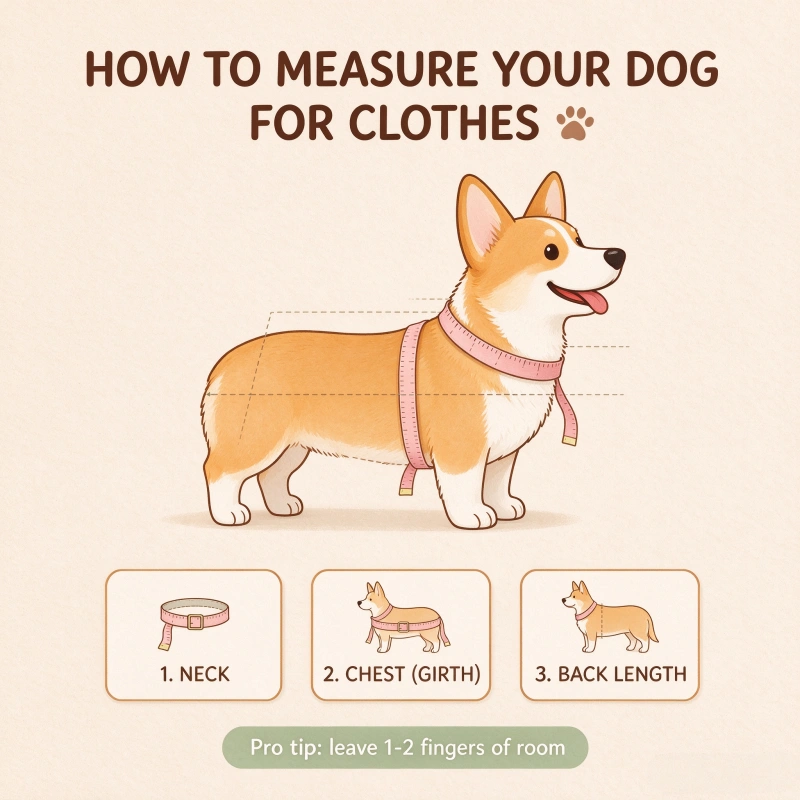
The three most important measurements for most dog clothing are neck circumference, chest girth, and back length. However, different manufacturers may define their measurement points differently, and some garments require additional measurements.
This guide explains how to measure your dog for clothes step by step, how to use a dog clothing size chart, what to do when your dog falls between sizes, and how to check the fit after you receive the garment. It also covers common measuring mistakes that can make clothing feel too tight, hang too loose, or restrict movement.
1. What Measurements Do You Need for Dog Clothes?
Before measuring your dog, understand which body dimensions are usually required and why each one matters.
| Measurement | Where to Measure | Why It Matters | Commonly Used For |
|---|---|---|---|
| Neck circumference | Around the base of the neck, where the garment neckline sits | Helps determine neckline comfort and opening size | Sweaters, T-shirts, jackets, dresses |
| Chest girth | Around the widest part of the rib cage, usually just behind the front legs | Determines whether the garment fits comfortably around the body | Nearly all jackets, coats, shirts, and sweaters |
| Back length | From the specified point near the base of the neck or shoulder blades to the base of the tail | Determines how much of the dog’s back the garment covers | Jackets, coats, sweaters, dresses |
| Belly length | Along the underside of the body, when required by the pattern | Helps determine coverage and clearance underneath the body | Four-legged outfits, jumpsuits, some coats |
| Leg circumference or leg length | Around or along the relevant leg, according to the manufacturer’s instructions | Helps prevent tight cuffs and incorrect leg coverage | Four-legged suits and fitted garments |
For most standard dog clothing, start by measuring the neck, chest, and back. Only take additional measurements when the design or manufacturer’s size chart requires them.
Important: Dog clothing sizes are not universal. A size medium from one brand may not fit the same way as a size medium from another. Always compare your measurements with the size chart for the exact product you intend to buy.
2. Prepare Your Dog Before Measuring
Accurate measurements begin with proper preparation. A moving dog can make it hard to keep the measuring tape in place, and even a small shift in tape placement can affect the result.
What you need
Prepare the following items:
- A soft, flexible tailor’s measuring tape.
- A notebook, phone, or measurement worksheet.
- A calm, non-slip area where your dog can stand naturally.
- Small treats to help your dog remain relaxed.
- Another person to assist if your dog moves frequently.
If you don’t have a tailor’s tape, use a piece of non-stretch string. Wrap the string around the required body area, mark the point where the ends meet, then lay the string against a ruler or measuring tape to obtain the measurement.
Do not use a rigid metal tape directly against your dog’s body. A flexible tape is easier to position around curved areas without creating unnecessary pressure.
Put your dog in the correct position
Ask your dog to stand naturally on a flat, non-slip surface. Ideally, the dog should stand with its weight distributed comfortably across all four legs.
Avoid measuring while your dog is sitting, lying down, crouching, or twisting its body. These positions can change the chest and back’s shape and apparent dimensions.
If your dog becomes anxious, pause and try again later. Take one measurement at a time rather than trying to complete everything in a single session.
For dogs with thick or long coats, gently part or compress the fur enough to identify the actual measurement points. Do not pull the tape tightly to flatten the coat.
3. Step One: Measure Your Dog’s Neck Circumference
Neck circumference is the distance around the neck where the garment’s neckline will sit.
This measurement helps you avoid clothing that presses against the neck or has an opening that is too loose.
How to measure the neck correctly
Step 1: Locate the base of the neck.
Find the area where the neck transitions into the shoulders. For most standard garments, this is around the lower neck, near where a collar naturally rests.
The exact location can vary by design, so check whether the manufacturer specifies the base of the neck or another neckline position.
Step 2: Wrap the measuring tape around the neck.
Place the soft tape around the neck, keeping it level and following the body’s natural shape. Make sure the tape does not twist or press tightly into the fur.
Step 3: Check the tension.
The tape should sit comfortably against the body without being pulled tight. You should be able to move it slightly without forcing it against the neck.
Do not leave excessive slack, as a loose measurement may lead you to choose a neckline that doesn’t sit correctly.
Step 4: Record the measurement.
Write down the circumference in centimetres or inches. Record the unit clearly so you do not confuse measurements later.
Step 5: Repeat the measurement.
Measure the neck a second time. If the two results differ noticeably, check the tape placement and repeat until you obtain a consistent reading.
Common mistakes when measuring neck size
Measuring too high under the jaw may give a number that doesn’t reflect the actual neckline area. Measuring too low over the shoulders can also produce an inaccurate result for some designs.
Another mistake is adding extra centimetres directly to the body measurement without checking the manufacturer’s instructions. Some size charts already include wearing ease, while others provide finished garment measurements rather than body measurements.
Record the dog’s actual measurement first. Use the specific sizing guide to tell you whether you need extra room.
4. Step Two: Measure Your Dog’s Chest Girth
Chest girth is generally one of the most important measurements for selecting dog clothes. If a jacket or sweater cannot fit comfortably around the widest part of the chest, it may be difficult to put on, restrict movement, or cause uncomfortable pressure.
How to measure chest girth
Step 1: Find the widest part of the rib cage.
With your dog standing naturally, locate the broadest part of the chest, usually just behind the front legs.
Do not measure only across the front of the chest. You need the full circumference around the body.
Step 2: Position the tape behind the front legs.
Place one end of the measuring tape against the side of the body, just behind the front legs. Guide the tape underneath the chest, around the opposite side, and back to the starting point.
The tape should follow the widest part of the rib cage rather than cut diagonally across the body.
Step 3: Keep the tape level.
Check that the tape is not slipping forward into the armpits or backward toward the waist. It should form a reasonably level loop around the torso.
Step 4: Adjust the tension.
Hold the tape comfortably against the coat without compressing the dog’s chest or pulling the fur tightly.
The measurement should reflect the dog’s body, not the tension your hand applies.
Step 5: Read and record the result.
Record the full circumference, not half of the chest width. Repeat the measurement to confirm that the tape is in the same position and that the result is consistent.
Why chest girth deserves special attention
A dog with a broad chest may need a larger garment size even if its back is relatively short. Conversely, a long-bodied dog may need additional back coverage without requiring a much larger chest measurement.
For example, consider a dog with these hypothetical body measurements:
| Measurement | Example Result |
|---|---|
| Neck circumference | 32 cm |
| Chest girth | 48 cm |
| Back length | 38 cm |
These figures are an illustration, not a universal size recommendation. The correct garment size depends on the product’s actual size chart, the garment’s intended fit, and whether the chart lists body measurements or finished garment measurements.
If the chest measurement falls outside the recommended range, don’t choose a size based only on the dog’s weight or back length.
5. Step Three: Measure Your Dog’s Back Length
Back length determines how far the clothing extends along the dog’s body. This matters most for coats, sweaters, dresses, and other garments designed to cover most of the back.
The main source of confusion is that manufacturers may use slightly different start and end points.
How to measure back length
Step 1: Position your dog naturally.
Ask your dog to stand with its back in a normal, relaxed position. Do not stretch the dog’s body or lift the tail to create an artificial measurement.
Step 2: Identify the manufacturer’s starting point.
Depending on the sizing guide, the starting point may be the base of the neck, the base of the collar area, or the withers—the highest point of the back around the shoulder blades.
Follow the brand’s specific instructions instead of assuming every company measures from the same location.
Step 3: Locate the base of the tail.
The endpoint is generally where the tail joins the body, not the tip.
Step 4: Measure along the back.
Lay the measuring tape along the dog’s back from the specified starting point to the base of the tail. Keep the tape aligned with the body, not floating in the air above the back.
Step 5: Record the length.
Write down the result and repeat the measurement to check consistency.
Why back length matters
A garment that is too short may leave part of the intended area uncovered. A garment that is too long may overlap the tail, interfere with movement, or extend farther underneath the body than intended.
Some products are deliberately shorter for mobility, while long coats or dresses may provide additional coverage. The goal isn’t to cover the greatest possible area; it is to achieve the coverage the garment’s design intends.
If your dog has a long back and a relatively narrow chest, compare the two measurements carefully. Don’t assume that increasing every dimension by choosing a larger size will give the best fit.
6. Step Four: Take Additional Measurements When Necessary
The neck, chest, and back measurements are sufficient for many basic garments. However, some dog clothes require extra information.
Belly length
For four-legged outfits, jumpsuits, or certain full-coverage coats, the manufacturer may request a belly measurement.
The starting and ending points depend on the garment’s construction. Some designs require a measurement from the chest area toward the underside of the abdomen, while others specify a different body segment.
For male dogs, belly coverage and the garment opening’s position can be particularly important. Follow the product’s measuring instructions, and make sure the finished garment doesn’t obstruct urination.
Leg circumference and leg length
For outfits with sleeves or separate leg openings, measure only the areas the manufacturer specifies.
A garment can fit well around the body but still be uncomfortable if the leg openings are too tight or the legs are too long.
Check that the dog can walk naturally and that the fabric doesn’t pull at the shoulders or restrict joint movement.
Harness opening and closure requirements
If you plan to use a jacket with a harness, confirm the product has an appropriate harness opening and that it aligns with the harness’s attachment point.
Don’t assume every dog coat is compatible with every harness. Depending on the design, you may need to compare the coat with the harness worn underneath.
Weight as supporting information
Your dog’s weight can help you understand product recommendations, but it should not replace direct measurements.
Two dogs with identical weights can have different body shapes. Use weight only as a secondary reference unless the manufacturer explicitly provides a validated weight-based sizing method.
7. Step Five: Record the Measurements Correctly
After you measure your dog, create a simple record. This is especially helpful if you buy clothing from several brands or intend to purchase seasonal garments later.
| Measurement | Your Dog | Unit | Notes |
|---|---|---|---|
| Neck circumference | ______ | cm or in | Record the location used |
| Chest girth | ______ | cm or in | Widest part behind the front legs |
| Back length | ______ | cm or in | Follow the selected brand’s start point |
| Belly length, if required | ______ | cm or in | Use the garment’s measuring guide |
| Leg measurements, if required | ______ | cm or in | Record the relevant leg and location |
| Date measured | ______ | — | Recheck if the dog’s body changes |
Take each measurement twice and use the same units throughout the record.
If you need to convert units, remember that 1 inch equals 2.54 centimetres. For example, a chest circumference of 48 cm is approximately 18.9 inches.
Avoid rounding measurements too aggressively. If your measuring tape gives you a clear result in centimeters, record the result before converting it.
Recheck measurements if your dog grows, gains or loses weight, develops a thicker coat, or changes body condition.
8. Step Six: Use the Dog Clothing Size Chart
After measuring your dog, compare the results with the manufacturer’s size chart for the exact garment.
Do not order based only on labels such as XS, S, M, L, or XL. Those labels are convenient, but the corresponding dimensions vary by brand and style.
Check whether the chart shows body measurements or garment measurements
This distinction is essential.
Body measurements describe the dog’s actual dimensions. You compare your dog’s measurements directly with the ranges or fit guidance provided.
Finished garment measurements describe the clothing’s dimensions. These may be larger than the dog’s body measurements because the garment needs enough room for movement and, in some cases, an underlying layer.
Do not add extra ease to a body measurement unless the brand instructs you to do so. Likewise, do not assume a finished garment must match the dog’s body circumference exactly.
Compare all the important measurements
Use this order when reviewing a standard jacket or sweater:
- Check chest girth to ensure the garment fits comfortably around the torso.
- Check back length to confirm that the garment provides the intended coverage.
- Check neck circumference and opening size.
- Review additional measurements if the garment has legs, special closures, or other fitted elements.
The priority can change with the design. For a fitted raincoat, chest girth may determine whether the garment can close comfortably. For a garment with a highly structured body shape, back length and other dimensions may also be decisive.
What if your dog is between two sizes?
Do not automatically select the larger size in every situation. First, determine which measurement falls outside the recommended range and how the garment is designed to fit.
- If the chest measurement exceeds the smaller size’s range, check whether the next size accommodates it without making the garment excessively long.
- If the chest fits but the back length is too short, look for a different cut or a style designed for a longer body.
- If only the neck is the issue, check the opening design and whether the neckline is adjustable.
- If the dog has an unusual body shape, consider a brand offering more specific fit options or custom sizing.
Some outdoor clothing brands recommend sizing up for a more relaxed fit, but this advice varies by product. Follow the selected manufacturer’s instructions.
9. Step Seven: Check the Fit After Receiving the Clothing
Correct measurements improve your chances of choosing the right size, but a size chart cannot guarantee a perfect fit on every dog. Always check the garment before using it for an extended period.
Signs of a comfortable fit
A properly fitted garment should generally:
- Allow the dog to walk, sit, turn, and lie down naturally.
- Fit around the chest without excessive pressure.
- Allow comfortable movement around the shoulders and front legs.
- Avoid rubbing the armpits, neck, or other sensitive areas.
- Keep it in place without twisting or slipping excessively.
- Provide the intended body coverage without obstructing the tail or legs.
- Avoid interfering with urination or defecation.
Check closures, elastic, straps, and any decorative details. They should not pinch the skin, pull excessively on fur, or come loose during normal movement.
Signs that the garment may be too tight
Watch for restricted steps, persistent scratching at the garment, difficulty sitting or lying down, skin indentation, strained closures, or obvious pulling around the chest and shoulders.
Signs that the garment may be too loose
Excessive shifting, twisting, slipping, fabric dragging on the ground, or leg openings that catch on the feet may indicate that the garment does not fit correctly.
If a dog repeatedly tries to remove clothing, chews the material, freezes, or seems distressed, it may not be comfortable wearing it. Remove the garment and reassess the fit and the dog’s tolerance rather than forcing continued wear.
For safety, supervise your dog while introducing new clothing, especially if it contains straps, fasteners, or detachable components. Do not leave clothing on a dog unattended if chewing, snagging, overheating, or entanglement may occur.
10. Common Mistakes When Measuring a Dog for Clothes
Even a good measuring tape cannot compensate for incorrect technique. Avoid these frequent mistakes.
| Mistake | Why It Causes Problems | Better Approach |
|---|---|---|
| Measuring while the dog is sitting | Changes the shape of the torso and back | Measure while the dog stands naturally |
| Measuring only by weight | Dogs with the same weight can have different proportions | Use neck, chest, and back measurements |
| Measuring the chest too far forward | May produce a circumference smaller than the widest rib cage | Measure just behind the front legs at the widest point |
| Pulling the tape too tightly | Underestimates the body’s actual dimensions | Keep the tape comfortably against the coat |
| Leaving excessive slack | Overestimates body dimensions | Keep the tape level and close to the body |
| Measuring back length from the wrong point | May cause a garment to be too long or too short | Follow the specific brand’s instructions |
| Comparing inches with centimetres without conversion | Creates incorrect size comparisons | Record units clearly and convert carefully |
| Adding extra room without checking the chart | May result in selecting a size that is too large | Determine whether the chart uses body or garment measurements |
| Choosing by breed name alone | Individual dogs vary in size and proportion | Measure your own dog |
| Ignoring movement during fitting | A garment may look correct while standing but restrict walking | Check the garment during natural movement |
The best way to avoid most sizing mistakes is to measure carefully, follow the selected brand’s chart, and check the garment’s fit after delivery.
11. Practical Example: How to Choose Dog Clothes Using Measurements
Suppose you measure a dog and record the following results:
- Neck circumference: 32 cm
- Chest girth: 48 cm
- Back length: 38 cm
You find a dog jacket size chart with separate ranges for neck, chest, and back length.
First, check which listed size accommodates the 48 cm chest measurement. Next, confirm whether that size also provides suitable back coverage. Finally, check the neckline and any additional requirements, such as a belly opening or harness access.
If the size chart recommends one size based on chest girth but the back length falls outside the stated range, do not assume that the recommendation is automatically correct for the dog’s shape. Check the brand’s fit guidance or contact its customer service with all three measurements.
This example shows why recording measurements separately is more useful than choosing a size from an approximate weight range.
12. Frequently Asked Questions
What is the most important measurement for dog clothes?
Chest girth is one of the most important measurements for many dog jackets, sweaters, and shirts because the garment must fit comfortably around the widest part of the torso. However, back length and neck circumference remain important, and the exact priority depends on the garment’s design.
How do I measure a dog for clothes without a measuring tape?
Use a piece of non-stretch string. Wrap it around the area you need to measure, mark where the ends meet, then lay the string against a ruler or measuring tape. Keep the string comfortably against the body, not pulled tight.
Should I measure my dog while standing or sitting?
Measure your dog while standing naturally on a stable surface. Sitting, lying down, or twisting the body can change the measurement points and make the results less reliable.
How do I measure a dog’s back length for a coat?
Measure from the starting point specified by the manufacturer—often the base of the neck or the area around the shoulder blades—to the base of the tail. Because brands define the starting point differently, follow the product’s exact instructions.
Should I add extra centimetres to my dog’s measurements?
Not automatically. Record the actual body measurements first. Check whether the manufacturer’s size chart uses body measurements or finished garment measurements, and follow its recommendations for fit allowance.
What if my dog’s chest fits one size but its back length fits another?
Check the brand’s guidance for conflicting measurements. A larger size may solve a chest-fit problem but become too long, while a smaller size may not close comfortably. Consider a different cut or a manufacturer with better proportions.
Can I choose dog clothing by breed?
Breed information can provide a rough starting point, but it cannot replace individual measurements. Dogs within the same breed can vary in body length, chest width, neck circumference, and coat thickness.
How often should I measure my dog?
Recheck measurements if your dog is growing, gaining or losing weight, or changing body condition. It is also sensible to check them before buying clothing from a new brand, even if you already know your dog’s approximate size.
How should dog clothes fit around the legs?
The openings should allow natural movement without pinching or rubbing. For four-legged garments, follow the manufacturer’s leg-measurement instructions and check the fit while the dog walks and turns.
Is a loose dog jacket better than a tight one?
Neither extreme is ideal. A garment should allow comfortable movement without shifting, dragging, or catching on the legs. The appropriate fit depends on the product’s purpose and construction.
Conclusion
Learning to measure a dog for clothes is straightforward when you follow the right steps. Begin with the neck circumference, chest girth, and back length, then take additional measurements when the garment requires them. Use a soft measuring tape, keep your dog standing naturally, record the results accurately, and compare all relevant dimensions with the specific brand’s size chart.
Remember that a dog’s weight, breed, and the S/M/L label alone cannot guarantee a good fit. The most reliable approach is to measure the individual dog, follow the garment’s measurement instructions, and check the finished fit for comfort, mobility, and safety.
With accurate measurements and a careful fit check, you can choose dog clothing more confidently and avoid common sizing problems.

I am a supplier with 10 years of experience in the apparel industry. As a professional clothing manufacturer, we provide you with a one-stop solution.


Leave a Reply
Want to join the discussion?Feel free to contribute!