

How to custom Women’s outdoor wears?
Women’s outdoor wear is no longer limited to traditional hiking jackets and basic windbreakers. Today’s outdoor apparel market covers a broad range of products, including lightweight hiking tops, waterproof jackets, softshell outerwear, insulated coats, fleece layers, outdoor pants, and versatile clothing designed for travel and everyday activities.
For fashion brands, wholesalers, retailers, and private-label businesses, developing a successful women’s outdoor clothing collection requires more than choosing an attractive design. Fabric performance, garment construction, women’s-specific fit, functional details, and production consistency all influence the final product.
So, how do you customize women’s outdoor wear from an initial idea to a finished bulk order?
This guide explains the complete OEM/ODM process, including product planning, fabric selection, functional specifications, pattern development, sampling, cost factors, quality control, and common sourcing risks. It also explains what information buyers should prepare before approaching a clothing manufacturer.
Whether you are developing a new outdoor clothing brand or expanding an existing women’s apparel collection, understanding these manufacturing details can help you make better sourcing decisions and reduce costly revisions.
1. What Is Custom Women’s Outdoor Wear?
Custom women’s outdoor wear refers to outdoor-oriented clothing developed according to a brand’s own designs, fabric requirements, fit specifications, functional features, and branding standards.
Unlike ordinary fashion clothing, outdoor apparel often needs to balance appearance with practical performance. Depending on its intended use, a garment may need to provide wind protection, water resistance, breathability, insulation, stretch, abrasion resistance, or moisture management.
For B2B buyers, customization generally involves three levels:
- Design customization: Developing the silhouette, colors, patterns, pockets, hoods, cuffs, closures, and other visual details.
- Material customization: Selecting fabrics, linings, membranes, insulation, trims, and functional finishes.
- Manufacturing customization: Adjusting patterns, measurements, construction methods, labels, packaging, and production specifications.
A brand may start with a complete technical package or simply provide a sketch, product photograph, reference garment, or initial concept.
An experienced manufacturer can help translate those requirements into a production-ready garment through pattern development, material selection, sample making, and bulk manufacturing.
For brands looking for an integrated supplier, Chengyuan’s women’s outdoor wear manufacturing service supports customized development for outdoor lifestyle, hiking, travel, and seasonal apparel collections.
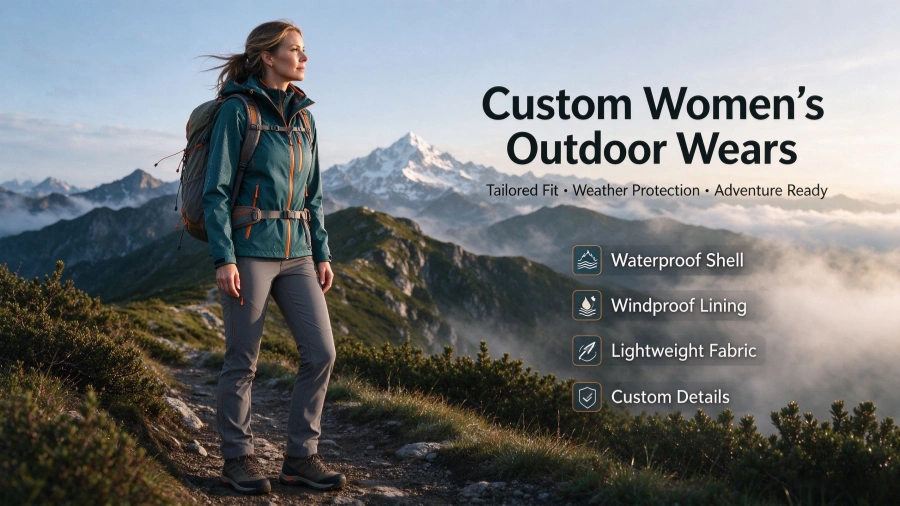
2. What Types of Women’s Outdoor Wear Can You Customize?
Before selecting fabrics or discussing quotations, define the product category. Different outdoor garments have different construction requirements, and treating every product as a general-purpose jacket can lead to incorrect material and cost decisions.
The following categories are common starting points for a women’s outdoor apparel collection.
2.1 Women’s Outdoor Jackets
Outdoor jackets are one of the most versatile categories. They can be designed for hiking, travel, commuting, camping, and everyday outdoor activities.
Common styles include:
- Lightweight outdoor jackets
- Waterproof hiking jackets
- Windproof jackets
- Softshell jackets
- Padded jackets
- Fleece-lined jackets
- Packable jackets
- Hooded outdoor coats
The key development decisions include shell fabric, lining, insulation, hood construction, pocket placement, closure design, and fit.
For example, a lightweight travel jacket should prioritize low weight, comfortable movement, and convenient storage. A jacket intended for frequent rainy conditions requires more attention to waterproof fabric, seam construction, and closure protection.
Explore custom women’s outdoor jackets for product development options involving different silhouettes, fabrics, and functional details.
2.2 Women’s Outdoor Tops
Outdoor tops are suitable for hiking, camping, walking, travel, and active outdoor lifestyles.
Typical products include:
- Lightweight hiking shirts
- Long-sleeve outdoor tops
- Quick-drying tops
- Stretch outdoor shirts
- Base-layer-style tops
- Lightweight active tops
- Casual outdoor shirts
Unlike heavy outerwear, these garments often sit closer to the skin. Fabric softness, breathability, moisture management, stretch recovery, and seam comfort therefore become important.
For warm-weather products, lightweight fabrics and appropriate ventilation may be more valuable than heavy protective construction.
See women’s outdoor tops for customized development of outdoor shirts, lightweight tops, and related styles.
2.3 Women’s Softshell Clothing
Softshell garments are designed to balance flexibility, comfort, and weather resistance.
They are commonly used for hiking, walking, travel, and outdoor activities where freedom of movement matters.
Typical features include:
- Stretch fabric
- Wind resistance
- Water-repellent surface finishes
- Brushed or fleece-backed interiors
- Adjustable cuffs
- Functional pockets
- Ergonomic pattern construction
Softshell should not automatically be treated as fully waterproof. Its performance depends on the fabric construction, membrane or coating, surface finish, and garment design.
2.4 Women’s Insulated and Padded Outdoor Wear
Insulated outdoor clothing is designed to retain warmth in cold environments.
Common products include:
- Puffer jackets
- Quilted jackets
- Lightweight padded coats
- Insulated vests
- Cold-weather outdoor coats
The main development variables are insulation type, fill weight, distribution, shell fabric, lining, quilting design, and garment volume.
A lightweight insulated jacket for autumn travel has different requirements from a winter coat designed for prolonged exposure to low temperatures.
2.5 Women’s Outdoor Vests and Mid-Layers
Vests and mid-layers can expand a brand’s collection without requiring every product to be a full jacket.
Examples include fleece vests, lightweight padded vests, outdoor knit layers, and functional mid-layer tops.
These products can be positioned as standalone garments or as part of a coordinated layering system.
3. How to Choose the Right Fabric for Custom Women’s Outdoor Wear
Fabric selection is one of the most important decisions in outdoor apparel development. It affects product performance, comfort, appearance, durability, and manufacturing cost.
A common sourcing mistake is choosing fabric based only on composition or price. Two polyester fabrics can behave very differently depending on yarn construction, fabric density, finishing, coating, and lamination.
The correct material should be selected according to the garment’s intended use.
3.1 Common Fabric Options for Women’s Outdoor Clothing
| Fabric Type | Typical Applications | Main Advantages | Points to Consider |
|---|---|---|---|
| Polyester woven fabric | Windbreakers, outdoor jackets | Durable, versatile, cost-effective | Check fabric weight, density, and finish |
| Nylon woven fabric | Lightweight jackets, hiking outerwear | Good strength-to-weight potential | Cost and fabric specifications vary |
| Polyester stretch fabric | Outdoor tops, activewear | Flexibility and comfortable movement | Check stretch recovery and pilling |
| Nylon-spandex blend | Softshell clothing, fitted outdoor wear | Stretch and abrasion-resistant potential | Confirm composition and recovery |
| Softshell bonded fabric | Outdoor jackets and mid-layers | Combines flexibility and weather resistance | Performance depends on bonded construction |
| Fleece | Mid-layers, warm jackets, vests | Soft hand feel and thermal comfort | Evaluate pilling and dimensional stability |
| Mesh lining | Jacket interiors and ventilation panels | Lightweight and breathable construction | Check snagging and seam durability |
| Quilted lining | Insulated outerwear | Supports insulation distribution | Quilting pattern and fill movement matter |
These are general material categories rather than guaranteed performance specifications. The final fabric should be approved through sample evaluation and appropriate testing.
3.2 Waterproof and Water-Resistant Fabrics
Waterproof and water-resistant are not interchangeable terms.
A water-resistant fabric may repel light rain or short-term moisture exposure, while a waterproof garment is designed to provide a higher level of protection under defined test conditions.
For waterproof women’s outdoor jackets, buyers should consider:
- Coated or laminated shell fabrics.
- Waterproof membrane options.
- Fabric hydrostatic-head performance.
- Seam construction and seam sealing.
- Water-resistant zippers or protective zipper flaps.
- Hood and collar design.
- Cuff and hem protection.
A waterproof fabric alone does not make the entire garment waterproof. Needle holes, unsealed seams, closures, and poorly constructed openings can become potential water-entry points.
If your product is intended for sustained rain exposure, specify the required waterproof performance and testing method before sampling.
3.3 Breathable and Moisture-Management Fabrics
Breathability is important for garments worn during hiking, walking, and other activities that generate body heat.
A garment that prevents external moisture but does not release internal moisture effectively may become uncomfortable during active use.
Depending on the product, buyers can consider:
- Breathable woven fabrics.
- Moisture-management knitted fabrics.
- Lightweight mesh panels.
- Ventilation openings.
- Breathable membranes.
- Quick-drying polyester or nylon blends.
Remember that quick-drying, moisture-wicking, and waterproof are different properties. They should be specified and evaluated separately.
3.4 Stretch Fabrics for Women’s Outdoor Wear
Stretch fabrics are particularly useful for fitted outdoor tops, softshell jackets, and garments designed for active movement.
Common material options include polyester-spandex and nylon-spandex blends.
However, stretch percentage alone does not determine garment comfort. Buyers should also consider recovery, fabric stability, seam elasticity, and how the fabric behaves after washing.
For example, a garment may initially feel comfortable but become loose around the elbows or waist if the material has poor recovery.
3.5 Fabric Weight and GSM Selection
GSM means grams per square meter and describes fabric weight. It is useful when comparing similar fabric constructions, but a higher GSM does not automatically mean better quality or greater warmth.
The following ranges are illustrative development references, not universal outdoor apparel standards.
| Product Application | Indicative Fabric Weight | Main Consideration |
|---|---|---|
| Lightweight outdoor tops | 100–180 GSM | Breathability and low weight |
| Stretch outdoor shirts | 150–230 GSM | Comfort and movement |
| Lightweight windbreakers | 60–120 GSM | Packability and wind protection |
| Fleece mid-layers | 150–300 GSM | Warmth and bulk |
| Softshell fabrics | 200–350 GSM | Weather resistance and flexibility |
| Lightweight insulated jacket shell | 40–100 GSM | Strength and weight balance |
| Outdoor jacket lining | 50–100 GSM | Comfort and construction |
Actual weight requirements depend on fiber composition, fabric structure, finishing, intended climate, and garment construction.
For accurate quotations, specify fabric composition, GSM, construction, color, finish, and any required performance properties rather than providing GSM alone.

4. How to Customize Functional Features and Garment Details
For outdoor clothing, small design decisions can have a significant effect on usability.
A jacket with the correct fabric may still be inconvenient if the hood moves poorly, the pockets are too small, or the cuffs allow wind to enter.
Before sampling, identify which functional features are essential and which are optional.
4.1 Hood Design
Hoods can be developed in several ways:
- Fixed hood.
- Detachable hood.
- Adjustable hood.
- Elastic-edged hood.
- Three-panel or multi-panel hood.
The choice depends on the product’s intended use and design direction.
For a hiking jacket, hood stability and adjustment may be important. For a casual outdoor jacket, a cleaner silhouette and comfortable neckline may be the priority.
4.2 Pocket Construction
Outdoor garments may require different pocket configurations.
| Pocket Type | Typical Application |
|---|---|
| Side-entry pockets | Everyday storage and hand warming |
| Zippered pockets | Securing small personal items |
| Chest pockets | Convenient access to frequently used items |
| Inner pockets | Additional storage |
| Hidden pockets | Clean visual appearance |
| Large utility pockets | Outdoor and travel-inspired designs |
Pocket dimensions should be determined by intended use, not just appearance. Buyers should consider whether pockets can accommodate common items such as a phone, cards, or keys.
4.3 Zippers and Closures
Zippers influence garment function, durability, and appearance.
Common choices include:
- Standard coil zippers.
- Molded-tooth zippers.
- Metal zippers for fashion-oriented designs.
- Water-resistant zipper options.
- Two-way front zippers.
- Snap buttons and hook-and-loop closures.
For outdoor garments, zipper selection should be compatible with fabric thickness and construction. A zipper that is too heavy may distort lightweight fabric, while a low-quality zipper can become a common failure point.
4.4 Cuffs, Hems, and Adjustable Details
Common customization options include:
- Elastic cuffs.
- Adjustable hook-and-loop cuffs.
- Ribbed cuffs.
- Elastic hem finishes.
- Drawcord-adjustable hems.
- Adjustable waist details.
- Snap-adjustable openings.
These details can improve fit and help control wind entry, but they also add components and assembly steps.
4.5 Branding and Decorative Details
Private-label outdoor clothing brands can customize:
- Woven labels.
- Printed neck labels.
- Care labels.
- Embroidered logos.
- Heat-transfer logos.
- Zipper pullers.
- Custom buttons.
- Hangtags.
- Branded packaging.
Logo placement should be decided during product development. If the garment uses waterproof or coated fabric, confirm that the selected branding method is compatible with the material and does not damage its finish.
5. Women’s Outdoor Wear Requires Specialized Fit and Pattern Development
Women’s outdoor apparel should not simply use a men’s pattern with smaller measurements.
Body proportions, garment balance, movement requirements, and layering needs all affect the final fit.
A women’s outdoor jacket may require different shaping around the bust, waist, hips, shoulders, and sleeves. The amount of shaping depends on the target customer and intended silhouette.
5.1 Define the Intended Fit
Before pattern making, decide whether the garment should be:
| Fit Type | Typical Positioning | Development Consideration |
|---|---|---|
| Slim fit | Close-fitting outdoor apparel | Body shaping and stretch |
| Regular fit | General outdoor and travel wear | Balanced movement and comfort |
| Relaxed fit | Casual outdoor clothing | Additional ease and softer silhouette |
| Oversized fit | Fashion-oriented outdoor collections | Proportion and visual balance |
| Athletic fit | Active outdoor use | Shoulder, armhole, and movement allowance |
A jacket intended to be worn over a thick fleece layer should not use the same ease allowance as a lightweight shell designed for a thin base layer.
5.2 Develop the Size Chart for the Target Market
Different markets may have different expectations regarding body measurements, garment ease, and preferred fit.
For international B2B projects, buyers should provide a clear size chart that includes:
- Bust circumference.
- Waist circumference.
- Hip circumference.
- Shoulder width.
- Sleeve length.
- Body length.
- Hem circumference.
- Garment-specific measurements.
It is important to distinguish body measurements from finished garment measurements.
For example, a bust measurement on a body size chart is not the same as the garment’s actual chest circumference. The difference represents wearing ease and depends on the fabric and intended fit.
5.3 Test Movement, Not Just Appearance
An outdoor jacket may look correct when a model stands still but become restrictive when the wearer raises her arms or bends forward.
During sample fitting, test:
- Reaching forward.
- Raising both arms.
- Rotating the shoulders.
- Bending at the waist.
- Wearing the garment over the intended mid-layer.
- Adjusting the hood and cuffs.
This is particularly important for hiking jackets, softshell clothing, and fitted outdoor tops.
6. How to Develop a Custom Women’s Outdoor Wear Tech Pack
A Tech Pack is one of the most useful documents in custom apparel manufacturing. It translates a design concept into clear instructions that the pattern, sampling, purchasing, and production teams can follow.
A photograph alone rarely communicates enough information for accurate bulk manufacturing.
For outdoor wear, a complete Tech Pack should include the following information.
| Tech Pack Section | Information to Include | Why It Matters |
|---|---|---|
| Product overview | Style name, product category, intended use | Defines the garment’s purpose |
| Technical drawings | Front, back, side, and detail views | Communicates design and construction |
| Fabric specification | Composition, GSM, construction, color | Controls material selection |
| Functional requirements | Waterproofing, breathability, stretch, warmth | Defines intended performance |
| Measurement chart | Body or finished garment measurements | Controls fit and sizing |
| Construction details | Stitching, seams, lining, panels | Guides manufacturing |
| Trims and accessories | Zippers, buttons, cords, labels | Prevents component substitutions |
| Artwork and branding | Logo size, position, color, method | Ensures brand consistency |
| Color information | Pantone references or approved swatches | Controls color matching |
| Packaging | Folding, hangtags, polybags, carton details | Supports retail and logistics requirements |
Example: Tech Pack Requirements for a Women’s Lightweight Hiking Jacket
| Item | Example Specification |
|---|---|
| Product | Women’s lightweight hiking jacket |
| Fit | Regular fit |
| Shell | Polyester or nylon woven fabric |
| Fabric weight | Target 80–120 GSM, subject to fabric selection |
| Closure | Front zipper |
| Hood | Adjustable attached hood |
| Pockets | Two zippered side pockets |
| Cuffs | Elastic or adjustable cuffs |
| Hem | Adjustable drawcord |
| Branding | Custom woven label and heat-transfer logo |
| Colors | Three approved colorways |
| Sizes | XS–XXL, based on approved size chart |
| Testing | Agreed fabric and finished-garment performance checks |
This is an illustrative specification, not a universal recommended construction. Actual requirements should be adjusted to the product’s target climate, performance level, and retail positioning.
A detailed Tech Pack helps the manufacturer quote more accurately and reduces the risk of misunderstandings during sampling and bulk production.
7. OEM vs. ODM: Which Customization Model Should You Choose?
When working with a women’s outdoor wear manufacturer, buyers generally choose between OEM and ODM services.
| Comparison | OEM | ODM |
|---|---|---|
| Starting point | Buyer’s own design or Tech Pack | Manufacturer’s existing design or development base |
| Design control | Higher buyer control | Shared or adapted design control |
| Development input | Buyer provides detailed specifications | Buyer provides product direction and preferences |
| Customization | Based on buyer requirements | Adapted from available design and construction options |
| Best suited for | Established brands with defined designs | New brands and buyers seeking product-development support |
OEM: Manufacturing According to Your Design
OEM is suitable when you already have a clear product concept and want the factory to manufacture according to your specifications.
You may provide:
- Technical drawings.
- Fabric specifications.
- Measurement charts.
- Construction details.
- Trims and accessories.
- Branding and packaging requirements.
The manufacturer then develops patterns and samples based on the approved information.
ODM: Developing Products with a Manufacturer
ODM is useful when you have a product direction but do not yet have a complete technical package.
For example, you may want to launch a collection of women’s lightweight outdoor jackets but need help deciding on fabric, silhouette, pocket layout, and functional details.
The manufacturer can help develop a suitable product direction, subject to its available design and production capabilities.
Which Is Better for a New Outdoor Clothing Brand?
Neither model is automatically better.
OEM provides greater control when your design specifications are established. ODM can reduce the amount of development work required from your team when you are starting with a concept rather than a finished design.
Some projects combine both approaches: the manufacturer helps develop the initial product, then produces it according to the brand’s approved specifications.

8. Custom Women’s Outdoor Wear Manufacturing Process: From Design to Bulk Production
A clear production workflow helps buyers manage development, approve critical details, and avoid unnecessary delays.
Step 1: Define the Product and Target Market
Start by identifying the product category, intended activity, season, customer profile, and target retail price.
For example, a lightweight travel jacket and a waterproof hiking shell may look similar in a product photograph, but they require different materials and construction.
Clarify the product’s main function before selecting the fabric.
Step 2: Prepare the Design Brief
Provide a Tech Pack if available. Otherwise, prepare sketches, reference photographs, existing garments, or a written product description.
Include as much information as possible about fabric, fit, colors, sizes, functional features, and branding.
The clearer the brief, the easier it is for the factory to identify missing information before sampling.
Step 3: Select Fabrics and Trims
Review suitable fabric options according to the intended performance and target price.
Confirm:
- Fiber composition.
- Fabric weight.
- Fabric construction.
- Surface finish.
- Stretch and recovery.
- Color availability.
- Lining and insulation.
- Zipper and trim compatibility.
If a fabric has a special performance requirement, ask for relevant test documentation or arrange testing before bulk approval.
Step 4: Pattern Making and Sample Development
The manufacturer develops the pattern and produces an initial sample.
This stage is used to evaluate the design, fit, measurements, fabric, construction, and functional details.
Do not approve a sample based only on appearance. Wear testing and practical evaluation may reveal problems that are not visible in photographs.
Step 5: Sample Review and Revision
Review the sample against the original requirements.
Common adjustments include:
- Bust and waist shaping.
- Sleeve length.
- Shoulder width.
- Jacket length.
- Hood shape.
- Pocket position.
- Cuff opening.
- Zipper length.
- Fabric hand feel.
- Overall weight and comfort.
Document every revision. The final approved sample and specification should become the reference for bulk production.
Step 6: Bulk Material Preparation
After sample approval, confirm the bulk fabric, colors, trims, labels, and packaging.
For performance garments, material substitutions should not be made casually. A different fabric or coating may change the garment’s waterproofness, breathability, stretch, weight, or appearance.
Step 7: Cutting, Sewing, and Assembly
The production team follows the approved pattern and construction specifications.
Depending on the garment, operations may include fabric inspection, spreading, cutting, panel preparation, sewing, lining attachment, zipper installation, insulation filling, finishing, and pressing.
Different outdoor clothing categories require different production operations.
Step 8: Quality Inspection and Packing
Finished garments should be inspected against the approved sample and specification.
Check dimensions, workmanship, fabric appearance, functional details, accessories, labels, and packing requirements before shipment.
The final inspection criteria should be agreed upon before the bulk order begins.
9. How to Control Quality in Women’s Outdoor Wear Production
Quality control for outdoor apparel should cover both ordinary garment workmanship and product-specific functional requirements.
A jacket may have clean stitching but still fail to meet the buyer’s intended weather-protection requirements. Similarly, a fabric may perform well in a laboratory test but be assembled incorrectly during production.
A practical QC plan should include several stages.
9.1 Fabric Inspection
Check incoming fabric for:
- Composition and fabric weight.
- Color consistency.
- Surface defects.
- Weaving or knitting defects.
- Width and dimensional stability.
- Coating or lamination condition.
- Relevant functional test results.
For coated and laminated fabrics, confirm that the bulk material matches the approved sample.
9.2 Measurement Inspection
Measure finished garments against the approved specification.
Important points may include:
- Bust circumference.
- Waist circumference.
- Hip circumference.
- Shoulder width.
- Sleeve length.
- Body length.
- Hem circumference.
- Pocket position.
- Hood dimensions.
Measurement tolerances should be agreed upon in advance rather than decided after production.
9.3 Workmanship Inspection
Check:
- Stitch consistency.
- Seam strength.
- Seam puckering.
- Zipper operation.
- Button and snap attachment.
- Pocket construction.
- Lining attachment.
- Cuff and hem finishing.
- Label placement.
- Thread trimming.
9.4 Functional Testing
Testing depends on the product and the claims made by the brand.
| Performance Requirement | Possible Verification |
|---|---|
| Water resistance | Spray or water-repellency testing |
| Waterproofness | Hydrostatic-head testing and finished-garment checks |
| Breathability | Water-vapor transmission testing |
| Colorfastness | Washing, rubbing, and other relevant colorfastness tests |
| Dimensional stability | Washing and shrinkage testing |
| Stretch recovery | Stretch and recovery evaluation |
| Abrasion resistance | Abrasion testing |
| Seam durability | Seam strength and construction inspection |
| Insulation performance | Fill weight, distribution, and garment construction checks |
Testing methods and acceptance limits should be selected according to the target market, product claims, and applicable requirements.
For example, ISO 811 is commonly used to evaluate resistance to water penetration under hydrostatic pressure. However, passing a fabric test alone does not prove that a completed jacket is waterproof.
9.5 Final Inspection
Before shipment, compare the finished goods with the approved sample, order specification, and packaging requirements.
AQL-based sampling inspection can be used when agreed by the buyer and supplier. The inspection level, sample size, defect classifications, and acceptance criteria should be defined before the order.
10. How Much Does It Cost to Customize Women’s Outdoor Wear?
There is no single factory price for custom women’s outdoor clothing.
A lightweight polyester windbreaker, a fleece jacket, a softshell hiking jacket, and a waterproof insulated coat involve different material costs and production processes.
The final quotation is influenced by several factors.
| Cost Factor | Effect on Manufacturing Cost |
|---|---|
| Fabric type | Nylon, polyester, stretch, coated, and laminated materials have different costs |
| Fabric weight | Heavier or specialized materials may increase material consumption and cost |
| Functional performance | Waterproof membranes, special finishes, and testing can add expense |
| Construction complexity | Multiple panels, linings, quilting, and seam treatments require more operations |
| Insulation | Fill material, fill weight, and distribution affect material and labor costs |
| Trims | Zippers, buttons, drawcords, and branded accessories affect the quotation |
| Pattern development | New patterns and sample revisions add development expenses |
| Order quantity | Setup, fabric purchasing, and production efficiency influence unit pricing |
| Branding | Embroidery, printing, labels, and packaging add customization costs |
| Quality requirements | Additional inspection and testing may increase project costs |
Why Are Two Similar Outdoor Jackets Quoted at Different Prices?
Consider two women’s lightweight outdoor jackets.
Both may have a hood, front zipper, and two pockets. However, one uses standard polyester woven fabric with a simple lining, while the other uses a laminated shell, specialized zipper components, adjustable cuffs, and additional functional testing.
Their appearance may be similar, but their material and manufacturing costs can be very different.
For this reason, buyers should compare quotations using the same Tech Pack and specifications.
What Information Is Needed for an Accurate Quotation?
Prepare the following information:
- Product design or reference photographs.
- Estimated order quantity.
- Fabric composition and weight.
- Functional performance requirements.
- Size range and measurement chart.
- Color and trim requirements.
- Logo and label specifications.
- Packaging requirements.
- Destination country.
- Target delivery date.
If some details are undecided, ask the manufacturer to quote alternative material or construction options separately.
11. Common Risks When Sourcing Custom Women’s Outdoor Wear
Outdoor apparel has more technical variables than many ordinary fashion products. A sourcing decision based only on the initial quotation can create problems later.
Here are common risks B2B buyers should address before placing bulk orders.
Risk 1: Choosing Fabric Based on Marketing Terms
Words such as waterproof, breathable, quick-drying, and windproof are not interchangeable.
A supplier may describe a material as waterproof without specifying a test method or performance level.
How to reduce the risk:
Define measurable performance requirements. Request fabric specifications and relevant test results. Confirm whether the requirements apply to the fabric alone or to the finished garment.
Risk 2: Approving Samples Without Practical Testing
A jacket may look attractive on a hanger but feel restrictive during movement.
How to reduce the risk:
Test the sample in the intended wearing conditions. Check arm movement, layering space, pocket access, hood adjustment, and comfort.
Risk 3: Using the Wrong Women’s Size Grading
A garment developed around one sample size may not fit consistently across the full size range.
How to reduce the risk:
Review the grading rules and fit multiple sizes where practical. Check bust, waist, hip, shoulder, sleeve, and garment length measurements.
Risk 4: Changing Materials After Sample Approval
Replacing the approved fabric with a cheaper or more readily available alternative can change the garment’s performance and appearance.
How to reduce the risk:
Record approved fabric specifications and require written buyer approval before substitutions.
Risk 5: Underestimating Material Lead Times
Specialized fabrics, custom colors, membranes, insulation, and branded trims may require additional sourcing time.
How to reduce the risk:
Confirm material availability before finalizing the production schedule. Identify any components with minimum purchasing quantities or longer lead times.
Risk 6: Focusing Only on the Unit Price
A low initial quotation may exclude testing, custom labels, packaging, or special construction requirements.
How to reduce the risk:
Request a clear cost breakdown and compare total project costs, not just the garment unit price.
Risk 7: Failing to Define Quality Standards
If the buyer and manufacturer have different expectations about stitching, measurements, fabric defects, or functional performance, disputes can occur after delivery.
How to reduce the risk:
Approve a reference sample, define measurement tolerances, document materials, and agree on inspection criteria before bulk production.
12. How to Build a Commercially Viable Women’s Outdoor Wear Collection
For brands, a successful outdoor apparel collection is not necessarily the one with the most product styles. It is the one with a clear market position and a manageable development plan.
A practical starting point is to build a small product system around a defined customer and use case.
Example: A Women’s Outdoor Lifestyle Collection
| Product | Main Purpose | Key Material Direction | Product Role |
|---|---|---|---|
| Lightweight windbreaker | Wind protection and travel | Lightweight woven fabric | Entry-level outerwear |
| Softshell jacket | Active outdoor use | Stretch softshell | Functional core product |
| Fleece mid-layer | Warmth and layering | Polyester fleece | Seasonal layering |
| Lightweight outdoor top | Hiking and everyday activity | Breathable stretch fabric | Repeat-wear basic |
| Insulated vest | Additional warmth | Woven shell with insulation | Layering option |
This collection provides different product functions while maintaining a coherent outdoor lifestyle direction.
Plan the Layering System
Outdoor apparel works best when the products can be worn together.
A simple layering system may include:
- Base layer: Worn next to the skin, focusing on comfort and moisture management.
- Mid-layer: Provides additional warmth, often using fleece or suitable knit fabrics.
- Outer layer: Helps protect against wind or rain.
When developing these products together, check that the shoulder, chest, sleeve, and body dimensions allow comfortable layering.
A shell jacket that fits well over a thin top may become restrictive when worn over a thicker fleece mid-layer.
Avoid Too Many Similar Styles at Launch
A new brand may be tempted to develop many colors and jacket variations immediately. This can increase material requirements, sample costs, and inventory complexity.
A more controlled launch can begin with a few styles that serve different purposes.
Once customer feedback and sales data identify successful products, the brand can expand into additional colors, fabrics, or seasonal variations.
13. Why Work with Chengyuan Garment for Custom Women’s Outdoor Wear?
Choosing a manufacturing partner is about more than finding a supplier that can sew a jacket. Buyers need a factory that can understand product specifications, coordinate development, and maintain consistency between approved samples and bulk orders.
Qingdao Chengyuan Garment Co., Ltd. is an integrated garment manufacturer based in Qingdao, Shandong, China. The company combines design, pattern making, sampling, and bulk production.
Its product categories include women’s outdoor wear, women’s knitwear, sleepwear and loungewear, men’s apparel, children’s clothing, and pet clothing.
Integrated Development and Manufacturing
Chengyuan supports the process from product concept to finished garments. Buyers can provide:
- Complete Tech Packs.
- Design sketches.
- Technical drawings.
- Measurement charts.
- Reference garments.
- Product photographs.
- Initial product concepts.
The development process can then cover pattern making, fabric selection, sample production, revisions, and bulk manufacturing.
Customization for Private-Label Brands
Depending on the product, buyers can customize:
| Development Area | Customization Possibilities |
|---|---|
| Fabric | Composition, weight, texture, stretch, and functional finishes |
| Fit | Slim, regular, relaxed, or oversized |
| Colors | Custom color development and color matching |
| Construction | Panels, linings, seams, cuffs, and hems |
| Functional details | Hoods, pockets, zippers, drawcords, and closures |
| Branding | Woven labels, printed labels, embroidery, and logos |
| Packaging | Hangtags, care labels, polybags, and branded packaging |
Production Capacity and Order Planning
Chengyuan reports a monthly production capacity of approximately 80,000–120,000 finished garments across its overall operations.
The company supports both small trial orders and larger B2B production programs. Actual MOQ and available capacity depend on the product category, fabric, construction, customization requirements, and production schedule.
For buyers developing new outdoor products, the sample approval process is particularly important. It provides an opportunity to evaluate fit, fabric, construction, and functional details before bulk manufacturing.
To understand the company’s broader manufacturing capabilities, visit the Chengyuan Garment product directory or its official website.
14. Frequently Asked Questions About Custom Women’s Outdoor Wear
Can I customize women’s outdoor wear from my own design?
Yes. Buyers can provide a Tech Pack, sketch, reference garment, product photographs, or measurement chart. The manufacturer can use these materials to develop patterns and samples according to the project requirements.
What fabrics are best for women’s outdoor clothing?
There is no single best fabric. Polyester and nylon woven fabrics are common for jackets, while stretch blends are useful for active garments. Fleece is often used for mid-layers, and coated or laminated fabrics may be suitable for waterproof products. The selection should depend on intended use, climate, performance requirements, and target price.
What is the difference between a waterproof jacket and a water-resistant jacket?
A water-resistant jacket is designed to resist limited moisture exposure, while a waterproof jacket is developed to provide a higher level of protection under defined test conditions. Waterproof construction may require suitable shell fabric, membrane or coating, seam sealing, and appropriate closures.
Can I customize the size chart for different markets?
Yes. Buyers can provide their own body measurement chart, finished garment measurements, and grading requirements. Pattern development should consider the intended market, target fit, and layering requirements.
Can I customize fabric colors and logos?
Yes. Depending on the selected materials and production method, buyers can customize fabric colors, prints, embroidery, heat-transfer logos, woven labels, care labels, and hangtags.
Can I order different women’s outdoor wear styles in one collection?
Yes, subject to the manufacturer’s product capabilities and production arrangements. Buyers should confirm the MOQ and material requirements for each style. Different products may require different fabrics, trims, and production processes.
How long does custom women’s outdoor wear manufacturing take?
The schedule depends on fabric availability, design complexity, sample revisions, order quantity, and production planning. Sampling, material sourcing, bulk production, inspection, and shipping should be planned as separate stages. Ask the manufacturer for a project-specific schedule rather than relying on a general estimate.
What is the MOQ for custom women’s outdoor wear?
MOQ varies according to garment style, fabric, color, construction, and customization. Stock fabrics may offer more flexibility than custom-developed or specially finished materials. Buyers should provide their expected quantity and specifications to receive a realistic MOQ assessment.
Should I approve a sample before bulk production?
Yes. Sample approval is strongly recommended. It allows you to check measurements, fabric, fit, construction, functional details, accessories, branding, and overall workmanship before committing to bulk production.
What should I include in an RFQ for a women’s outdoor wear manufacturer?
Include product designs, fabric requirements, functional specifications, sizes, quantities, colors, trims, branding, packaging, and delivery destination. A complete Tech Pack will usually make the quotation more accurate.
Conclusion
Customizing women’s outdoor wear requires a coordinated approach to product design, material selection, pattern development, functional construction, sampling, and quality control.
The first step is to define the product’s intended use. A lightweight travel jacket, a softshell hiking garment, a waterproof outer layer, and an insulated winter coat should not share the same material and construction assumptions.
For B2B buyers, a successful manufacturing project starts with clear specifications. Define the fabric properties, fit, size chart, functional features, branding, and quality requirements before sampling. Test the sample in realistic wearing conditions, approve the final specifications, and use them as the reference for bulk production.
Qingdao Chengyuan Garment Co., Ltd. provides integrated design, sampling, and garment manufacturing services for brands, wholesalers, retailers, and private-label businesses. If you are planning a new women’s outdoor wear collection, you can share your product concept, reference sample, or Tech Pack to discuss suitable development and production options.

I am a supplier with 10 years of experience in the apparel industry. As a professional clothing manufacturer, we provide you with a one-stop solution.


Leave a Reply
Want to join the discussion?Feel free to contribute!