
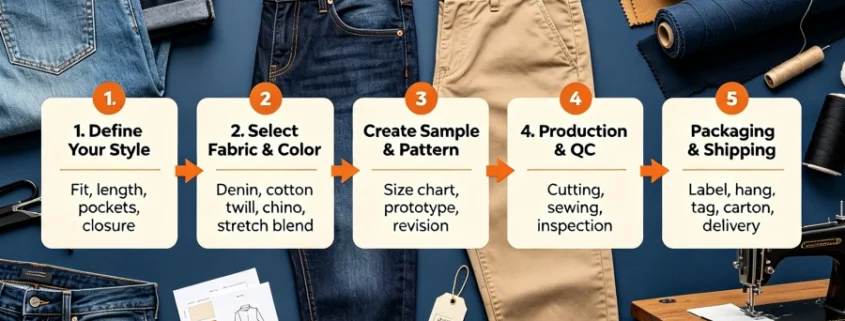
How to make custom Men’s bottoms from China
Developing a custom men’s bottoms collection requires more than choosing a pair of trousers and adding your brand logo. For clothing brands, wholesalers, fashion retailers, and private-label businesses, successful product development involves selecting suitable fabrics, defining accurate measurements, creating production-ready patterns, evaluating samples, and finding a reliable manufacturing partner.
China remains an important sourcing destination for international apparel buyers because of its established textile supply chains, garment manufacturing capabilities, material choices, and production infrastructure. However, choosing the right factory and controlling product specifications are essential if you want to turn your designs into consistent commercial products.
Whether you plan to manufacture men’s casual trousers, cargo pants, joggers, sweatpants, shorts, or outdoor hiking trousers, this guide explains how to develop custom men’s bottoms in China step by step.
We will cover product selection, fabric sourcing, pattern development, OEM and ODM manufacturing, sample approval, MOQ, production costs, quality control, and international shipping. You will also learn what information to prepare before requesting quotations from Chinese clothing manufacturers.
1. Understand the Different Types of Custom Men’s Bottoms
Before contacting a manufacturer, define exactly what type of men’s bottoms you want to produce.
Men’s bottoms cover several product categories, and each requires different materials, patterns, construction techniques, and production considerations. A manufacturer experienced in casual knit trousers may not automatically be the best choice for technical outdoor pants or structured woven cargo trousers.
Here are the main categories to consider.
Men’s Casual Pants
Men’s casual pants are designed for everyday activities, commuting, leisure, and smart-casual outfits. Common styles include straight-leg trousers, tapered pants, relaxed-fit trousers, cotton pants, and drawstring trousers.
Typical fabric options include cotton twill, cotton-polyester blends, stretch woven fabric, and lightweight knit materials.
Important customization details include:
- Straight, slim, tapered, or relaxed leg shapes.
- Flat-front or elastic waistbands.
- Belt loops and drawstrings.
- Side pockets and back pockets.
- Zippers, buttons, and other closures.
- Different inseam and outseam lengths.
For brands developing everyday men’s collections, custom men’s casual pants offer a versatile starting point.
Men’s Joggers and Sweatpants
Joggers and sweatpants are widely used in athleisure, streetwear, sports-inspired apparel, and homewear collections.
Joggers typically feature a tapered leg and elasticated cuffs, while sweatpants can have straight, wide, relaxed, or tapered silhouettes.
Common materials include French terry, cotton fleece, polyester-cotton blends, and stretch knitted fabrics.
Key customization options include:
- Elastic or ribbed waistbands.
- Adjustable drawcords.
- Elasticated or open leg openings.
- Side-seam, patch, or zippered pockets.
- Embroidered logos and printed graphics.
- Brushed or unbrushed fabric interiors.
For a private-label athleisure collection, you can develop custom men’s sweatpants with your own fabric specifications, fit, colors, and branding.
Men’s Cargo Pants
Cargo pants combine functional pocket designs with casual, outdoor, workwear, or streetwear aesthetics.
Their main distinguishing feature is the additional storage space created by side cargo pockets. Pocket construction and placement must be carefully developed because they affect both appearance and garment balance.
Typical options include:
- Flap cargo pockets.
- Bellows pockets.
- Zippered utility pockets.
- Adjustable waistbands.
- Reinforced knee panels.
- Elastic or adjustable leg openings.
- Cotton twill, ripstop, and stretch woven fabrics.
Buyers developing utility-inspired collections can explore custom men’s cargo pants for different pocket configurations and construction details.
Men’s Shorts
Men’s shorts are commonly used for casualwear, summer collections, sports-inspired products, outdoor activities, and loungewear.
Popular styles include:
- Casual cotton shorts.
- Drawstring shorts.
- Cargo shorts.
- Athletic shorts.
- Quick-dry shorts.
- Knit lounge shorts.
The most important development considerations are inseam length, leg opening, waistband construction, pocket design, and fabric suitability for the intended application.
Men’s Outdoor and Hiking Pants
Outdoor trousers require more attention to functional performance than ordinary casual pants.
Depending on the intended use, buyers may need lightweight construction, stretch, abrasion resistance, water resistance, wind protection, or breathable fabrics.
Typical applications include hiking, trekking, camping, fishing, and outdoor travel.
If your brand targets this segment, explore men’s outdoor wear manufacturing and specialized men’s waterproof hiking pants.
Which Type Should You Manufacture First?
| Product category | Common fabric | Main buyer priorities | Target market |
|---|---|---|---|
| Casual trousers | Cotton twill, stretch woven | Fit, comfort, appearance | Fashion retailers |
| Joggers | French terry, cotton blends | Softness, elasticity, silhouette | Athleisure brands |
| Sweatpants | Fleece, jersey | Warmth, comfort, durability | Sportswear and loungewear |
| Cargo pants | Twill, ripstop | Pocket construction, durability | Streetwear and outdoor brands |
| Shorts | Cotton, polyester, nylon | Lightweight comfort, length | Summer and casualwear |
| Hiking pants | Nylon, polyester, stretch woven | Mobility, protection, functionality | Outdoor brands |
Our recommendation is to begin with one or two core product categories rather than developing too many unrelated styles in your first order. This allows you to concentrate your budget on fit development, fabric selection, and quality consistency.

2. Define Your Target Market and Product Specifications
A men’s bottoms design should be developed according to the customers who will eventually wear it.
For example, a European casualwear retailer may prefer relaxed silhouettes, understated colors, and durable cotton fabrics. A North American streetwear label may prioritize oversized fits, heavyweight materials, cargo pockets, and distinctive branding.
A wholesale sportswear buyer may focus more on moisture management, stretch recovery, and repeated-wash performance.
Before manufacturing, define the following information:
Target customer: Age group, market, lifestyle, and purchasing preferences.
Product positioning: Budget, mid-range, premium, or performance-focused.
Fit preference: Slim, regular, relaxed, straight, tapered, wide-leg, or oversized.
Seasonality: Lightweight summer products, transitional collections, or heavier winter products.
Retail price target: Your intended selling price and expected wholesale margin.
Order quantity: Estimated units per style, color, and size.
These details influence material selection, manufacturing costs, and the development process.
A useful approach is to prepare a short product brief for each style. It does not need to be a complete technical document initially, but it should communicate the product’s intended appearance, function, and target price.
3. Choose the Right Fabric for Your Men’s Bottoms
Fabric selection is one of the most important decisions in custom garment manufacturing.
The material influences comfort, garment structure, durability, appearance, production difficulty, and final unit cost. A fabric that works well for joggers may not be suitable for structured cargo trousers.
Common Fabrics for Custom Men’s Bottoms
| Fabric | Typical use | Main characteristics |
|---|---|---|
| Cotton twill | Casual pants, cargo trousers | Structured appearance and versatile everyday use |
| Cotton fleece | Sweatpants, winter joggers | Soft interior and warmth |
| French terry | Joggers, casual trousers | Loop-back construction and comfortable wear |
| Cotton jersey | Lightweight lounge pants | Soft, flexible knitted construction |
| Polyester-cotton blend | Sportswear and casual pants | Different combinations of comfort and durability |
| Nylon | Outdoor and functional trousers | Lightweight options and potential abrasion resistance |
| Ripstop | Cargo and outdoor pants | Reinforced woven construction |
| Stretch woven | Slim-fit casual and outdoor pants | Greater flexibility when properly specified |
| Modal or viscose blends | Lounge and sleep pants | Soft hand feel and drape |
Woven vs. Knitted Fabric: What Is the Difference?
This distinction matters because knitted and woven materials behave differently during pattern development, cutting, sewing, and wear.
Woven fabrics are commonly used for tailored trousers, chinos, cargo pants, and outdoor pants. Their construction generally provides more dimensional stability and a structured appearance.
Knitted fabrics are commonly used for sweatpants, joggers, lounge pants, and comfortable casual styles. Depending on their construction and fiber content, they can provide greater stretch and a softer feel.
For example:
- Cotton twill is a practical choice for everyday casual trousers.
- French terry works well for comfortable joggers.
- Fleece is suitable for warmer sweatpants.
- Ripstop can be considered for utility-focused outdoor pants.
- Stretch woven fabrics can support movement in fitted casual or outdoor styles.
How to Specify Fabric Properly
Avoid telling a manufacturer only that you want premium or high-quality fabric.
Instead, define:
- Fiber composition.
- Fabric construction.
- Fabric weight in GSM where relevant.
- Stretch and recovery requirements.
- Surface texture and hand feel.
- Color and colorfastness requirements.
- Shrinkage expectations.
- Intended washing and care method.
For example, a request for 320 GSM cotton-rich French terry with a specified blend ratio is much clearer than simply requesting heavy fabric.
The exact specifications should be confirmed through available fabric swatches and sample evaluation.
Also consider whether the material will require garment washing, brushing, dyeing, special finishing, or additional shrinkage control. These processes can influence both cost and production lead time.
4. Prepare a Professional Tech Pack for Custom Men’s Bottoms
A technical package, commonly called a tech pack, communicates how a product should be manufactured.
It reduces misunderstandings between buyers and suppliers and provides a reference for sampling, costing, and bulk production.
For men’s bottoms, the tech pack should contain more than a front-view design illustration.
Essential Contents of a Men’s Bottoms Tech Pack
| Technical item | Information to provide |
|---|---|
| Technical drawings | Front, back, and important construction details |
| Fabric specifications | Composition, GSM, construction, and finish |
| Color information | Pantone references or approved fabric swatches |
| Size chart | Measurements for each size |
| Fit description | Slim, regular, relaxed, straight, or oversized |
| Waistband design | Elastic, drawstring, button, zipper, or belt loops |
| Pocket construction | Pocket types, placement, opening, and dimensions |
| Stitching | Seam type, stitch appearance, and reinforcement |
| Trims | Zippers, buttons, drawcords, eyelets, and labels |
| Branding | Embroidery, printing, patches, and label placement |
| Packaging | Folding, hangtags, bags, barcodes, and carton requirements |
Important Measurement Points for Men’s Pants
Incorrect measurements can cause customer complaints, returns, and additional production expenses.
The following measurements should be considered during product development.
| Measurement | Description | Why it matters |
|---|---|---|
| Waist circumference | Waist measurement of the garment | Determines waistband fit |
| Hip circumference | Width around the fullest hip area | Affects seat comfort |
| Front rise | Front crotch seam to top of waistband | Influences front fit |
| Back rise | Back crotch seam to top of waistband | Affects seat coverage |
| Thigh width | Width at the defined upper-thigh measurement point | Controls leg comfort |
| Knee width | Width at the specified knee position | Defines silhouette |
| Leg opening | Finished width at the hem | Determines overall leg shape |
| Inseam | Inner leg seam to hem | Controls leg length |
| Outseam | Outer side length, including waistband reference as specified | Controls total garment length |
| Waistband height | Finished waistband height | Affects appearance and support |
For example, two pairs of men’s pants may have the same waist measurement but very different fits because their rise, hip, thigh, and leg-opening measurements are different.
This is why a size chart should describe the entire garment rather than relying on waist measurements alone.
Define Measurement Tolerances
Manufacturers need to know how much variation is acceptable for each measurement.
A tolerance is the permitted difference between the approved specification and the finished garment.
For instance, you may define different tolerances for waist circumference, inseam, and pocket placement according to your brand’s requirements.
Do not use one universal tolerance for every measurement. The appropriate tolerance should reflect the construction, material, measurement method, and target quality level.
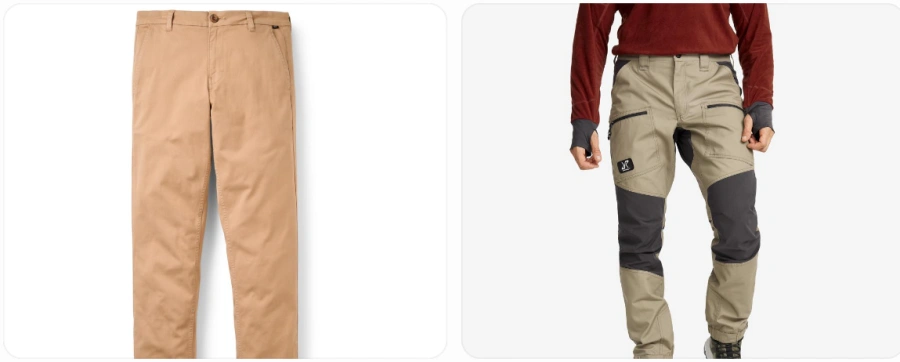
5. Develop Patterns and Samples Before Bulk Production
Pattern development converts your design and measurement specifications into garment components that can be cut and assembled.
This stage is particularly important for men’s bottoms because fit depends on several interacting factors, including waist position, crotch shape, rise, hip ease, thigh width, knee position, and leg opening.
A good sample process helps identify problems before they are repeated across hundreds or thousands of garments.
Step 1: Pattern Making
The manufacturer creates or adjusts patterns according to your technical drawings, measurements, and reference samples.
If you are developing an oversized streetwear trouser, for example, the pattern must reflect the desired width distribution rather than simply increasing every measurement equally.
Step 2: First Prototype Sample
The first sample allows you to review the overall product.
Check:
- General silhouette and proportions.
- Fabric appearance and hand feel.
- Waistband design.
- Pocket position and functionality.
- Crotch construction.
- Seam details.
- Initial measurements.
At this stage, the objective is to identify major design and construction issues.
Step 3: Fit Sample and Revisions
Try the sample on an appropriate fit model or compare it with a confirmed reference garment.
Pay special attention to:
- Waistband comfort when standing and sitting.
- Crotch depth and movement.
- Hip and thigh ease.
- Knee position.
- Leg opening.
- Total garment length.
- Pocket access and usability.
For knitted sweatpants, also evaluate stretch recovery. A waistband or leg opening that becomes loose after repeated stretching can negatively affect the finished product.
Step 4: Size Set and Grading
Once the base size is approved, the manufacturer develops the remaining sizes according to an agreed grading rule.
Do not assume that every measurement should increase by the same amount from one size to another.
The grading process should reflect the body proportions and garment fit expected in your target market.
Where necessary, review a size set before authorizing bulk production.
Step 5: Pre-Production Sample Approval
The pre-production sample, or PP sample, represents the agreed version for bulk manufacturing.
It should use the approved material, colors, trims, construction, measurements, labels, and branding.
The approved sample and final technical specifications should serve as the reference for bulk production.
Important: Do not approve mass production while major details remain uncertain. A small correction during sampling is usually easier to manage than correcting an entire shipment.
6. Choose Between OEM, ODM, and Private Label Manufacturing
Chinese garment manufacturers commonly offer different cooperation models.
The best choice depends on whether your brand already has designs, technical specifications, and product development resources.
OEM Manufacturing
OEM stands for Original Equipment Manufacturing.
In an OEM project, the buyer provides the design, technical specifications, or approved reference requirements, and the manufacturer produces the garment accordingly.
OEM is suitable for established brands that already have:
- Technical drawings.
- Fabric specifications.
- Size charts.
- Construction details.
- Branding guidelines.
- Packaging requirements.
For example, a fashion brand may provide a complete tech pack for cargo trousers and require the factory to reproduce the approved specifications.
ODM Manufacturing
ODM stands for Original Design Manufacturing.
In an ODM project, the manufacturer supports more of the product development process.
Depending on the supplier, this may include design suggestions, existing style adaptations, material recommendations, pattern development, and sample creation.
ODM can be useful for startup businesses and wholesalers that understand their target market but do not have a complete in-house technical design team.
Private Label Manufacturing
Private label manufacturing allows buyers to sell garments under their own brand.
Customization may include:
- Woven brand labels.
- Care labels.
- Embroidered logos.
- Printed graphics.
- Custom hangtags.
- Packaging bags.
- Barcode and SKU labels.
Private labeling can be combined with either OEM or ODM production.
For brands sourcing multiple garment categories, Chengyuan’s OEM and ODM garment development services provide an integrated approach to custom product development, sampling, and bulk production.
Which Manufacturing Model Is Best?
| Business situation | Recommended model |
|---|---|
| Established brand with complete tech packs | OEM |
| Startup with product concepts but limited technical resources | ODM |
| Online retailer using existing garment designs | Private label |
| Wholesale buyer with custom specifications | OEM or ODM |
| Brand developing a differentiated collection | Custom OEM/ODM development |
The important point is to confirm exactly which services are included. The terms OEM, ODM, and private label are sometimes used differently by suppliers.
7. How to Find a Reliable Men’s Bottoms Manufacturer in China
The manufacturer you choose will influence product development, price, quality consistency, communication, and future production capacity.
A suitable supplier should understand the specific types of bottoms you want to manufacture.
A factory that produces simple cotton trousers may not necessarily have the same capabilities for technical hiking pants, complex pocket construction, or specialized garment finishing.
Check the Manufacturer’s Product Experience
Ask for examples of previously manufactured products similar to yours.
If you are developing joggers, request examples of knitted trousers with comparable waistband construction, pocket details, and fabric weight.
If you are developing cargo trousers, evaluate the manufacturer’s experience with woven fabrics, pocket assembly, reinforced seams, and garment dimensions.
Product-specific experience is more useful than a general claim that a supplier manufactures all types of clothing.
Evaluate Sampling and Pattern Development
A manufacturer should be able to explain how it develops samples and handles revisions.
Ask whether the factory can:
- Work from technical drawings.
- Follow your measurement chart.
- Develop patterns from reference garments.
- Recommend suitable fabric options.
- Revise fit and construction details.
- Produce samples before bulk manufacturing.
Understand Production Capacity
Capacity matters because a supplier must be able to handle both your initial order and future replenishment requirements.
However, total factory capacity is not necessarily the same as the capacity available for one particular product category.
Ask about production scheduling, available sewing lines, and the number of units that can realistically be allocated to your order.
Evaluate Quality Control
Ask how the manufacturer checks:
- Fabric quality and color consistency.
- Cutting accuracy.
- Critical garment measurements.
- Waistband construction.
- Pocket placement.
- Seam strength.
- Stitching appearance.
- Logo and label positioning.
- Finished garment cleanliness.
- Packing accuracy.
For specialist outdoor pants, also confirm whether appropriate material and functional performance tests can be arranged.
Compare Communication and Commercial Terms
Before paying a deposit, clarify:
- Legal company name and production location.
- MOQ per style and color.
- Fabric and trim sourcing arrangements.
- Sample charges.
- Production schedule.
- Payment terms.
- Defect handling and rework arrangements.
- Inspection rights.
- Shipping terms and destination responsibilities.
A reliable manufacturer should be able to explain its process and identify potential production limitations before the order is confirmed.
8. Understand MOQ When Manufacturing Men’s Bottoms in China
MOQ means Minimum Order Quantity.
It is an important consideration for startups, online fashion brands, wholesalers, and retailers that are launching new products.
However, there is no universal MOQ for all men’s bottoms manufacturers.
The required quantity depends on:
- Garment type.
- Fabric availability.
- Custom dyeing requirements.
- Construction complexity.
- Number of colors.
- Printing and embroidery processes.
- Customized trims and accessories.
- Factory production arrangements.
For example, an existing cotton fabric may allow more flexible order quantities than a specially developed fabric that requires a larger minimum production run.
A simple drawstring jogger may also have different manufacturing requirements from a multi-pocket cargo trouser with custom zippers and reinforcement panels.
MOQ Per Style vs. MOQ Per Color
Always clarify how a supplier calculates MOQ.
For example, a buyer ordering three trouser designs in three colors may need to understand whether the quantity is calculated:
- Per style.
- Per color.
- Per fabric.
- Per production order.
Also ask whether different sizes can be mixed within a colorway.
A supplier may accept a total order quantity but still require a minimum quantity for each individual fabric or color combination.
How Can You Reduce Initial Inventory Risk?
For a new collection, consider these approaches:
Start with fewer styles. Develop products with broader market appeal instead of launching numerous experimental designs.
Use available fabrics. Existing stock fabrics may offer more flexibility than custom-developed materials.
Limit unnecessary color options. Focus on the shades most suitable for your target market.
Prioritize core sizes. Use market research and customer data to prepare a realistic size distribution.
Test before scaling. Begin with a manageable trial program, evaluate customer feedback, and expand successful styles.
The goal is not simply to find the lowest MOQ. It is to find a manufacturing arrangement that supports both product quality and commercially sensible inventory planning.
9. How Much Does It Cost to Make Custom Men’s Bottoms in China?
The cost of manufacturing custom men’s bottoms depends on the material, garment construction, order quantity, production process, and customization requirements.
A supplier cannot provide a reliable final price based only on a product name.
For a more accurate quotation, the manufacturer needs to understand what the finished product should look like and how it should be made.
Main Factors Affecting Manufacturing Costs
| Cost factor | How it affects the quotation |
|---|---|
| Fabric composition | Different fibers and fabric constructions have different material costs |
| Fabric weight | Heavier materials may increase fabric consumption |
| Pattern complexity | More complicated construction can require additional development work |
| Garment dimensions | Larger garments may require more material |
| Pocket design | Additional pockets increase cutting and sewing operations |
| Waistband construction | Elastic, drawcords, buttons, and hardware affect material and labor costs |
| Printing and embroidery | Decoration method, size, and complexity affect cost |
| Washing and finishing | Special treatments can increase production expenses |
| Order quantity | Larger quantities can distribute some setup costs |
| Labels and packaging | Custom branding and retail packaging add costs |
Example: Comparing Two Custom Men’s Pants Designs
Consider two fictional product development projects.
Project A: Basic Cotton Joggers
- Cotton-rich French terry.
- Elastic waistband.
- Drawstring.
- Two side pockets.
- Ribbed leg cuffs.
- Small embroidered logo.
Project B: Custom Cargo Pants
- Cotton stretch woven fabric.
- Multiple cargo pockets.
- Zipper and button closure.
- Reinforced construction.
- Custom woven labels.
- Additional hardware and decorative details.
Project B may require more material components and construction operations than Project A.
Even if both products use similar quantities of fabric, their production costs can differ because of pocket construction, hardware, sewing time, and finishing requirements.
A Practical Cost Calculation Formula
For a complete sourcing budget, use the following structure:
Factory unit cost = Fabric + Trims + Cutting and Sewing + Decoration + Washing and Finishing + Packaging + Allocated Manufacturing Costs
Landed unit cost = Factory Unit Cost + Freight + Insurance (if applicable) + Applicable Import Duties and Taxes + Other Inbound Costs
The second formula helps you understand the real cost of receiving products at your warehouse.
When comparing quotations, make sure all suppliers are quoting according to the same specifications.
A low quotation may exclude customized labels, special washing, packaging, testing, or additional quality inspections.
For this reason, the cheapest factory price is not always the most economical sourcing option.
10. Understand the Bulk Manufacturing Process
Once the sample and commercial terms have been approved, bulk production can begin.
A structured manufacturing process helps reduce misunderstandings and improves consistency between approved samples and finished goods.
Step 1: Purchase Order and Specification Confirmation
The buyer and manufacturer confirm the final order quantity, size breakdown, colors, fabric, trims, technical specifications, labels, packaging, and delivery requirements.
Step 2: Fabric and Trim Preparation
The factory prepares the approved materials and accessories.
Important checks may include:
- Fabric composition.
- Color shade.
- GSM or material weight.
- Fabric width.
- Shrinkage.
- Surface defects.
- Zipper and button quality.
- Elastic recovery.
Fabric and trim approvals should be completed before cutting starts.
Step 3: Fabric Relaxation and Cutting
Depending on the fabric and manufacturing process, fabric may need to be relaxed before cutting.
This helps manage dimensional changes and supports more consistent cutting.
Patterns are then arranged for fabric utilization and cut according to the confirmed production requirements.
Step 4: Sewing and Assembly
Cut panels are assembled according to the approved construction specifications.
For men’s bottoms, important production areas include:
- Front and back rise seams.
- Inseam and outseam stitching.
- Waistband attachment.
- Pocket construction.
- Fly and closure assembly.
- Belt loops.
- Hem finishing.
- Reinforcement stitching.
The sewing sequence differs according to the type of trousers and construction method.
Step 5: Finishing and Branding
Depending on the product, finishing can include garment washing, pressing, thread trimming, embroidery, printing, label attachment, and final appearance adjustments.
Step 6: Final Inspection
Finished garments are checked against the approved sample and technical specifications.
Step 7: Folding, Packing, and Shipment
Products are folded and packed according to the buyer’s requirements.
Cartons should be labeled correctly and match the confirmed packing list, quantities, sizes, and color breakdown.
For international shipments, agree on the applicable Incoterm, shipping method, destination, and documentation responsibilities before production is completed.
11. How to Control Quality When Manufacturing Men’s Bottoms
Quality control should start before production, not only after the garments are finished.
For B2B buyers, a quality problem in bulk production may affect product returns, retailer relationships, brand reputation, and repeat orders.
A practical inspection system should cover materials, construction, measurements, and final packaging.
Incoming Material Inspection
Before production begins, check whether the materials match the approved specifications.
Important inspection points include:
- Fabric color and shade.
- Surface defects.
- Fabric weight.
- Composition documentation.
- Shrinkage performance.
- Elastic and trim quality.
For products requiring technical performance, define the relevant test method and acceptance criteria before purchasing the material.
In-Process Inspection
During cutting and sewing, monitor critical manufacturing details.
| Inspection area | What to check |
|---|---|
| Cutting | Pattern accuracy and panel dimensions |
| Waistband | Elastic attachment, stitching, and measurements |
| Pockets | Placement, size, stitching, and functionality |
| Crotch seams | Construction and seam integrity |
| Inseam and outseam | Length and stitching consistency |
| Leg openings | Width and finishing |
| Embroidery | Artwork position and appearance |
| Labels | Correct information and placement |
Final Product Inspection
Before shipment, compare finished garments against the approved sample.
Check:
- Measurements according to the agreed size chart.
- Fabric and color consistency.
- Seam quality and thread trimming.
- Zippers, buttons, and drawcords.
- Pocket construction and functionality.
- Logo and label placement.
- Stains, holes, and visible fabric defects.
- Quantity and packing accuracy.
Depending on the order, buyers can arrange third-party inspection and agree on an AQL-based sampling plan or other acceptance criteria.
For a new supplier relationship, independent inspection can provide additional assurance before goods are released for shipment.
Product-Specific Testing
Different men’s bottoms require different tests.
For knitted joggers, you may consider shrinkage, pilling, colorfastness, and stretch recovery.
For woven trousers, you may consider dimensional stability, seam strength, colorfastness, and abrasion performance where relevant.
For technical outdoor pants, the inspection plan may include water resistance, seam performance, and other functional tests according to the intended product claims.
Testing should be selected based on the intended market and the actual product requirements rather than adding unnecessary tests to every garment.
12. Customize Branding, Labels, and Packaging
For private-label clothing businesses, branding is part of the product, not simply an extra decoration.
A consistent branding system helps customers recognize your products and supports a more professional retail presentation.
Common Customization Options
Woven labels: Brand identity labels attached to the waistband or inner garment.
Care labels: Provide applicable washing, drying, and garment-care instructions.
Hangtags: Present product names, brand stories, barcodes, and retail information.
Embroidery: Suitable for small brand logos, initials, and decorative details.
Printing: Offers additional design possibilities for casual and streetwear pants.
Custom packaging: Includes branded bags, stickers, barcode labels, and retail-ready presentation.
If you are developing coordinated men’s homewear products, Chengyuan also offers men’s sleepwear and loungewear manufacturing, which can help buyers explore complementary lounge pants and matching apparel collections.
Before production, confirm that all label information meets the requirements of your destination market. Fiber-content declarations, care information, country-of-origin identification, and other labeling obligations vary by jurisdiction and product type.
13. Why Work with Chengyuan Garment for Custom Men’s Bottoms?
Choosing a Chinese manufacturer involves evaluating product development capabilities, sample control, production resources, and communication.
Qingdao Chengyuan Garment Co., Ltd. is based in Qingdao, Shandong, China, and provides integrated garment design, sampling, and manufacturing services for international clothing brands, wholesalers, retailers, and importers.
According to its company profile, Chengyuan operates an in-house design team, a dedicated sample room, and independent garment production lines. Its published overall garment production capacity is approximately 80,000–120,000 finished pieces per month.
The company also highlights flexible small-batch orders and bulk production, supporting both emerging brands and established apparel buyers.
Integrated OEM and ODM Development
Chengyuan supports the product development process from design communication and pattern making to sample development and bulk production.
Whether buyers provide a complete technical package, a reference garment, or an initial design concept, the team can discuss the required development process.
Customization for Different Men’s Bottoms
Buyers can discuss customization options such as:
- Fabric composition and weight.
- Colors and patterns.
- Waistbands and drawstrings.
- Leg shapes and garment measurements.
- Pocket designs and positions.
- Zippers, buttons, and trims.
- Printing and embroidery.
- Brand labels and hangtags.
- Packaging and carton requirements.
Flexible Order Planning
Different brands have different sourcing requirements.
A startup may need a smaller trial order to evaluate product-market fit, while a wholesaler may require a larger order with multiple colors and sizes.
Chengyuan’s published manufacturing profile emphasizes support for small-batch and scaled-up orders. Specific MOQ and production arrangements should be confirmed for each product, fabric, and customization requirement.
Quality Management from Samples to Bulk Orders
Sample approval creates a clear reference for production.
For men’s bottoms, this is particularly important because fit, waistband construction, inseam, pocket position, and garment proportions strongly influence the finished product.
The objective is to ensure that the agreed production specifications are followed throughout the manufacturing process.
If you are looking for a supplier for a broader clothing collection, you can also review Chengyuan’s garment manufacturing facilities and company profile.
14. Common Mistakes to Avoid When Sourcing Custom Men’s Bottoms from China
Even experienced clothing buyers can encounter problems when product requirements are not clearly defined.
Here are several mistakes worth avoiding.
Mistake 1: Choosing a Manufacturer Based Only on Price
A low quotation may exclude important components or reflect different material and quality specifications.
Compare quotations using identical tech packs, order quantities, fabric requirements, branding details, and delivery terms.
Mistake 2: Ignoring Fit Development
A pair of trousers can have correct waist measurements but still fit poorly because of incorrect rise, hip, thigh, or leg-opening proportions.
Test the garments on suitable fit models and review the complete measurement chart.
Mistake 3: Changing Fabric After Sample Approval
Different fabrics can behave differently during cutting, sewing, washing, and wearing.
Changing the material after approving the sample may affect measurements, appearance, and overall fit.
Any material substitution should be reviewed and approved before production.
Mistake 4: Not Confirming MOQ Details
A supplier may quote a total quantity without clarifying minimums for individual colors or fabrics.
Confirm MOQ by style, color, fabric, and size breakdown before calculating inventory costs.
Mistake 5: Skipping Pre-Production Approval
Bulk production should follow an agreed sample and final specifications.
Approving production while major details are still changing increases the risk of defects and disputes.
Mistake 6: Ignoring Packaging and Shipping Details
Incorrect labels, carton markings, quantities, or delivery terms can cause unnecessary problems after manufacturing is finished.
Include packaging and shipping requirements in the purchase order.
15. What Information Should You Send a Chinese Manufacturer for a Quotation?
Providing complete information helps a factory evaluate your project and prepare a more relevant quotation.
Before contacting a supplier, prepare the following information.
| Information | Example |
|---|---|
| Product type | Men’s cargo pants, joggers, or casual trousers |
| Reference design | Technical drawing or sample photograph |
| Fabric | Cotton twill, French terry, nylon, or blended fabric |
| Fabric weight | Required GSM or an approved reference |
| Fit | Regular, relaxed, slim, tapered, or oversized |
| Size range | S–XXL or your own measurement chart |
| Colors | Black, navy, beige, olive, etc. |
| Quantity | Estimated pieces per style and color |
| Branding | Embroidery, woven label, printing, or hangtag |
| Packaging | Individual bags, barcode labels, and carton requirements |
| Destination | Country and preferred shipping arrangement |
| Target price | Expected manufacturing price where available |
If you do not have a complete tech pack, you can still begin with a reference product or design concept.
However, more detailed information generally leads to more accurate quotations and fewer sample revisions.
Frequently Asked Questions About Custom Men’s Bottoms Manufacturing in China
1. Can I manufacture men’s bottoms in China with my own design?
Yes. Many Chinese clothing manufacturers provide OEM services for buyers with their own designs and specifications.
You can provide technical drawings, measurement charts, reference garments, fabric requirements, and branding instructions. The manufacturer can then evaluate pattern development, sampling, and bulk production requirements.
2. What types of men’s bottoms can be customized?
Common options include casual trousers, cotton pants, cargo pants, joggers, sweatpants, shorts, lounge pants, and outdoor hiking trousers.
The available products and manufacturing capabilities depend on the factory and the required construction.
3. What is the MOQ for custom men’s pants in China?
There is no universal MOQ. It depends on the fabric, style, color, construction, customization, and supplier’s production arrangement.
Ask the manufacturer to clarify whether the minimum applies per style, color, or fabric.
4. How long does it take to produce custom men’s bottoms?
The total development and production schedule depends on pattern complexity, sample revisions, fabric availability, trim sourcing, and production quantity.
Request separate estimated schedules for sampling, material preparation, bulk manufacturing, inspection, and shipment.
5. Can I order different sizes and colors in one production order?
Many manufacturers can arrange multiple sizes and colors in one order, but the permitted breakdown depends on their production requirements and MOQ policy.
Confirm the quantity for each size and color before placing your order.
6. What information do I need to prepare for a custom pants quotation?
Ideally, provide the product type, design, fabric, weight, colors, size chart, order quantity, pocket details, branding requirements, and packaging specifications.
A complete tech pack is helpful, but an initial quotation discussion can also begin with a reference sample or design concept.
7. Can I approve a sample before mass production?
Yes. Sample development is an important stage of custom clothing manufacturing.
Buyers should evaluate the material, fit, measurements, construction, branding, and finishing before approving the production sample.
8. Can manufacturers provide OEM, ODM, and private-label services?
Yes. Many garment manufacturers offer these services, although the exact customization scope differs.
OEM is suitable for buyers with existing designs, ODM provides greater product-development assistance, and private-label manufacturing adds the buyer’s branding to the finished products.
9. How can I ensure consistent quality across bulk orders?
Establish clear specifications, approve a pre-production sample, confirm materials and trims, monitor key production checkpoints, and arrange final inspection against agreed acceptance criteria.
For repeat orders, keep the approved reference sample and technical documents available to compare subsequent production batches.
10. Can I manufacture a complete men’s clothing collection with one Chinese supplier?
This depends on the manufacturer’s product range and production capabilities.
Some integrated garment suppliers support several categories, including men’s bottoms, tops, outdoor clothing, knitwear, and loungewear. Using one supplier for complementary products may simplify communication and collection planning.
Start Your Custom Men’s Bottoms Project with Chengyuan Garment
Making custom men’s bottoms in China involves several interconnected decisions, from selecting the right fabric and defining fit specifications to approving samples and managing bulk production.
The most effective sourcing strategy is to prepare a clear product brief, compare manufacturers based on their actual capabilities, confirm all commercial requirements, and establish quality standards before starting production.
For clothing brands, wholesalers, and private-label businesses, working with an integrated OEM/ODM manufacturer can simplify product development and help turn design concepts into market-ready garments.
Qingdao Chengyuan Garment Co., Ltd. supports custom clothing development through design, pattern making, sampling, and bulk manufacturing. Buyers can discuss men’s casual pants, joggers, sweatpants, cargo trousers, shorts, and other customized apparel according to their collection requirements.
Ready to develop your own men’s bottoms collection?
Send your design drawings, reference samples, fabric preferences, size chart, estimated order quantity, and branding requirements to Chengyuan Garment.
Visit our full product catalog or contact our team for a custom manufacturing quotation.
Let’s develop men’s bottoms that match your brand positioning, target market, and production requirements.

I am a supplier with 10 years of experience in the apparel industry. As a professional clothing manufacturer, we provide you with a one-stop solution.


Leave a Reply
Want to join the discussion?Feel free to contribute!