
dog backpack
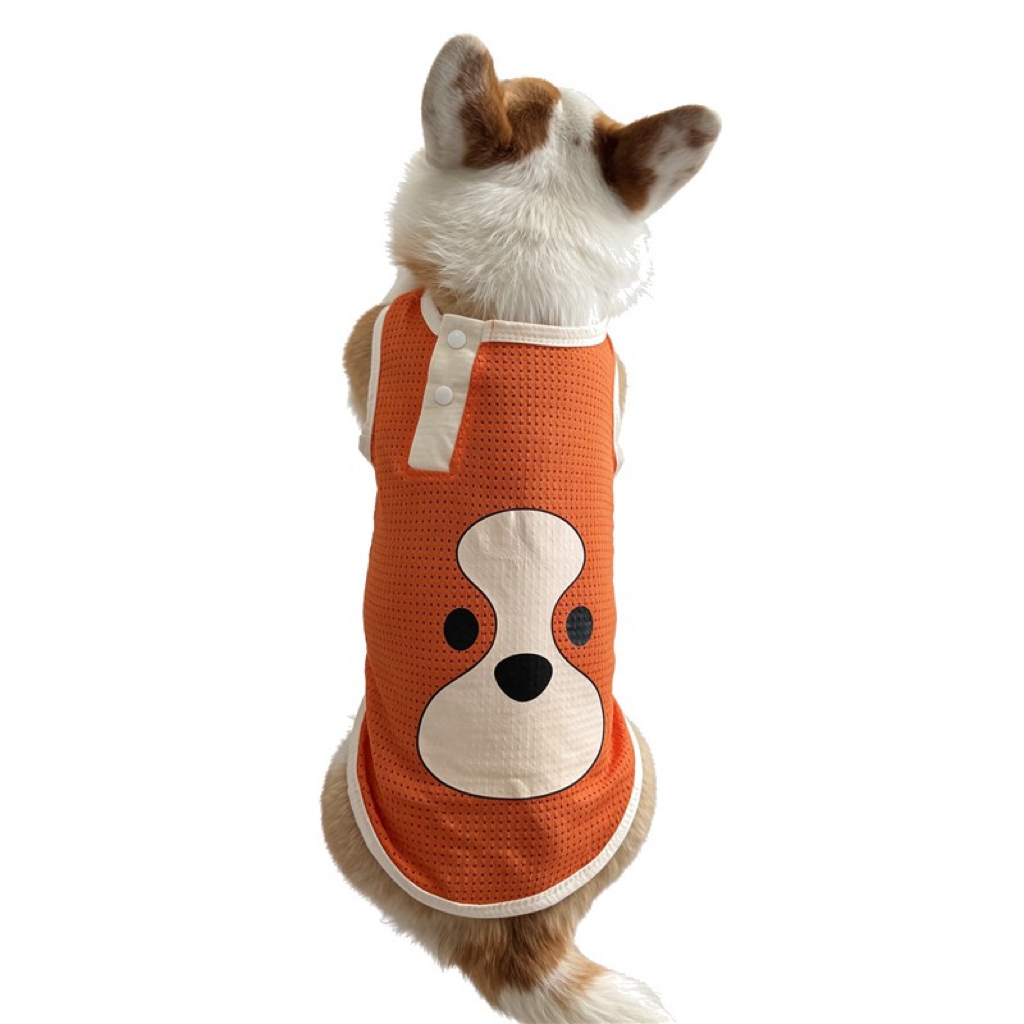
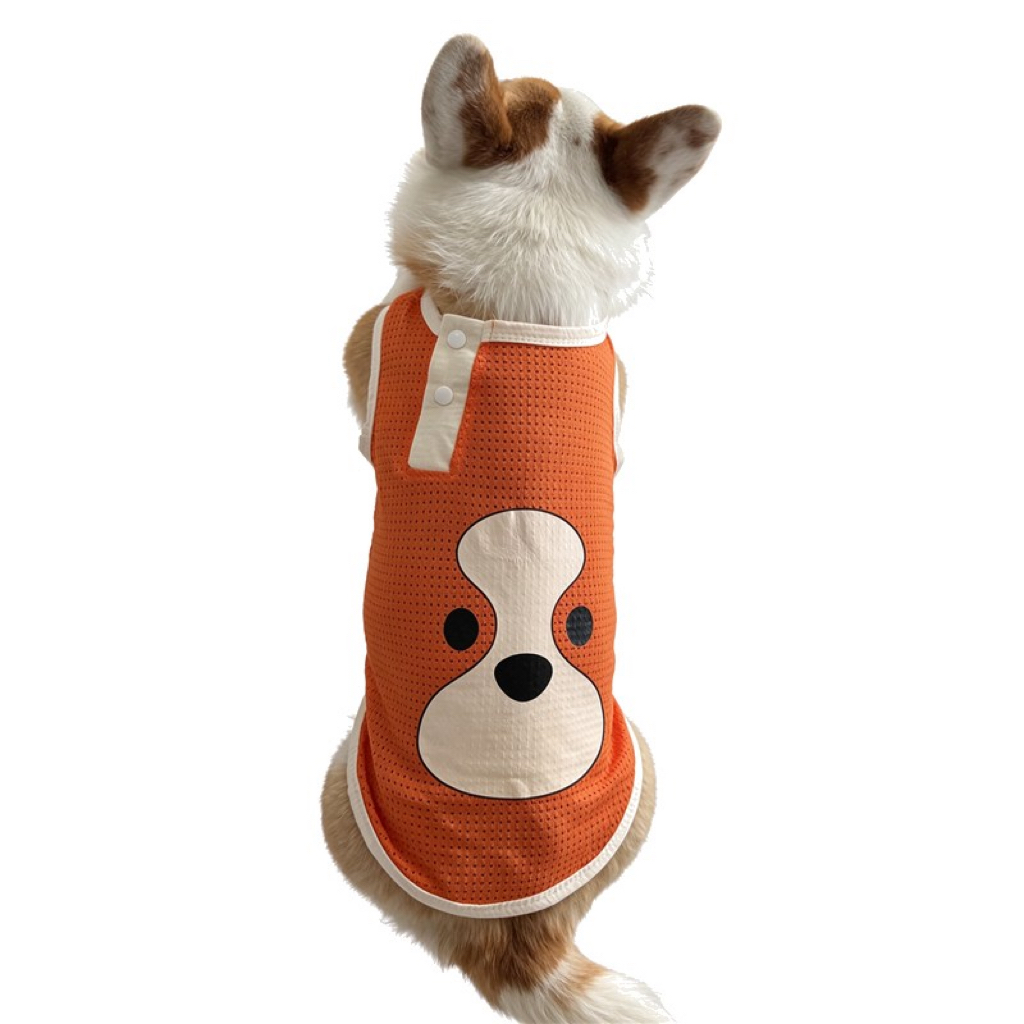
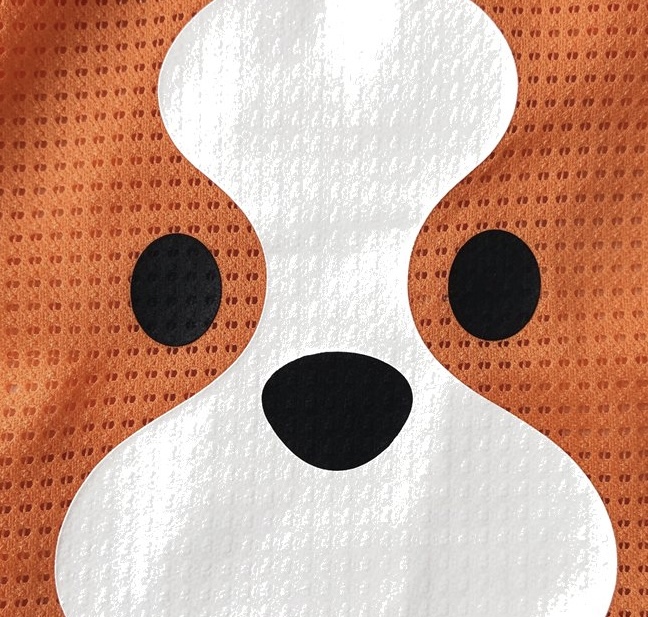
Summer heat no longer has to mean miserable walks. This summer dog vest is engineered around six details that make a real difference. A new knitted micro-hole mesh replaces heavy fabric, creating genuine airflow that supports a dog’s natural cooling while staying light, quick-drying and snag-resistant. A wide placket opening lets the vest slip on over the body, with no wrestling fabric over the head, making dressing stress-free even for anxious dogs. Smooth, lightweight resin snaps resist rust, heat and fur damage, outlasting ordinary plastic or metal hardware. Dopamine-bright colors lift mood, boost visibility on walks and stay vivid wash after wash, while a durable back cartoon print adds personality and photo appeal. Backed by clear sizing guidance, simple care instructions and flexible OEM/ODM customization, this vest brings comfort, function and style together in one thoughtfully built piece — a summer essential designed to keep dogs cool and look good doing it.
Knitted Micro-Hole Mesh Dog Vests: Fabric, Fit & Custom Manufacturing
A summer mesh dog vest has to feel effortless to the customer: light on the dog, easy to put on, cool to the touch and bright enough to photograph well. Behind that simple experience sit several production decisions. The knit must vent heat without turning sheer or snagging, the wide opening must close flat and stay closed, the snaps must survive heat and repeated use, and the print and color must hold up to a full season of washing. This guide focuses on one specific product direction: a summer dog vest built from knitted micro-hole mesh, with a wide placket opening, resin snaps, dopamine-bright colors and a back cartoon print.
As a custom pet clothing manufacturer serving pet brands, wholesalers and private-label businesses, Chengyuan uses requirements like these as the starting point for fabric selection, pattern development and sampling. View our custom dog vest page for the product overview, then use the technical points below to prepare a clearer production brief.
What Each Specification Means — and What Still Needs Confirming
The features of a summer mesh vest are related, but they do not describe the same property. Separating them early prevents a brief from mixing fabric, construction and appearance requirements.
| Specification | What it suggests | What still needs confirmation |
|---|---|---|
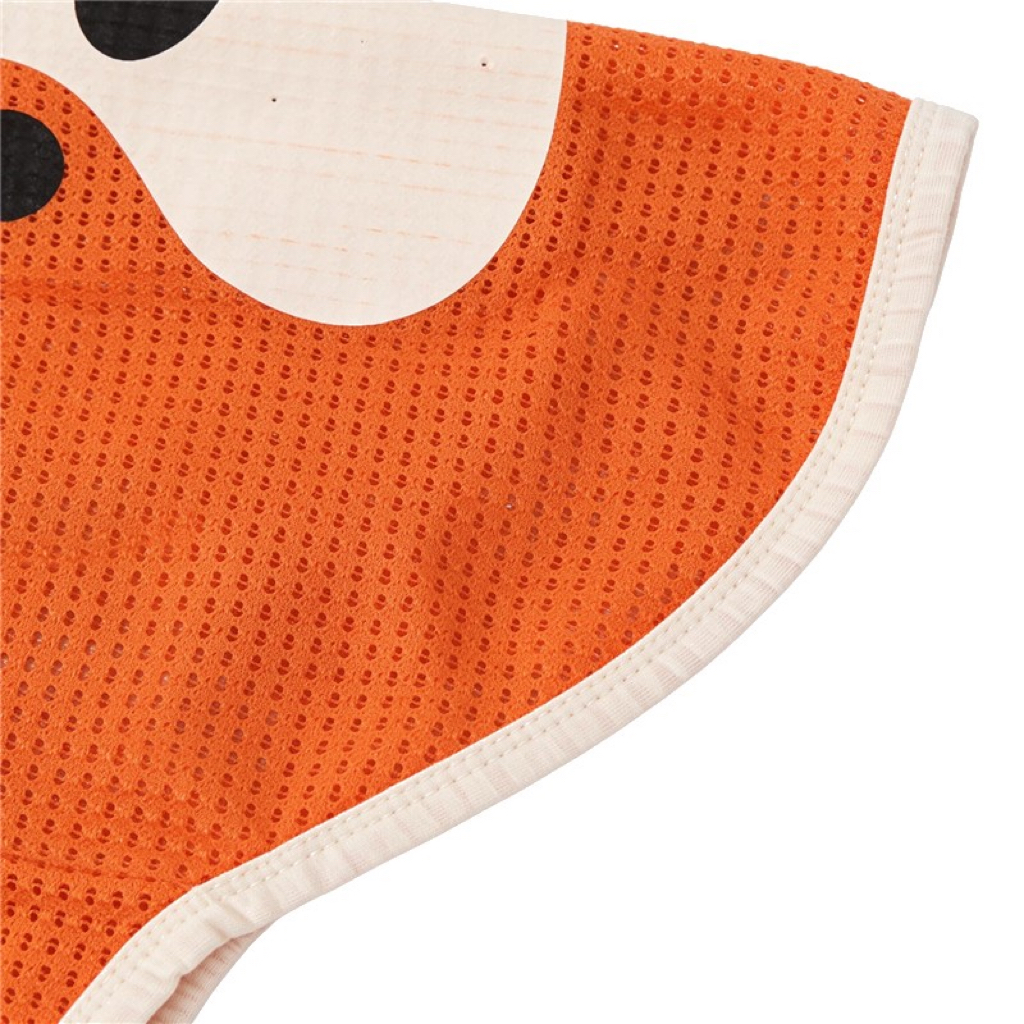
| Knitted micro-hole mesh | A fine knit with a dense field of small perforations; airy, light and less see-through than coarse net | Fiber content, hole diameter and distribution, fabric weight (GSM), air-permeability test method, dimensional stability after washing |
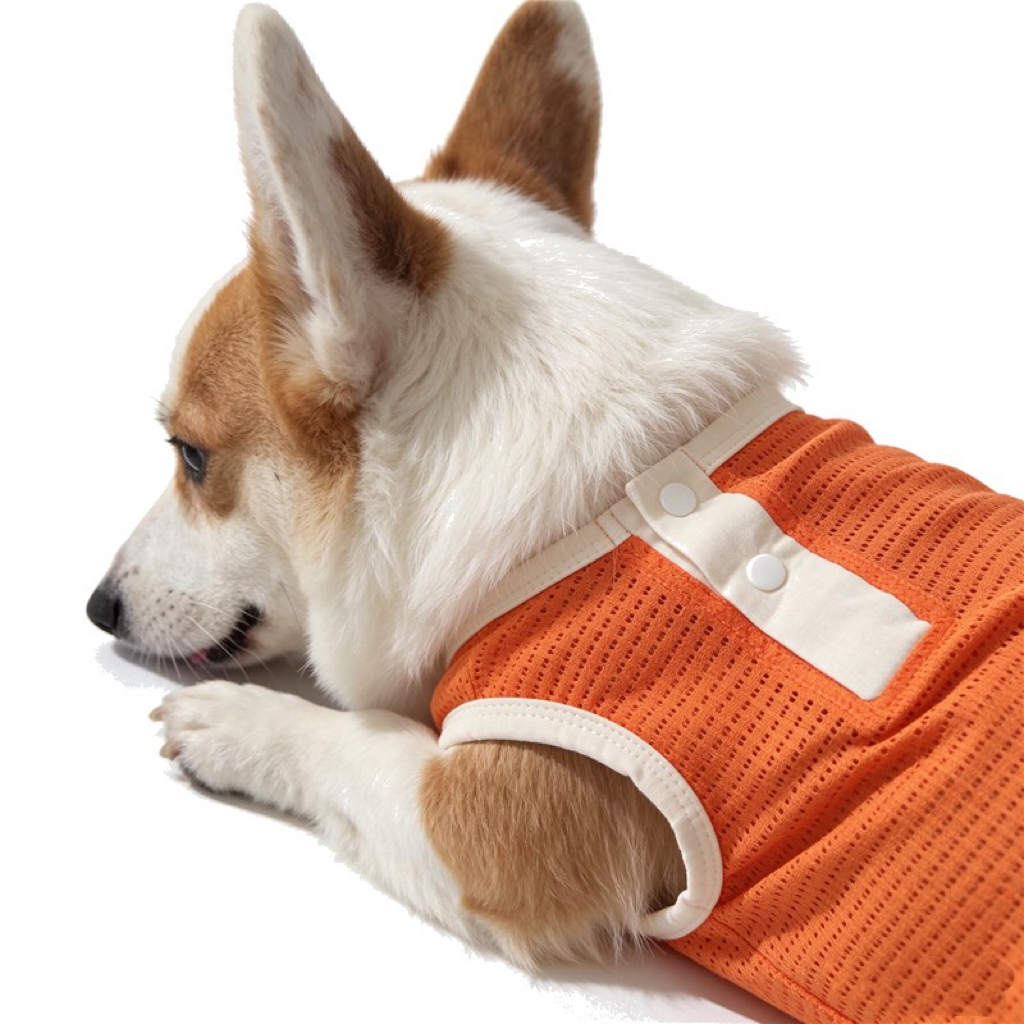
| Wide placket opening | The vest opens along the neck/chest and goes on over the body instead of over the head | Opening length and angle, closure overlap, edge binding, stretch direction, recovery after opening, whether it catches fur |
| Resin snaps | Lightweight, smooth, rust-free fastening that stays comfortable in heat and cold | Snap-in/snap-out force, temperature range, chemical resistance, edge flash or burr, cycle life, color match to the garment |
| Dopamine colors | High-saturation, cheerful hues with mood and visibility appeal | Dye system, colorfastness to washing/rubbing/light, lot-to-lot shade variation, interaction with the print |
| Back cartoon print | A visible graphic on the back that carries personality and brand identity | Print method (screen, heat transfer, digital, embroidery), handfeel, wash durability, crack resistance, placement tolerance |
| Summer positioning | Light, breathable warm-weather apparel | Actual fabric weight, whether any UV protection is tested, and whether “quick-dry” can be supported by test data |
A finer knit may look smoother and feel softer, but a higher gauge or smaller holes do not automatically make a vest cooler, stronger or better. Fabric architecture, density, finishing and the relationship between face and back matter as much as any single number.
What Shoppers Expect from a Summer Mesh Vest
Cooling that can be felt, not just claimed
Dogs release heat mainly by panting and through the skin. A vest should let air move across the body and let moisture escape, rather than sealing a pocket of warm air against the coat. The useful question is not “is it mesh?” but “how much air passes through this specific knit, and does it still pass after washing?” This is the core criterion behind a genuine dog cooling vest — airflow is the mechanism, not an accessory.
Softness without a loose, twisting fit
The dog should move freely, but the vest should not slide off the shoulders or bunch to one side. Mesh can be light and still twist if the pattern is unbalanced or the recovery is poor.
Dressing that does not become a struggle
A wide opening should let the vest go on over the body and fasten at the neck. It must open far enough for a wiggly or sensitive dog, sit flat when closed and avoid catching long hair at the closure edge.
Fit across different body proportions
Neck, chest girth, back length and body depth do not scale at the same rate across breeds. A Corgi, French bulldog and greyhound may need very different pattern balances even at similar weights.
Honest care expectations
A cotton- or synthetic-rich mesh can be comfortable without being quick-drying. Buyers should not describe a vest as moisture-wicking, quick-dry or UV-protective unless the exact fabric and finished garment have been tested for that claim.
Distinguish This Vest from Other Kinds of Dog Vests
| Vest type | Typical purpose | What buyers expect |
|---|---|---|
| Knitted micro-hole mesh vest | Summer comfort, airflow and everyday wear | Light breathable knit, wide opening, secure light fastening, bright colors |
| Evaporative cooling vest | Heat relief through water activation | Wet-and-wring use, gel or PCM inserts, measurable temperature drop |
| Sun-protection shirt | UV coverage in strong sun | Denser coverage, UPF claims backed by testing |
| Cotton fleece / sweater vest | Cool-weather layering and indoor comfort | Soft handfeel, warmth, stretch recovery |
| Padded winter vest | Insulation in cold conditions | Fill, wind resistance and coverage |
| Service or training vest | Identification and working equipment | Patch attachment, load stability, durable construction |
This micro-hole mesh vest belongs in the soft warm-weather apparel group. If real UV performance is required, it should be developed alongside a dedicated dog sun-protection shirt rather than borrowing that claim by implication.
Understand Why a Micro-Hole Knit Breathes
A micro-hole knit moves air through thousands of small openings formed during knitting, rather than through a few large cells. The result is a fabric that feels soft and nearly solid to the eye while still venting heat. What the label cannot tell you is how much air actually passes, or whether that performance survives production and laundering.
The production brief should therefore include:
- fiber composition and yarn count;
- fabric weight in grams per square meter;
- hole structure — knitted opening, mesh gauge or perforation method;
- air permeability under an agreed test method and value;
- stretch direction, extension percentage and recovery;
- drying behavior after controlled wetting;
- dimensional change and hole distortion after the proposed wash cycle.
See how these choices come together in a finished warm-weather piece in this summer cooling dog vest example. Fabric selection is where a cooling claim is either earned or lost.
Wide Opening and Resin Snaps Are a System, Not Two Features
The placket and the closure have to work together. A wide opening is only useful if it closes securely and lies flat; a good snap is only comfortable if the opening is aligned and the edge is finished.
Opening design
- Confirm opening length and angle against the neck and chest of the target breeds.
- Specify closure overlap so the vest cannot pop open during a stride.
- Finish the edge with binding or a cover stitch that will not roll or rub.
- Test opening recovery after repeated use — a stretched opening will sag on the dog.
Why resin snaps
Plastic snaps can become brittle and crack; metal snaps can rust, heat up in the sun, feel cold in winter and catch fur. Resin sits between them: light, smooth-edged, corrosion-free and temperature-stable. But “resin” is a material family, not a performance guarantee. Define snap-in and snap-out force, cycle life, edge quality and color match, then test them on the assembled vest. You can see related warm-weather hardware and construction approaches in this cool vest for dogs piece.
Cotton, Poly or Blend — the Backing Changes the Product
Micro-hole mesh is a structure, not a fiber. It can be knitted from polyester, nylon, polypropylene or a cotton-rich blend, and the choice changes handfeel, drying, pilling and cost.
- Surface softness: the surface touching the dog should feel smooth and consistent around the neck, chest and belly.
- Pilling and snagging: mesh can pill under a harness or catch on vegetation; set an abrasion standard appropriate to the market.
- Weight: yarn count is not fabric weight — confirm actual GSM before comparing samples.
- Color consistency: bright saturated dyes need lot-to-lot shade checks, especially alongside a printed panel.
Avoid describing any mesh as quick-dry until a drying test supports it, and avoid “anti-pilling” or “will not shrink” language without a passed test report.
Design the Vest Around the Dog’s Body
| Body zone | Fit question | Specification to define |
|---|---|---|
| Neck | Does the opening sit cleanly without rubbing or slipping? | Neck circumference, binding width, closure overlap, stretch direction |
| Chest & shoulders | Can the front legs extend naturally? | Armhole depth, front panel length, stretch balance, seam position |
| Back | Does the vest stay level during movement? | Back length, center balance, hem shape, fabric recovery |
| Belly | Enough coverage without interfering with elimination? | Panel depth, relief shape, closure position, elastic tension |
| Forelegs | Does the armhole roll, rub or pull? | Binding width, opening size, cover-stitch finishing |
| Rear hem | Does the vest lift, drag or twist? | Hem sweep, tail clearance, lower-back tension |
Review the sample while the dog stands, walks, trots, sits and sniffs. A mesh vest can look perfect in a static photo while the armhole pulls as soon as the dog reaches forward. Our dog clothes size chart by breed gives a practical reference for balancing these zones across body types.
Use a Stretch- and Recovery-Aware Size Range
Confirm four measurements before pattern development:
- Neck circumference at the position where the vest will fasten;
- Chest girth around the widest part of the rib cage;
- Back length from the base of the neck to the tail base;
- Chest-to-belly body depth.
Document the useful fit range for each size. If a Medium fits chest girths from 18 to 21 inches, record that range rather than implying the vest fits every Medium dog. Follow the step-by-step dog measuring guide when collecting measurements for product testing.
During grading, check neck, chest, back and depth separately: neck, chest and back length cannot always be graded at the same rate, so each zone needs its own tolerance.
A Validation Matrix for Micro-Hole Mesh Summer Vests
| Check | Why it matters | Approval evidence |
|---|---|---|
| Fiber composition | Confirms the stated fabric blend | Fiber test report or supplier documentation |
| Hole structure | Defines the actual micro-hole geometry | Fabric spec and magnified image record |
| Fabric weight | Basis for handfeel, lightness and cost | GSM result under an agreed method |
| Air permeability | Quantifies the cooling mechanism | Lab result before and after washing |
| Drying behavior | Sets honest care and quick-dry claims | Controlled wetting and drying record |
| Wash shrinkage | Protects fit and back length | Face fabric and assembled-garment results |
| Spirality / twisting | Keeps side seams and center front balanced | Washed-sample comparison |
| Snagging & pilling | Tests mesh surface under friction | Abrasion result plus visual review |
| Colorfastness | Protects dopamine colors and trims | Washing, rubbing and light exposure testing |
| Print durability | Checks the cartoon print for cracking or peeling | Repeated wash and flex review |
| Resin snap performance | Prevents popping open, snagging or edge curl | Cycle test, force test and assembled fit check |
| Opening recovery | Keeps the wide placket lying flat | Repeated open/close and post-wear review |
| Seam extension | Confirms seams move with the knit | Stretched and washed seam review |
| Gait & rubbing | Shows whether the pattern supports movement | Photo and video review during walk and trot |
| UV performance | Required only if a UPF claim is made | Relevant lab test on the finished fabric |
Acceptance values should be agreed with the brand and target market. A bright color or an open knit is not evidence of performance on its own. Where sun exposure is part of the product story, validate the claim against a tested dog UV protection set approach rather than assuming the mesh blocks UV.
Build a Production-Ready Tech Pack
A useful brief for a knitted micro-hole mesh vest should include:
- Intended season, climate and use environment;
- Target breeds, weights and body profiles;
- Neck, chest, back and body-depth measurements;
- Fit range and measurement tolerances;
- Fiber composition and yarn specification;
- Fabric structure, hole geometry, face finish and actual GSM;
- Color standard, Pantone references and colorfastness requirement;
- Air-permeability and stretch/recovery targets;
- Print artwork, method, placement and durability requirement;
- Wide-opening dimensions and closure overlap;
- Resin snap type, size, color and force requirement;
- Neckline, armhole and hem finishing;
- Harness or leash-opening location, if any;
- Labels, logos, packaging and care content;
- Quantity by size, color and style option.
Six Sampling Gates
Gate 1 — Design direction
Confirm whether the vest is a summer everyday layer, a fashion piece or part of a coordinated set. Approve silhouette, opening and closure concept.
Gate 2 — Fabric and mesh
Approve fiber, knit structure, hole geometry, weight, color and handfeel after the fabric has relaxed. Record permeability and drying behavior here.
Gate 3 — First fit sample
Check neck access, chest tension, armhole clearance, back length and belly coverage. Mark every area that lifts, twists or restricts movement.
Gate 4 — Color and print strike-off
Approve the dopamine color standard and the cartoon print strike-off together. Check shade, handfeel, placement and the print’s effect on stretch.
Gate 5 — Washed sample
Wash and dry the assembled vest according to the proposed care label. Recheck dimensions, hole appearance, print, snap performance and opening recovery.
Gate 6 — Pre-production sample
Approve final fabric lots, measurements, color, trims, labels and packaging. Use this sample as the bulk inspection reference, and confirm that the chosen production route matches the approved construction.
Build a Coherent Warm-Weather Range
A summer mesh vest works best as a soft core product rather than an isolated style.
- Cooling layer: pair the vest with other cooling vests for dogs for a heat-relief assortment.
- Outer protection: for wet or windy days, a separate dog rain jacket can sit over the vest without compressing the shoulders.
- Coordinated styling: bright colors and prints can extend into matching owner-and-dog pieces using the same color card.
- Broader assortment: compare vests, shirts and sewn products across the range without implying they all share the same function.
Plan MOQ and Cost Around the Actual Fabric Brief
There is no universal MOQ for a micro-hole mesh summer vest. Quotation variables include:
- stock versus custom-developed mesh fabric;
- fabric minimums and color availability;
- number of dopamine colors and print designs;
- screen or strike-off charges for the cartoon print;
- size-range development and grading;
- resin snap type, tooling and color matching;
- sample revisions and performance testing;
- labels, packaging and barcode requirements;
- total quantity and the breakdown by size and colorway.
Send a quantity matrix with pieces per size and color rather than a single total. For brands expanding beyond one style, our dog clothing business guide offers a practical framework for range, sizing and launch planning.
Bulk Quality Control and Care
The production inspection plan should check:
- neck, chest, back and body-depth measurements;
- fabric structure, hole appearance and shade consistency;
- fiber composition and fabric lot traceability;
- air permeability and drying behavior on the assembled vest;
- stretch, recovery and seam flatness;
- print placement, handfeel and crack resistance;
- resin snap force, security and edge quality;
- wide-opening recovery and binding finish;
- armhole and neckline finishing;
- label and care-instruction accuracy;
- washed appearance and packed condition.
Care instructions should follow the actual fabric and finish. A mesh vest may benefit from gentle cold washing, reshaping and flat or line drying, while excessive heat can distort the knit or the snaps. Confirm the care process through the washed sample. Learn more about our factory and production approach, or discuss target-market test requirements for your product.
Create a Vest That Fits the Customer’s Real Need
A strong summer mesh vest is not defined by its ingredient list or its color name. The value comes from the complete system: a genuinely breathable micro-hole knit, a wide opening that makes dressing effortless, resin snaps that stay comfortable and secure, colors that stay vivid, a print that survives a season, and a care process customers can actually follow.
Start with a sketch, reference sample, fabric specification, size chart, print artwork and quantity matrix. Contact our team to discuss custom knitted mesh dog vests, private-label pet apparel or a coordinated summer collection.
Knitted Mesh Summer Dog Vest FAQ
1. What is a knitted micro-hole mesh dog vest?
It is a summer vest made from a fine knit with many small openings that allow air to pass through. The structure can be produced from different fibers, and the finished garment should be evaluated for air permeability rather than judged by appearance alone.
2. Is micro-hole mesh cooler than ordinary pet mesh?
It can feel softer and less sheer, and it may distribute airflow more evenly. Whether it is actually cooler depends on the specific knit, weight and finish, so compare air-permeability results between samples.
3. What does a wide placket opening change?
It lets the vest go on over the body and fasten at the neck, avoiding the struggle of pulling fabric over the head. It also allows more fit adjustment, provided the opening recovers and closes securely.
4. Why choose resin snaps over plastic or metal?
Resin snaps are light, smooth, rust-free and more stable across temperatures. Confirm the specific snap’s force, edge quality and cycle life — the material alone is not a performance guarantee.
5. Are dopamine colors colorfast?
Not automatically. Bright saturated dyes need washing, rubbing and light testing, plus lot-to-lot shade control, especially when combined with a printed panel.
6. How durable is a back cartoon print?
It depends on the print method and finish. Screen printing and quality transfers can stay flexible and resist cracking, but the final standard should be a repeated wash-and-flex test on the approved fabric.
7. Is a mesh vest quick-drying or UV-protective?
Only if the specific fabric and finished garment have been tested. Mesh dries quickly when moisture passes through, but cotton-rich blends absorb more. UV protection requires a dedicated test and claim.
8. How should a summer mesh vest fit?
It should allow natural shoulder movement, stay level on the back, clear the elimination area and feel secure at the neck and chest without compression.
9. Can the vest be customized with a private label?
Yes. Fabric, colors, print artwork, snaps, sizes, woven and care labels, hangtags and packaging can all be developed for private-label orders.
10. What information is needed for a quotation?
Provide the design, fabric specification and weight, colors, print artwork, sizes, opening and snap requirements, branding, packaging and estimated quantity by variant, plus any test standards required by your market.


Leave a Reply
Want to join the discussion?Feel free to contribute!